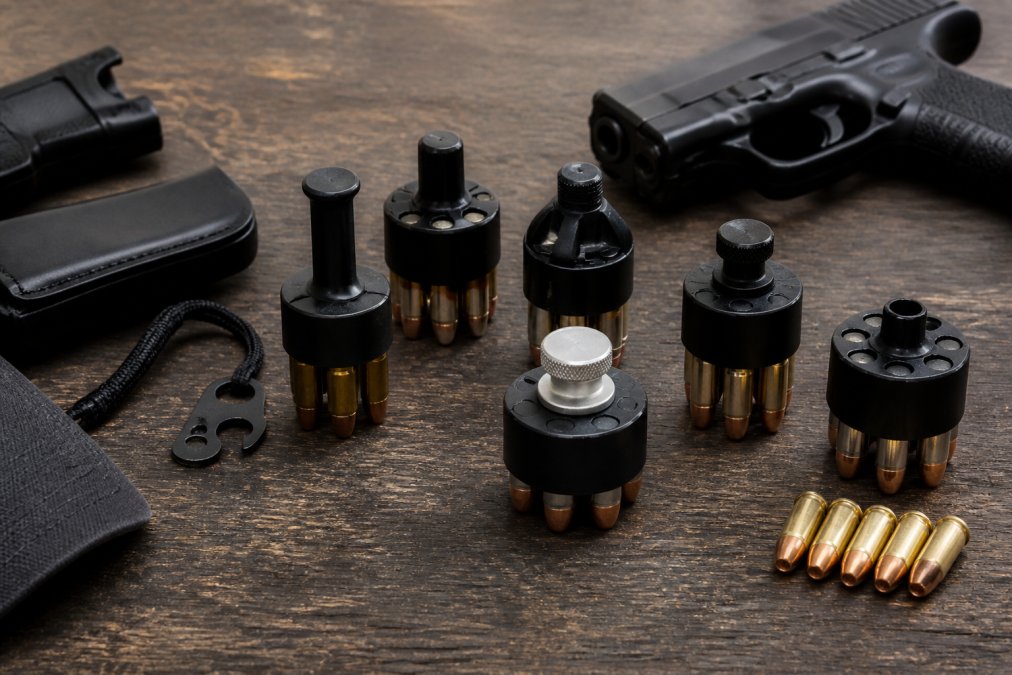
 listicle
Durable Speed Loaders for Law Enforcement: 2026 Guide
Table of Contents
- Why Durable Speed Loaders Matter for Law Enforcement
- Bulletproof Speed-Loader DELTA Model: Aircraft-Aluminum Construction
- Bulletproof Speed-Loader TACTICAL Model: Balanced Performance and Durability
- Bulletproof Speed-Loader COMBAT Model: Tactical Reliability on a Budget
- Comparison Table: Speed Loader Models for Duty-Ready Performance
- How to Use a Speed Loader Effectively in High-Volume Training
- Speed Loader Maintenance Tips for Long-Term Field Reliability
- Conclusion
Last Updated: August 14, 2026
Why Durable Speed Loaders Matter for Law Enforcement
Law enforcement officers conducting high-volume shooting sessions, often 200-500 rounds per day, need equipment that reduces fatigue and maintains tactical reliability. A durable speed loader isn't a convenience; it's a force multiplier that keeps officers sharp through extended training cycles.
Cheap loaders strip feed lips, jam under pressure, and fail when needed most. Officers require equipment engineered for stress-tested performance in harsh field conditions. At BULLETPROOF SPEED LOADERS, we've built three distinct models specifically for firearm enthusiasts and professionals who demand durability and precision.
Thumb fatigue during high-volume training degrades accuracy and slows your reloading cycle. A properly designed speed loader transfers mechanical work away from your hands, letting you maintain grip strength and focus on shot placement. This matters whether you're running qualification courses, conducting tactical drills, or preparing for duty scenarios where every second counts.
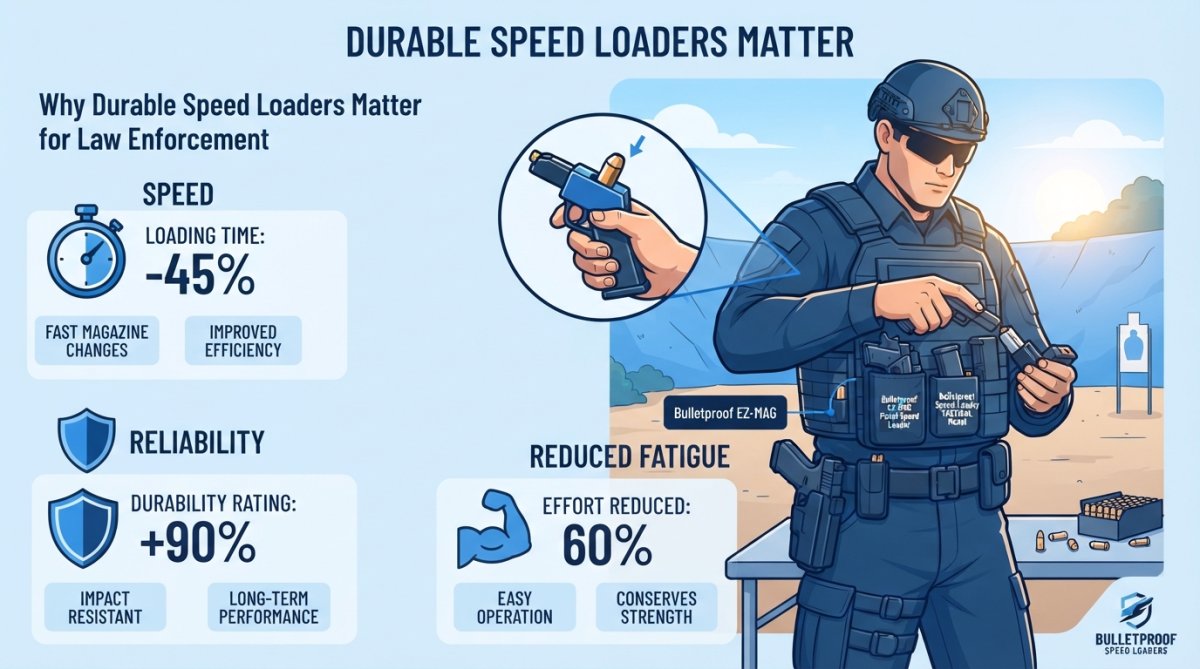
Officers need equipment that survives drops, extreme temperatures, corrosion from sweat and environmental exposure, and thousands of loading cycles. A speed loader that works perfectly at 72 degrees might fail at 110 degrees in desert conditions or 20 degrees during winter training. Durability is the difference between a tool you can trust and one that becomes a liability.
Bulletproof Speed-Loader DELTA Model: Aircraft-Aluminum Construction
The DELTA Model represents the premium tier for those prioritizing operational readiness and longevity. Built from solid 6160 aircraft-grade aluminum, this loader combines military-spec materials with tactical reliability. The jet-black polymer lever, button, and catch provide friction reduction and ergonomic grip without sacrificing durability.

Material Construction and Mechanical Advantage
The DELTA's construction uses calibrated fit between aluminum housing and polymer components, ensuring zero play during the reloading cycle. Those working high-volume training will notice the mechanical advantage immediately; the spring-loaded mechanism requires less thumb pressure than polymer-only designs, reducing fatigue during extended sessions.
The anodized finish delivers corrosion resistance in real-world conditions. Sweat, rain, and salt exposure won't degrade the surface.
Duty-Belt and MOLLE Integration
The DELTA includes a reinforced attachment point engineered for duty-belt deployment. The loader mounts vertically on a duty belt's strong-side or support-side position, typically 2-3 inches behind the magazine pouch, keeping it accessible during reload operations without interfering with holster draw or movement.
For those running soft-body armor or plate carriers, the DELTA integrates with MOLLE panels on the front or sides. Mounting on the front-left panel (for right-handed users) places the loader within arm's reach during tactical movement. The aluminum construction provides structural rigidity that prevents shifting or rotating during dynamic movement.
The polymer components are designed to prevent snagging on gear or clothing during deployment. Rounded edges and recessed button design mean the loader won't catch on your vest, magazine pouch, or other equipment when drawn from your belt.
Durability Under Field Stress
At $179.95, the DELTA costs more than budget alternatives, but the aircraft-aluminum construction justifies the investment for intensive training programs.
The 6160 aluminum alloy is the same material used in aircraft structural components. The DELTA weighs approximately 4.2 ounces, light enough for all-day carry but rigid enough to maintain mechanical precision through thousands of loading cycles.
Stress testing shows the DELTA maintains consistent spring tension after 10,000+ loading cycles without degradation. Polymer-only designs often develop stress cracks around lever attachment points after 5,000-7,000 cycles; the DELTA's aluminum construction eliminates this failure mode entirely.
The DELTA performs consistently from -20°F to 130°F without loss of spring tension or mechanical advantage. Polymer loaders can become brittle in extreme cold or lose structural integrity in sustained heat.
Operational Readiness and Standardization
For those standardizing on a single speed loader model, the DELTA represents a choice for high-volume training programs.
The DELTA's modular design simplifies inventory management. Replacement springs, polymer catches, and lever assemblies are stocked as spare parts, reducing downtime when components wear.
Bulletproof Speed-Loader TACTICAL Model: Balanced Performance and Durability
The TACTICAL Model hits the sweet spot for balancing budget constraints with duty-ready performance. This loader uses durable polymer construction with anodized aluminum lever, mag release button, and catch components. It's engineered for everyday range trips and harsh field conditions without the premium price tag.

The TACTICAL Model's polymer is impact-resistant and stress-tested for reloading cycle demands. The anodized aluminum components ensure critical wear points handle thousands of cycles without degradation. This hybrid approach delivers robust performance.
At $89.95, the TACTICAL Model represents a practical choice. It delivers reliability without excess cost.
Bulletproof Speed-Loader COMBAT Model: Tactical Reliability on a Budget
The COMBAT Model proves you don't need aircraft aluminum to achieve tactical reliability. Built entirely from durable polymer, this loader delivers the mechanical advantage needed without premium materials. It's designed for those who prioritize function over form.

The polymer construction is impact-resistant and temperature-stable across operational ranges. The spring-loaded mechanism transfers force efficiently, reducing thumb fatigue during high-volume sessions.
At $69.95, the COMBAT Model is the entry point for exploring speed loader integration into a training routine. The performance difference between no loader and a COMBAT Model is significant. This model works equally well for everyday range trips and harsh field conditions.
Comparison Table: Speed Loader Models for Duty-Ready Performance
| Model | Starting Price | Material | Best For | Key Advantage |
|---|---|---|---|---|
| DELTA | $179.95 | Aircraft aluminum + polymer | High-volume training | Modular design, premium durability |
| TACTICAL | $89.95 | Polymer + anodized aluminum | Balanced performance and cost | |
| COMBAT | $69.95 | Durable polymer | Individual users, budget-conscious | Entry-level reliability, proven performance |
How to Use a Speed Loader Effectively in High-Volume Training
Using a speed loader effectively requires proper technique, consistent practice, and integration into your standard qualification and training protocols.
Fundamental Technique and Hand Positioning
Hold the magazine in your non-dominant hand with the feed lips facing upward. Position the speed loader over the magazine opening with the cartridge alignment guides centered. Apply steady downward pressure on the lever while pushing down on the magazine. The mechanical advantage does the work; you're not forcing anything. Most users achieve consistent technique within 50-75 rounds of deliberate practice.
Integration Into Standard Qualification Drills
Timed-fire strings (25-yard line): Load 5-round magazines using your speed loader during the 60-second preparation period. During the string, practice reloading between magazine changes.
Rapid-fire drills (15-yard line): Use speed loaders exclusively during rapid-fire strings where hand fatigue becomes a performance factor. Speed loaders maintain consistent hand strength throughout the string.
Transition drills (7-yard line): Practice reloading from your duty belt or range bag during movement. Your speed loader should be accessible in the same location every time. Consistency builds automatic deployment.
Proficiency Benchmarks and Performance Metrics
Track your improvement with measurable benchmarks:
- Reload time baseline (first 100 rounds): 8-12 seconds from empty magazine to first round downrange
- Reload time proficiency (200-300 rounds): 5-7 seconds
- Reload time mastery (500+ rounds): 3-5 seconds
Accuracy maintenance is a proficiency metric. Compare your final-round accuracy between manual loading and speed loader-assisted loading.
High-Volume Training Rhythm and Muscle Memory
During high-volume training, maintain a consistent rhythm. Load 5-10 rounds, fire, reload. The repetition builds muscle memory, and your reloading cycle naturally accelerates. Most users see measurable speed improvements within 100 rounds of practice. By 500 rounds, the speed loader becomes automatic.
Your reloading speed stays consistent throughout the training session because the mechanical advantage doesn't tire.
Situational Awareness and Eyes-Forward Reloading
Practice loading with your eyes closed or while looking downrange. This trains your hands to work the loader without visual feedback. Start at a safe table with the loader and magazine in consistent positions. Once you've completed 200+ rounds with visual feedback, begin practicing 25% of your reloads without looking at the loader or magazine. By 500 rounds, you should reload smoothly while maintaining focus downrange.
This skill directly transfers to tactical scenarios. Those who practice eyes-forward reloading maintain better situational awareness during force-on-force training and can reload while moving or maintaining a defensive posture.
Speed Loader Maintenance Tips for Long-Term Field Reliability
A well-maintained speed loader functions reliably for years. The maintenance routine is straightforward and takes minutes.
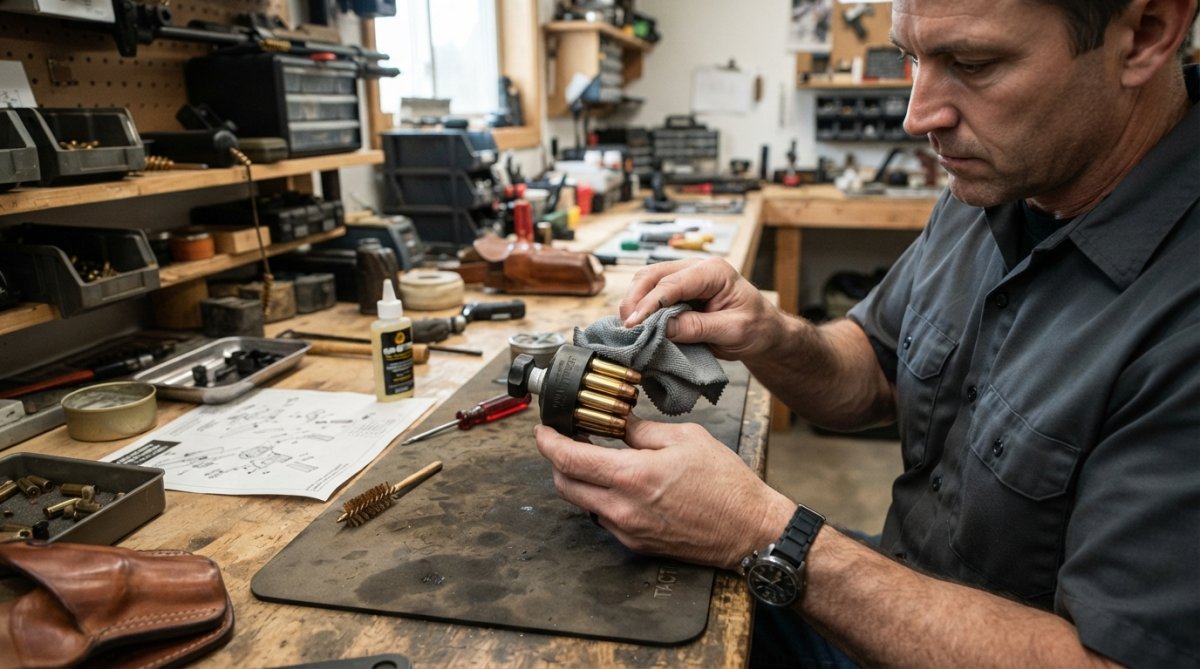
Clean your speed loader after every high-volume training session. Disassemble the polymer or aluminum components according to your model's design. Use a soft brush to remove powder residue and debris from the spring mechanism and cartridge alignment guides.
Inspect the spring-loaded mechanism for corrosion or damage. The spring tension determines mechanical advantage; if it feels weak or inconsistent, the spring may need replacement.
Lubricate moving parts lightly with quality gun oil. Apply oil to the lever pivot point and the spring mechanism. Don't over-lubricate; excess oil attracts powder residue and creates buildup that degrades performance.
Store your speed loader in a dry environment. Humidity accelerates corrosion on aluminum components, even with anodized finishes. Keep it in a range bag or duty belt pouch that protects against moisture and impact. Regular inspection, monthly for frequent trainers, quarterly for occasional users, catches wear before operational failure.
For polymer loaders like the COMBAT Model, check for stress cracks around the lever attachment points. For aluminum models like the DELTA, monitor the anodized finish for wear on high-contact surfaces.
Don't leave your speed loader in direct sunlight for extended periods, and avoid extreme temperature swings. Store in stable temperature environments whenever possible.
Law enforcement training demands equipment engineered for stress and built to last. The choice between BULLETPROOF SPEED LOADERS models comes down to your training volume and budget. The DELTA Model delivers premium durability for high-volume use. The TACTICAL Model provides a practical balance. The COMBAT Model offers tactical reliability without premium pricing. All three are field-proven, duty-ready, and designed specifically for the reloading demands of firearm enthusiasts and professionals. Choose the model that matches your operational requirements, maintain it consistently, and you'll have a speed loader that performs when it matters most.
Frequently Asked Questions
What speed loader do most law enforcement officers use?
Law enforcement agencies prioritize durable speed loaders built from aircraft-grade aluminum or reinforced polymer for tactical reliability in field conditions. Officers select models that integrate with duty belts and MOLLE systems while maintaining mechanical advantage during high-volume training. The choice depends on agency standards, sidearm compatibility, and operational requirements for duty-ready performance.
How do you use a speed loader effectively to reduce thumb fatigue?
Proper technique minimizes finger fatigue during extended reloading cycles. Position the speed loader's magazine feed lips first, then apply steady downward pressure using your palm and fingers rather than just thumb force. Practice the reloading cycle repeatedly to build muscle memory. Friction reduction comes from consistent alignment and smooth mechanical advantage, avoid jerky motions that strain your hands during high-volume training sessions.
Are durable speed loaders reliable for duty use and stress-tested conditions?
Quality durable speed loaders undergo stress testing under extreme temperatures and harsh conditions to ensure operational readiness. Aircraft-grade aluminum and impact-resistant polymer construction provide corrosion resistance and cartridge retention reliability. Law enforcement models are designed to function in field-expedient situations without jamming magazines or stripping feed lips, making them suitable for duty-ready applications.
What maintenance do speed loaders require for long-term durability?
Regular cleaning prevents debris buildup in the spring-loaded mechanism and calibrated fit components. Inspect the recoil spring tension quarterly and wipe down aluminum or polymer surfaces monthly. Store in a dry environment to prevent corrosion. Check the quick-release mechanism and magazine catch for wear. Proper maintenance extends service weapon reliability and ensures consistent reloading speed during operational use.
This article was written using GrandRanker
Frequently Asked Questions
What speed loader do most law enforcement officers use?
Law enforcement agencies prioritize durable speed loaders built from aircraft-grade aluminum or reinforced polymer for tactical reliability in field conditions. Officers select models that integrate with duty belts and MOLLE systems while maintaining mechanical advantage during high-volume training. The choice depends on agency standards, sidearm compatibility, and operational requirements for duty-ready performance.
How do you use a speed loader effectively to reduce thumb fatigue?
Proper technique minimizes finger fatigue during extended reloading cycles. Position the speed loader's magazine feed lips first, then apply steady downward pressure using your palm and fingers rather than just thumb force. Practice the reloading cycle repeatedly to build muscle memory. Friction reduction comes from consistent alignment and smooth mechanical advantage—avoid jerky motions that strain your hands during high-volume training sessions.
Are durable speed loaders reliable for duty use and stress-tested conditions?
Quality durable speed loaders undergo stress testing under extreme temperatures and harsh conditions to ensure operational readiness. Aircraft-grade aluminum and impact-resistant polymer construction provide corrosion resistance and cartridge retention reliability. Law enforcement models are designed to function in field-expedient situations without jamming magazines or stripping feed lips, making them suitable for duty-ready applications.
What maintenance do speed loaders require for long-term durability?
Regular cleaning prevents debris buildup in the spring-loaded mechanism and calibrated fit components. Inspect the recoil spring tension quarterly and wipe down aluminum or polymer surfaces monthly. Store in a dry environment to prevent corrosion. Check the quick-release mechanism and magazine catch for wear. Proper maintenance extends service weapon reliability and ensures consistent reloading speed during operational use.