 listicle
Concealed Carry Mistakes to Avoid in 2026
Table of Contents
- Why Most Concealed Carry Mistakes Start With the Holster
- How to Prevent Printing While Carrying: Clothing, Belts, and Body Mechanics
- Concealed Carry Training Drills That Build Real-World Skills
- Trigger Discipline and Muzzle Discipline: The Mistakes That End Lives
- Situational Awareness and Threat Assessment: The Mental Game of Concealed Carry
- Legal Liability and Safe Storage: What Every Concealed Carrier Must Know
- Gear That Supports Good Habits: Speed Loaders and Carry Accessories
- Conclusion: Building a Concealed Carry Routine That Lasts
- Frequently Asked Questions
Last Updated: September 22, 2026
Why Most Concealed Carry Mistakes Start With the Holster
Most concealed carry mistakes start with gear chosen for looks or price instead of fit. A holster that shifts, digs, or prints forces constant adjustment, and that fidgeting is what gets carriers noticed. At BULLETPROOF SPEED LOADERS, shooters blame their wardrobe when the real problem is a holster that never matched their body or draw style.

Retention, Cant, and Ride Height: The Three Specs That Matter
Retention is how firmly the holster grips the firearm. Too little and the gun shifts or falls; too much and you fight the draw under stress. Passive friction retention suits most daily carriers; active retention, like a thumb break, adds a mechanical lock.
Appendix vs. Strong Side: Matching Holster to Body and Wardrobe
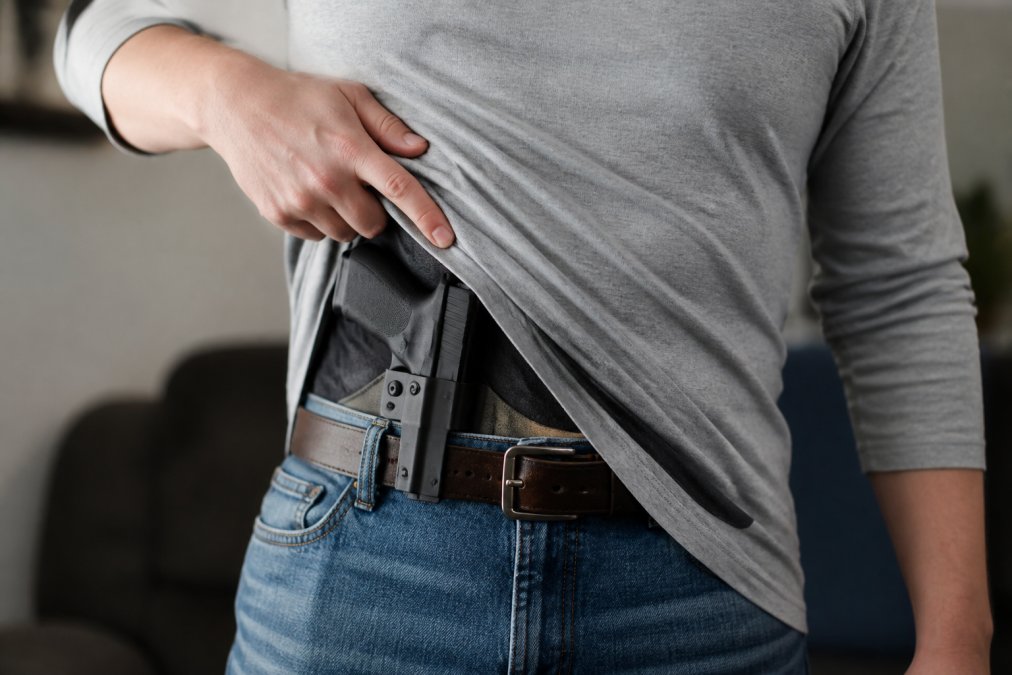
Appendix carry places the firearm inside the waistband at the front of the body. It offers fast access and easy concealment under an untucked shirt, but demands strict muzzle discipline because the muzzle points near your body when seated.
How to Prevent Printing While Carrying: Clothing, Belts, and Body Mechanics
Printing is the visible outline of your firearm through clothing. Prevent it with a proper gun belt, a concealment garment, and body mechanics that keep the firearm flat against your torso, clothing alone rarely solves it.
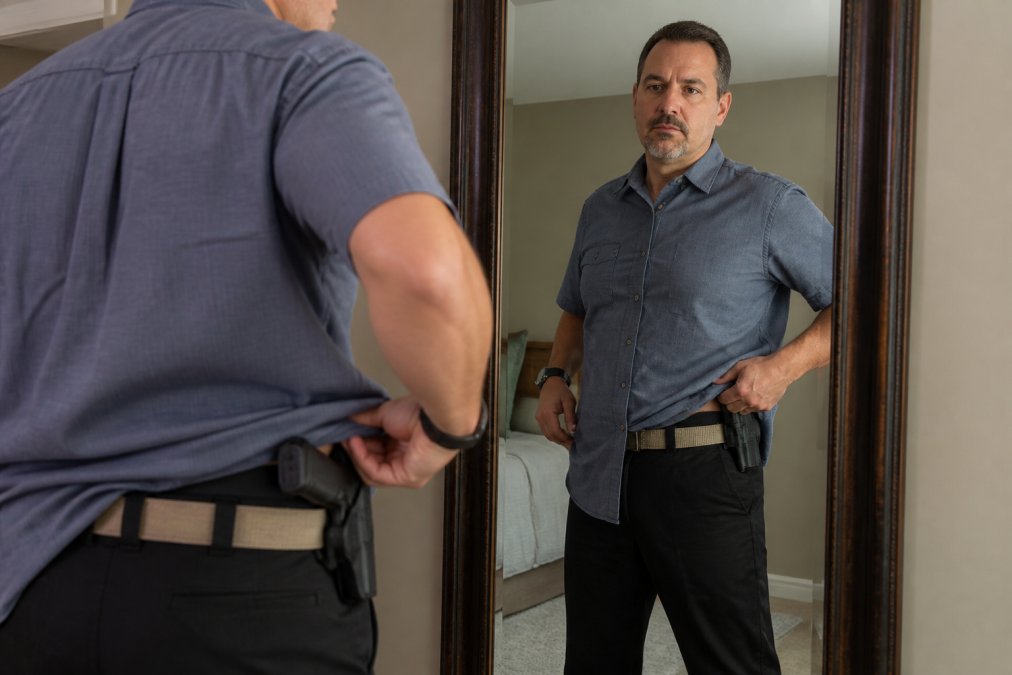
The Concealment Garment Checklist
- Shirt is one size larger than your usual fit
- Fabric has structure, not cling (patterns hide outlines better than solid colors)
- Hem falls below the holster's grip
- Belt is reinforced and rated for firearm weight
- You can reach, bend, and sit without adjusting
Body mechanics matter too. Stand with your carry-side shoulder slightly forward, bend at the knees rather than the waist, and reach overhead with the opposite arm.
Concealed Carry Training Drills That Build Real-World Skills
Skill comes from repetition under realistic conditions, not from owning the right gear. The two drills that matter most, the draw stroke and the re-holster, can be trained safely at home with an unloaded firearm.
Dry Fire Drills for the Draw Stroke
Dry fire means training the draw and trigger press with no live ammunition. Clear the firearm, remove all ammunition from the room, and confirm the chamber is empty before every session.
- Start with your hand relaxed at your side
- Sweep the garment clear with your support hand
- Establish a full firing grip on the pistol
- Draw straight up until the muzzle clears the holster
- Rotate toward the target and press out to full extension
- Acquire a sight picture and press the trigger
Live Fire Drills for Re-Holstering and Malfunction Clearing
At the range, re-holster with your eyes on the holster. A common mistake is jamming the firearm back in without checking for clothing or debris in the holster mouth, that is how negligent discharges happen.
Trigger Discipline and Muzzle Discipline: The Mistakes That End Lives
Trigger discipline means keeping your finger off the trigger and outside the trigger guard until your sights are on a target you have decided to shoot. Muzzle discipline means the firearm always points in a safe direction, even when unloaded.
Situational Awareness and Threat Assessment: The Mental Game of Concealed Carry
Most carry articles treat awareness as a bumper sticker: keep your head on a swivel. That is not a skill, and it does not survive a real encounter. The mental side of carrying determines whether you ever have to draw at all.
The Psychological Shift: From Armed to Responsible
The moment you start carrying, your default response to conflict has to change. The firearm is not a tool for winning arguments, recovering property, or proving a point. It is a last-resort response to an imminent threat of death or serious bodily harm; everything short of that must be handled another way.
That shift shows up in small decisions:
- You stop escalating. A rude driver, a bumped shoulder, a hostile comment, none is worth a confrontation you might have to resolve with force.
- You stop volunteering. You do not announce that you carry, display the firearm to make a point, or intervene in disputes that are not yours unless someone's life is at stake.
- You accept losing an argument on purpose. Walking away from a fight you could win is the correct outcome, not a defeat.
- You plan for the aftermath. A justified use of force still means police, attorneys, interviews, and a long recovery.
A Working Awareness Framework
Awareness is not paranoia. It is a habit of noticing what is normal so that what is not normal stands out. A practical loop:
- Baseline. Know what your environment looks like on an ordinary day, the foot traffic, the parked cars, the people who belong there. You cannot spot an anomaly without a baseline.
- Anomaly. Notice what breaks the pattern: someone watching you instead of the room, matching your pace, a vehicle idling where none should be, a person whose hands you cannot see.
- Distance and cover. Put space between you and anything that feels off; space buys time, and time buys options. Identify exits and hard cover as you move.
- Exit. Always know your way out. In a restaurant, sit facing the entrance with a clear path to a secondary exit; in a parking lot, scan before you commit.
- Decision. Decide in advance what would make you leave, call for help, or draw. Pre-deciding removes hesitation and reduces the chance of a panicked reaction.
De-Escalation as the Primary Skill
De-escalation is not the last resort before force. It is the first tool you reach for, and it works more often than most carriers expect.
- Lower your voice and slow your movements. Aggression feeds on aggression; calm is contagious in the other direction.
- Create distance without turning your back. Step offline, keep your hands visible and empty, and avoid cornering anyone.
- Give the other person a way out. Most confrontations end when someone can save face. Offer that exit instead of demanding an apology.
- Use verbal boundaries, not challenges. "I don't want any trouble. I'm leaving." is de-escalation; "You want to go?" is escalation and can destroy your legal justification.
- Leave early. The best de-escalation is the one you never perform because you saw the situation forming and walked away.
Recognizing When Force Is Actually Justified
A threat is not the same as discomfort. The legal standard generally requires an imminent threat of death or serious bodily harm, and the review happens after the fact. Markers that separate a real threat from a tense moment:
Bulletproof Concealed Carry Tactical →
- Immediate capability. The person has a weapon, or the size and position to cause serious harm, and is close enough to use it.
- Intent signaled by behavior. Not words alone, but movement, closing distance, reaching, blading the body, scanning for witnesses.
- No safe alternative. Retreat is blocked or would put you or someone else in greater danger.
The most common mental mistake is treating the firearm as a solution to a problem instead of a response to an emergency. Carriers who get into legal trouble usually did not misjudge their gear, they misjudged the situation and escalated when they could have walked away.
Train the mental game the same way you train the draw: deliberately, repeatedly, and under mild stress. Rehearse what you would do in a crowded store, a parking garage, or a road-rage encounter. The decision you have already made is the one you will actually execute.
Legal Liability and Safe Storage: What Every Concealed Carrier Must Know
Most carry guides stop at gear. The part that actually changes your life after a defensive encounter is legal, and it is where carriers are least prepared. Two bodies of law apply: the rules for carrying the firearm, and the rules for using it.
Carry Law: Reciprocity, Permits, and Prohibited Places
Carry rules vary by state and do not travel with you automatically. Three patterns exist:
- Permitless (constitutional) carry states allow eligible adults to carry without a permit, but eligibility rules and places you may carry still differ.
- Shall-issue states issue a permit to applicants who meet statutory criteria, typically a background check and sometimes a training course.
- May-issue or discretionary states give the issuing authority latitude, and practical requirements can be stricter than the statute suggests.
Use-of-Force Law: The Standard You Will Be Judged Against
Every defensive use of force is reviewed after the fact, and the review is not about what you felt in the moment, it is about whether a reasonable person in your position would have feared imminent death or serious bodily harm. Two doctrines do most of the work:
- Ability, opportunity, and jeopardy. The other person had the means to cause harm, the proximity to do it, and acted in a way that placed you in immediate danger. All three generally must be present.
- Duty to retreat. Some states require you to retreat if you can do so safely before using deadly force; others have stand-your-ground provisions removing that duty in places you have a right to be. The rule that applies is the rule where the encounter happens.
After the Encounter: The Steps That Protect You
What you do in the first minutes and hours after a defensive use of force shapes everything that follows.
- Call 911 and identify yourself as the victim. State that you were attacked and need police and medical help. Do not narrate the sequence.
- Holster or secure the firearm if it is safe and the scene is stable, and keep your hands visible when officers arrive.
- Give a brief, factual account, who, what, where, then say you will provide a full statement with counsel present. This is not an admission of guilt; it is standard practice.
- Do not speak to anyone else about the details, not bystanders, not social media, not the other party's associates. Offhand comments get quoted.
- Preserve evidence. Keep the clothing you wore, note witness names, and photograph anything relevant once it is safe.
- Contact an attorney who handles self-defense matters in your jurisdiction. Many offer a consultation, and some carry coverage plans worth researching before you ever need one.
Safe Storage: The Legal and Practical Baseline
Safe storage means the firearm is secured whenever it is not under your direct control, not just a nightstand, but your vehicle, gym bag, hotel room, and any home where children or prohibited persons may have access.
A few practical rules that hold up across jurisdictions:
- Use a locked container or locking device that fits the firearm, and keep the key or code under your control only.
- Never leave a firearm in an unattended vehicle unless it is locked and out of sight, and check your state's rules, several impose specific vehicle-storage requirements.
- If a firearm is lost or stolen, report it to law enforcement promptly. Many jurisdictions require it, and the report protects you if the firearm is later used in a crime.
- Store ammunition separately from the firearm when practical, and keep both away from anyone who should not have access.
Legal preparation is a habit, not a one-time read. Verify reciprocity and prohibited-place rules before every trip, review your state's use-of-force standard at least once a year, and decide now, before anything happens, that you will give a brief account and then ask for counsel. That decision is much harder to make in the moment.
official state firearms resources
Gear That Supports Good Habits: Speed Loaders and Carry Accessories
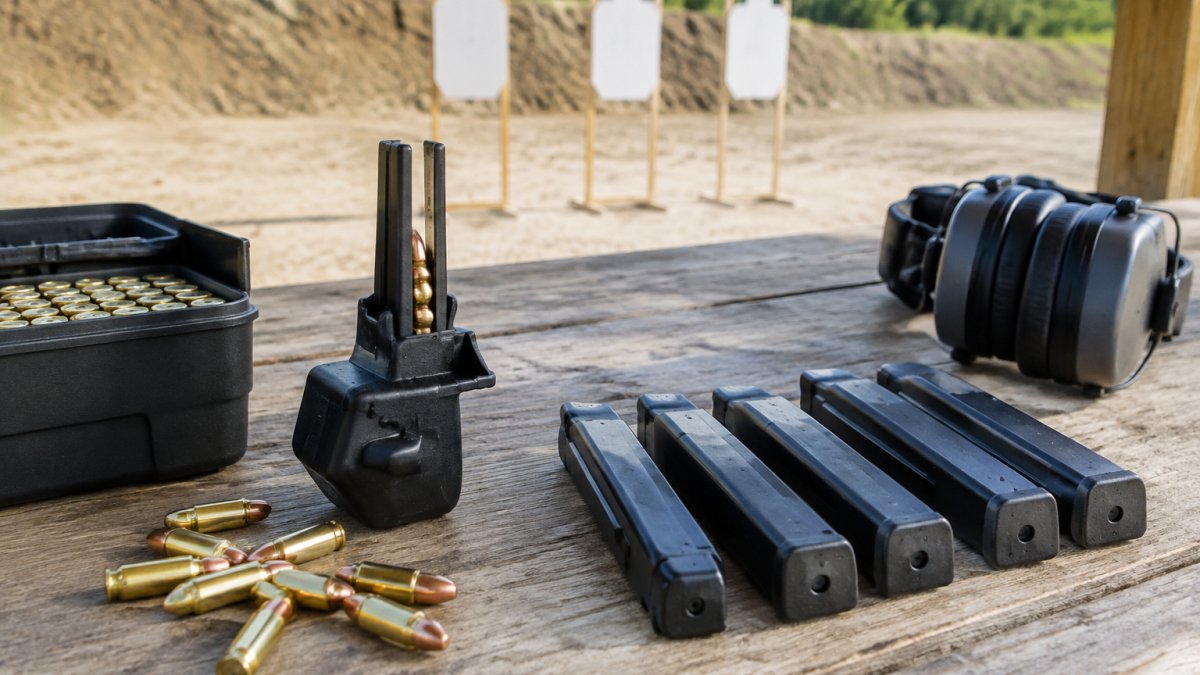
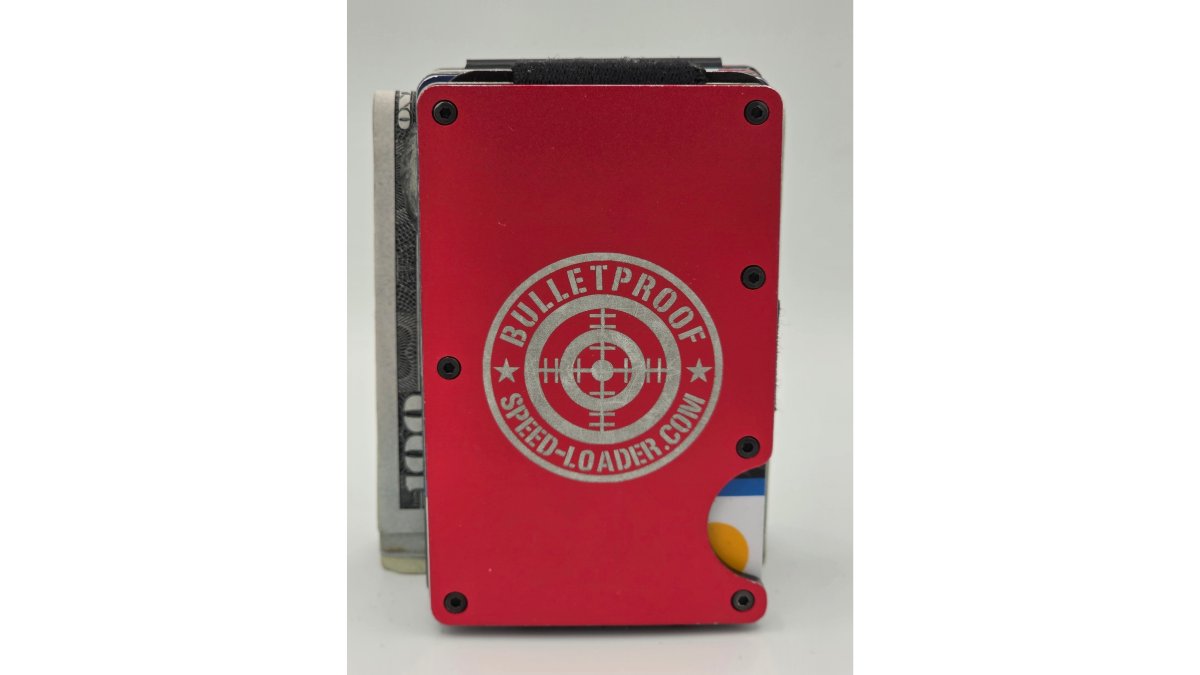
Good gear reinforces good habits. A speed loader reduces the thumb fatigue that leads to sloppy loading and lets you spend more range time on the skills that matter. A quality carry wallet keeps daily essentials organized without adding bulk.
| Product | Price | Best For | Material |
|---|---|---|---|
| EZ-MAG Pistol Speed Loader | $34.95 | Pistol mags, range days | Polymer |
| COMBAT Speed Loader | $69.95 | Everyday range use | Polymer |
| TACTICAL Speed Loader | $89.95 | Heavy use, hostile conditions | Polymer with aluminum parts |
| Tier-1 AR-15 Speed Loader | $199.95 | AR-15 platform, pro use | 6160 aluminum |
| Concealed Carry Tactical Wallet | $29.95 | Daily carry essentials | Aluminum or carbon fiber |
Conclusion: Building a Concealed Carry Routine That Lasts
The mistakes that matter most are rarely about gear. They are about habits: a holster you never fit properly, a draw you never practiced, a belt you never upgraded, a threat you never saw coming. Fix the habits and the gear follows.
Frequently Asked Questions
What are the most common concealed carry mistakes?
The most frequent mistakes include choosing the wrong holster, improper clothing and belt selection, prioritizing comfort over effectiveness, and neglecting consistent practice. Many carriers also fail to maintain situational awareness, exhibit poor trigger discipline, leave firearms unsecured, and skip draw stroke practice. Each of these increases risk and reduces readiness.
What does 'Mexican carry' mean and why is it dangerous?
Mexican carry refers to carrying a firearm without a holster, typically tucked into the waistband. It is dangerous because the trigger is unprotected, the gun can shift or fall, and re-holstering is unsafe. This method also makes it nearly impossible to achieve consistent grip or draw stroke, increasing the chance of an accidental discharge.
Should I keep one in the chamber when concealed carrying?
Yes, carrying with a round in the chamber is standard for self-defense. Modern firearms are designed to be carried this way safely, provided you use a proper holster that covers the trigger guard. Without a chambered round, you may not have time to rack the slide under stress. Training and familiarity with your firearm are essential.
How often should I practice drawing from concealment?
Aim for dry fire practice at least three times per week, focusing on a smooth, consistent draw stroke. Live fire training should occur monthly if possible, including drawing from concealment and re-holstering. Even 10 minutes of dry fire daily can build muscle memory and improve speed and safety.