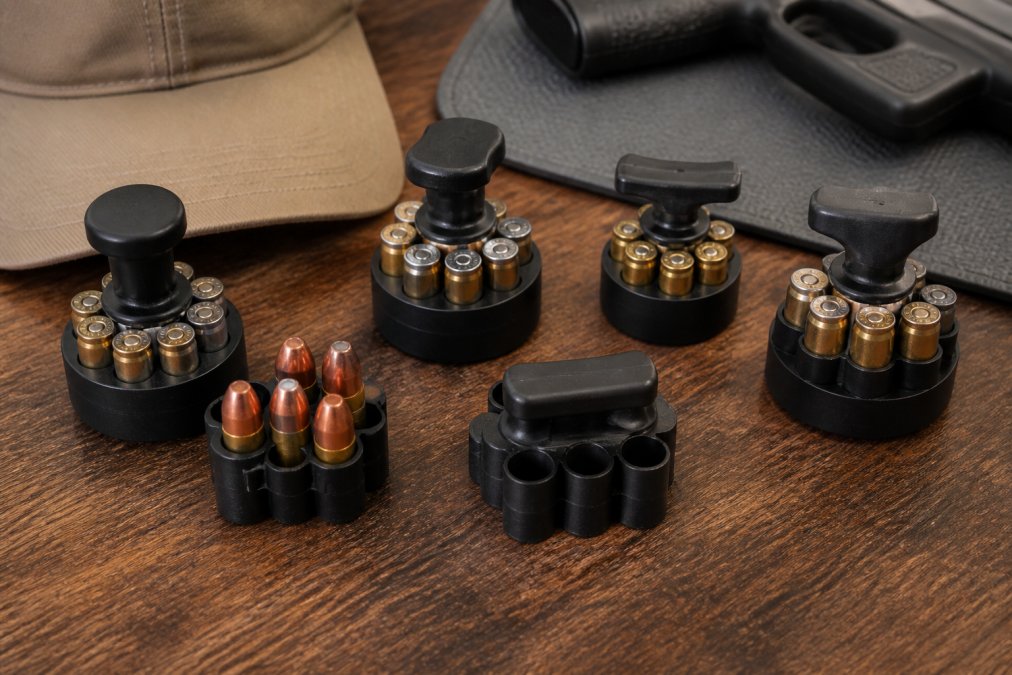
 listicle
Speed Loaders for Competition Shooters: 2026 Guide
Table of Contents
- Speed Loaders for Competition Shooters: What Separates Winners from the Field
- Speed Loader Comparison Table: Top Models for Competitive Shooting
- How to Use a Speed Loader Effectively in Match Conditions
- Moon Clips vs Speed Loaders for Competition: Which Reloading Method Wins
- Speed Loader Pouches for Competition: Gear Integration and Belt Rig Setup
- Evaluating Speed Loaders: Reliability, Durability, and Cold-Weather Performance
- Bulletproof Speed Loaders: Models Built for Stage Time
- Conclusion: Choose Your Competitive Edge
Last Updated: August 6, 2026
Speed Loaders for Competition Shooters: What Separates Winners from the Field
Competitive shooting demands precision, speed, and reliability. A fraction of a second separates first place from second, and every reload counts. Speed loaders for competition are engineered to shave milliseconds off your cycle time while maintaining absolute reliability under pressure. This guide from Bulletproof Speed Loaders covers what separates high-performance competition gear from basic range equipment, and how to choose the right loader for your discipline.
Competition shooters operate in a different world: stage design changes every match, reloads happen under stress, and gear must function flawlessly when it matters most. A speed loader that works fine at the bench can fail when you're pushing hard under match conditions. The right speed loader reduces finger fatigue, improves reload consistency, and lets you focus on sight picture rather than struggling with magazines.

Speed Loader Comparison Table: Top Models for Competitive Shooting
| Model | Type | Best For | Key Advantage |
|---|---|---|---|
| Bulletproof EZ-MAG | Pistol speed loader | Compact, hand-size adaptive | Two-step loading, minimal hand fatigue |
| Bulletproof COMBAT | Polymer construction | Everyday range use, harsh conditions | Durable, affordable entry point |
| Bulletproof TACTICAL | Polymer with aluminum | Versatile competition use | Balanced performance across calibers |
| Bulletproof DELTA | Aircraft aluminum | Precision shooters, high-volume training | Premium durability, consistent indexing |
| Bulletproof TIER-1 | AR-15 magazine loading | PCC competition, rifle-focused shooters | Specialized magazine compatibility |
Competition shooters face a choice: universal loaders that work across multiple calibers, or specialized models built for specific cartridges and magazine types. For most competitive shooters, specialization wins, your match gun is your match gun, and you're not swapping between platforms mid-stage.

Bulletproof Speed Loaders provides high-performance tactical gear and specialized speed-loading solutions designed for firearm enthusiasts and professionals. Our collection features robust, combat-ready equipment including the EZ-MAG pistol speed loader and various tactical models engineered for reliability and efficiency. We serve those who demand durability and precision in their carry gear, ensuring you are always prepared when it matters most. Explore our range of tactical wallets and accessories to complete your loadout with gear built to withstand the toughest conditions.
How to Use a Speed Loader Effectively in Match Conditions
Knowing how to use a speed loader and using one under match stress are two different things. Proper technique requires understanding hand positioning, indexing consistency, and deployment speed.
Proper Hand Positioning and Indexing
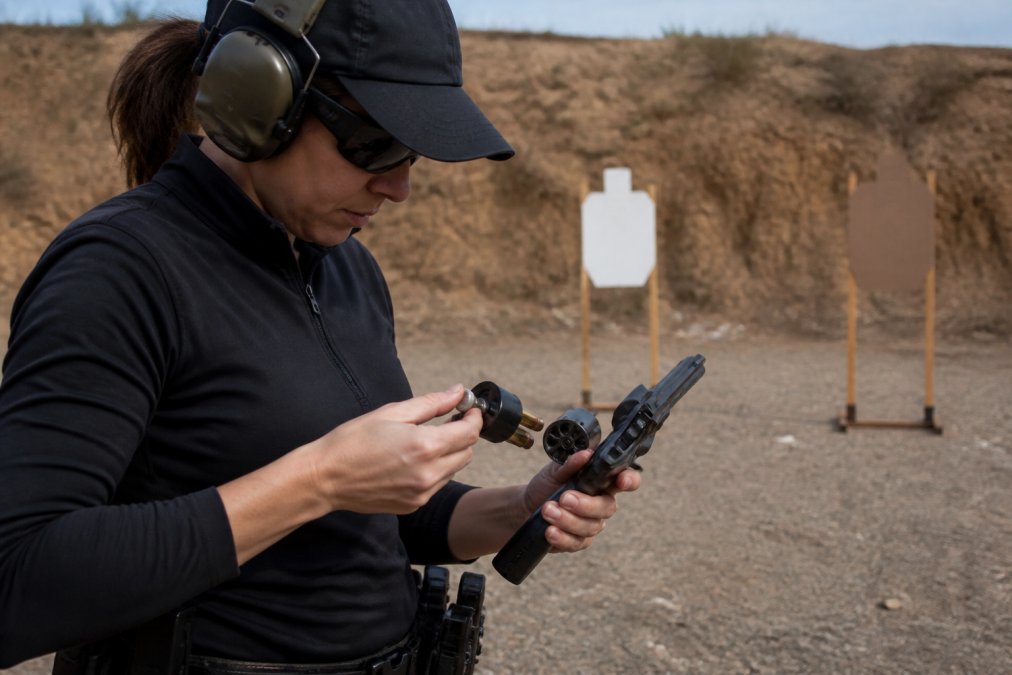
Hand positioning determines whether your reload takes 2 seconds or 4 seconds. Most shooters grip the speed loader too tightly, creating friction that slows cartridge release. The correct grip is firm enough to control the loader, loose enough to let cartridges drop freely.
Hold the speed loader in your non-dominant hand with your thumb and index finger on opposite sides of the release button. Your remaining fingers should cradle the cartridges lightly. The loader should sit at a 45-degree angle to your body, not vertical, angled orientation lets cartridges align with cylinder chambers naturally.
Indexing means aligning each cartridge with its corresponding chamber before release. A speed loader with poor spring tension won't maintain alignment under recoil. When you insert the loader into the cylinder, cartridges should nestle into chambers with zero resistance. If you feel binding, the loader is worn or the cylinder is dirty.
Deployment Speed and Cycle Time
The fastest competitive shooters reload in under 3 seconds from holster to first shot. To achieve this, your speed loader must be positioned for immediate access in a dedicated pouch on your belt rig, not loose in a pocket. The pouch should allow a one-handed draw with the release button facing forward and slightly upward.
Cycle time depends on spring-loaded retention quality. A weak spring releases cartridges too slowly; a stiff spring requires excessive force, causing fumbling under fatigue. The Bulletproof DELTA uses precision-engineered spring tension that releases all cartridges simultaneously without requiring excessive hand strength.
Practice your reload sequence dry-fire first. Load the speed loader, insert it into an empty cylinder, press the release, remove the loader, and close the cylinder. Repeat 20 times without ammunition. Your hands will learn the movement pattern, and when you move to live fire, the motion becomes automatic.
Moon Clips vs Speed Loaders for Competition: Which Reloading Method Wins
Moon clips and speed loaders solve the same problem, fast reloading, but through completely different mechanisms. Moon clips are metal rings that hold cartridges in a fixed circle, allowing simultaneous insertion into the cylinder. Speed loaders hold cartridges in individual chambers and release them one at a time.
Moon clips work exceptionally well in IPSC revolver division with fixed-barrel revolvers designed specifically for moon clip use. If your match gun is built for moon clips, use them, they're faster and more reliable for that platform. The downside is that moon clips are expensive, wear out over time, and must be matched to your specific revolver model.
Speed loaders work with any revolver that has standard cylinder chambers. They're universal across calibers and frame sizes. A Bulletproof speed loader works with your .38 Special, .357 Magnum, and .45 ACP revolver without modification.
For 3-Gun competitors shooting pistol stages, speed loaders dominate because you're using semi-automatic pistols with magazines, not revolvers. For USPSA revolver division, the choice depends on your specific gun.
Speed Loader Pouches for Competition: Gear Integration and Belt Rig Setup
A speed loader is only as fast as your access to it. Competitive shooters who carry loaders in loose pockets waste 1-2 seconds fumbling for them. Dedicated speed loader pouches eliminate this problem by positioning the loader for instant access.
A proper competition belt rig integrates speed loader pouches alongside magazine carriers and holster. The layout depends on your shooting style. IPSC shooters typically carry two or three speed loaders in pouches positioned at 3 o'clock (strong side, forward of the hip). USPSA shooters often position loaders at 4 o'clock, slightly rearward of the hip.
The pouch itself matters. A retention pouch holds the speed loader securely enough that it won't fall during movement, but loosely enough that you can draw it with one hand in under one second. Elastic-lined pouches work well for this. Most competitive shooters prefer modern synthetic materials that maintain consistent retention over thousands of reloads.
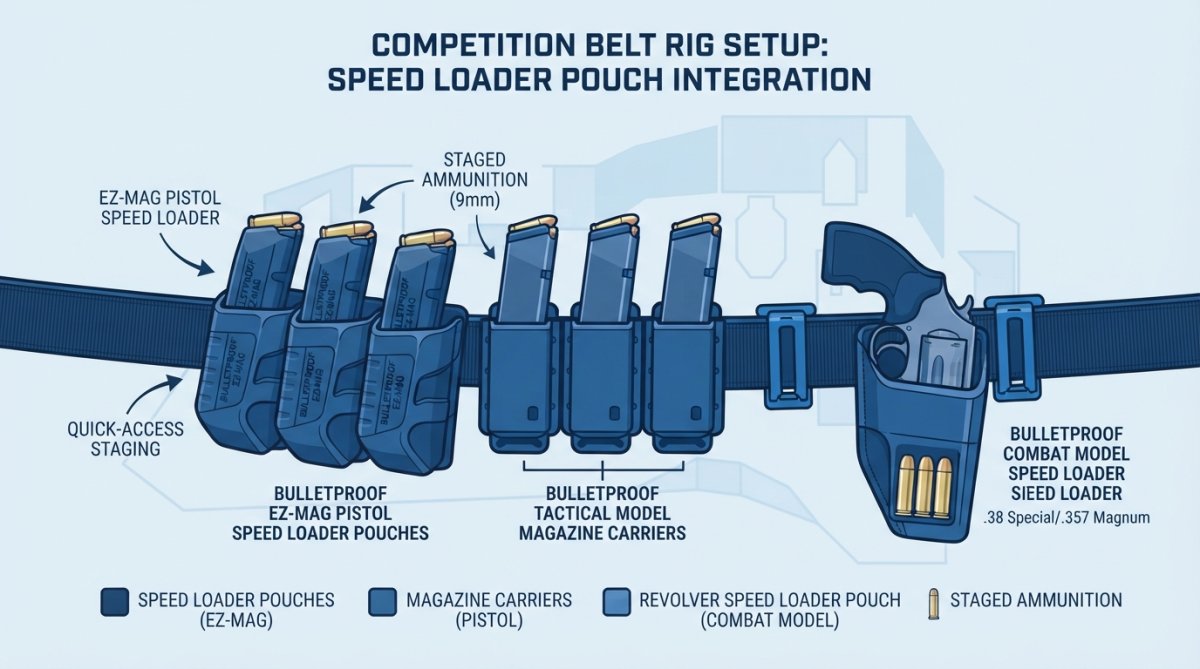
Mounting position affects reload speed more than most shooters realize. The sweet spot is typically 2-4 inches forward of your hip bone, at a slight forward angle. This position allows a smooth draw that flows naturally into insertion.
Evaluating Speed Loaders: Reliability, Durability, and Cold-Weather Performance
Competition shooters evaluate speed loaders by three criteria: reliability, durability, and environmental performance.
Material Construction and Spring-Loaded Retention
Material choice determines durability and maintenance requirements. Polymer speed loaders are lightweight and affordable. Aluminum construction adds weight but provides superior durability for high-volume shooters who reload hundreds of times per month.
The Bulletproof DELTA model uses aircraft-grade aluminum, which resists wear from repeated insertion and removal. The spring-loaded retention system maintains consistent tension even after 10,000+ reloads. A budget speed loader with weak springs will loosen up after 2,000 reloads, causing cartridges to fall out during insertion, a match-ending failure.
Spring tension is critical. A properly engineered spring holds cartridges firmly enough that they don't rattle during movement, but loosely enough that you can release them without excessive force. Cold-weather performance separates quality loaders from mediocre ones. Polymer becomes brittle in cold temperatures and can crack during deployment. Aluminum maintains its properties across temperature ranges.
Ergonomics Across Hand Sizes and Calibers
Speed loader ergonomics vary dramatically based on hand size. A loader designed for large hands becomes a liability for shooters with smaller hands. The Bulletproof EZ-MAG solves this problem through adaptive design. The two-step loading mechanism doesn't require precise hand positioning or excessive grip strength.
Caliber compatibility adds another layer. A speed loader for 9mm has different cartridge spacing than one for .45 ACP. Universal loaders perform adequately for all calibers but optimally for none. Specialized loaders, built specifically for 9mm, .40 S&W, or .45 ACP, provide superior reliability because tolerances are tight and indexing is precise.
Competition shooters with multiple match guns often carry caliber-specific loaders for each. This eliminates the reliability penalty of universal designs.
Bulletproof Speed Loaders: Models Built for Stage Time
Bulletproof Speed Loaders offers five distinct models, each engineered for specific competition scenarios.
Bulletproof EZ-MAG Pistol Speed Loader
The EZ-MAG is built for shooters who prioritize accessibility and minimal hand fatigue. The two-step loading process reduces the manipulation complexity that fatigues hands during high-volume training. Most speed loaders require precise hand positioning and significant grip strength to deploy cartridges. The EZ-MAG eliminates this through a lever-driven mechanism that compresses magazine springs without requiring manual force.
This is critical for shooters with smaller hands, older shooters, or anyone dealing with hand fatigue from extended range sessions. A typical competitive match involves 200-300 rounds across multiple stages. Manual magazine loading causes hand cramping by stage three. The EZ-MAG distributes force across the lever mechanism instead of concentrating it in your fingers.
At $34.95, the EZ-MAG is the entry point into quality speed loading. Many competitive shooters keep one in their range bag as insurance against hand fatigue during heavy training.
Bulletproof COMBAT Model: Tactical Reliability
The COMBAT model ($69.95) targets shooters who need a reliable loader that handles harsh conditions without complaint. Polymer construction keeps weight minimal, and the anodized aluminum lever and release button resist corrosion and wear. This is the model for shooters who train year-round in variable conditions.
The COMBAT prioritizes reliability and durability over speed. The spring-loaded retention is engineered conservatively, meaning cartridges won't accidentally deploy. This is the sweet spot for competitive shooters who value consistency over microsecond advantages.
The COMBAT works across multiple calibers without requiring adjustment, making it genuinely universal. For most competitive shooters, this versatility is acceptable.
Bulletproof TACTICAL Model: Versatility Across Disciplines
The TACTICAL model ($89.95) bridges the gap between the budget-friendly COMBAT and the premium DELTA. It uses durable polymer with anodized aluminum components for enhanced durability without the weight penalty of full aluminum construction. The spring-loaded retention is precisely engineered to maintain consistency across calibers.
The TACTICAL excels in 3-Gun competition, where shooters transition between pistol, rifle, and shotgun stages. Magazine compatibility varies across platforms, and the TACTICAL's loose tolerances accommodate this variability without sacrificing reliability.
This model appeals to competitive shooters who are serious about their sport but not yet ready to commit to discipline-specific equipment.
Bulletproof DELTA Model: Aluminum Construction for Precision
The DELTA model ($179.95) represents the premium end of the Bulletproof lineup. Aircraft-grade aluminum construction provides unmatched durability, and precision CNC machining ensures tolerances tight enough that cartridge indexing is flawless across thousands of reloads. This is the model for competitive shooters who train 200+ hours per year.
The spring-loaded retention on the DELTA is engineered to exacting specifications. After 10,000 reloads, the DELTA performs identically to day one. Other loaders degrade noticeably after 5,000 reloads.
The DELTA is caliber-specific, available in 9mm, .40 S&W, and .45 ACP configurations. High-volume competitive shooters often own multiple DELTA models, one for each match gun, because the performance advantage justifies the investment.
Bulletproof TIER-1 Model: AR-15 Magazine Loading
The TIER-1 model ($199.95) addresses a gap in the competitive shooting market: fast AR-15 magazine loading for PCC competition. Pistol Caliber Carbine divisions have exploded in popularity, and magazine loading speed directly impacts stage times. A slow loader costs 2-3 seconds per magazine.
The TIER-1 is engineered specifically for AR-15 magazines, with indexing and spring tension optimized for magazine geometry and spring characteristics. This specialization delivers performance that universal loaders can't match.
PCC competitors who invest in the TIER-1 gain a measurable advantage. Loading magazines during stage breaks becomes faster and more consistent, reducing fatigue and improving focus for the next stage.
Conclusion: Choose Your Competitive Edge
Speed loader selection directly impacts your competitive performance. A marginal loader costs you fractions of a second per reload, which compounds across a multi-stage match. The difference between first place and second often comes down to gear reliability and efficient technique.
Bulletproof Speed Loaders delivers competition-grade equipment built specifically for shooters who demand reliability under pressure. The EZ-MAG reduces hand fatigue. The COMBAT provides durable, affordable reliability. The TACTICAL bridges versatility and performance. The DELTA offers uncompromising durability for high-volume shooters. The TIER-1 specializes in PCC magazine loading.
Choose your loader based on your competition format, hand size, and training volume. Test it extensively before match day. Practice your reload sequence until it becomes automatic. The right speed loader becomes invisible, it just works.
Frequently Asked Questions
What speed loader do professional competition shooters use?
Professional competitors select speed loaders based on their firearm type and discipline. Revolver shooters favor spring-driven or push-button designs for rapid indexing and retention. Pistol competitors often use universal loaders that work across multiple calibers and magazine types. The choice depends on caliber, magazine capacity, and whether you're shooting USPSA, IDPA, or 3-Gun. Bulletproof Speed Loaders serve this market with models like the EZ-MAG for pistols and the DELTA Model for tactical efficiency, each engineered for the speed and reliability that stage time demands.
Are speed loaders allowed in USPSA or IDPA competitions?
Yes, speed loaders are legal and widely used in both USPSA and IDPA matches. Both organizations permit spring-loaded and push-button speed loaders as standard reloading tools. IDPA specifically approves injection-molded and CNC-machined designs. Check your local match rules, as some divisions have equipment restrictions, but speed loaders themselves are unrestricted in major competitive shooting sports. This makes them essential gear for anyone serious about competitive shooting.
What is the difference between a speed loader and a moon clip?
Speed loaders hold individual cartridges and release them into the cylinder or magazine through mechanical action (push-button, spring-driven, or twist-knob). Moon clips are steel rings that hold cartridges in a fixed pattern and load directly into the cylinder as a unit. Speed loaders offer faster manipulation for most shooters and work with standard firearms. Moon clips require specific firearms designed for them, but they deliver the fastest possible reload when properly indexed. For competition, speed loaders provide more versatility across different revolver models and calibers.
How do I know if a speed loader will work with my specific firearm and caliber?
Speed loaders are caliber and frame-size specific. Check the manufacturer's compatibility chart for your exact revolver model and caliber, or your pistol magazine type and capacity. Universal pistol loaders work across 9mm, .40 caliber, and similar cartridges, but revolver loaders require matching frame size (K-frame, L-frame, N-frame). Bulletproof Speed Loaders provide detailed fitment information for each model. If you shoot multiple calibers or firearms, consider a universal loader to reduce your gear burden at the range.
Can I modify or tune a speed loader to improve performance?
Yes, many competitive shooters adjust spring tension and lever friction to optimize deployment speed and cartridge retention. Common modifications include sanding friction surfaces, adjusting spring preload, and fine-tuning alignment for faster indexing. However, modifications can affect reliability and durability if done incorrectly. Start with a quality loader like Bulletproof's DELTA or TACTICAL models, which are engineered for performance out of the box. Test any DIY modifications extensively at the range before match day to ensure cartridges load consistently and springs maintain proper retention under recoil and stress.
Competitive success demands equipment that matches your commitment. Get started with [EXTERNAL_LINK: Bulletproof Speed Loaders' competition-grade lineup | speed-loader.com] and eliminate the reload from your performance equation. Whether you're competing in IPSC, USPSA, 3-Gun, or PCC divisions, Bulletproof offers a purpose-built loader engineered for stage time. Your next match win might depend on the loader you choose today.
This article was written using GrandRanker