 listicle
Speed Loader Alternatives for Shooters: 2026 Guide
Table of Contents
- Speed Loader Alternatives That Actually Work for Shooters
- Speed Loader vs Speed Strip: Which Reloading Method Fits Your Shooting
- High-Capacity Revolver Loaders: Mechanical Advantage and Reload Speed
- How to Choose a Revolver Speed Loader for Your Caliber and Carry Style
- Bulletproof Speed Loaders: Combat-Ready Performance for Tactical Use
- Durability, Retention, and Pocket Carry: What Separates Premium Loaders
- Conclusion: Choosing Your Speed Loader Strategy
Last Updated: August 9, 2026
Speed Loader Alternatives That Actually Work for Shooters
Speed loader alternatives have become essential for shooters who want faster reloads without the learning curve or hand fatigue that comes with traditional speedloaders. Whether you're at the range, competing, or carrying for personal defense, the right reloading solution can cut your reload time significantly while reducing finger strain.
At Bulletproof Speed Loaders, we've tested dozens of approaches to understand which alternatives deliver real performance gains. The landscape has changed dramatically in recent years, and products claiming "universal fit" often perform poorly across different calibers and cylinder sizes.
Traditional speedloaders require specific hand strength and technique, jam magazines, and demand practice to use reliably under pressure. This guide breaks down what actually works, why it matters, and how to choose the right system for your shooting discipline and carry style.
Speed Loader vs Speed Strip: Which Reloading Method Fits Your Shooting
Speed loaders and speed strips represent two fundamentally different approaches to revolver reloading, and understanding the trade-offs determines which system fits your actual needs.
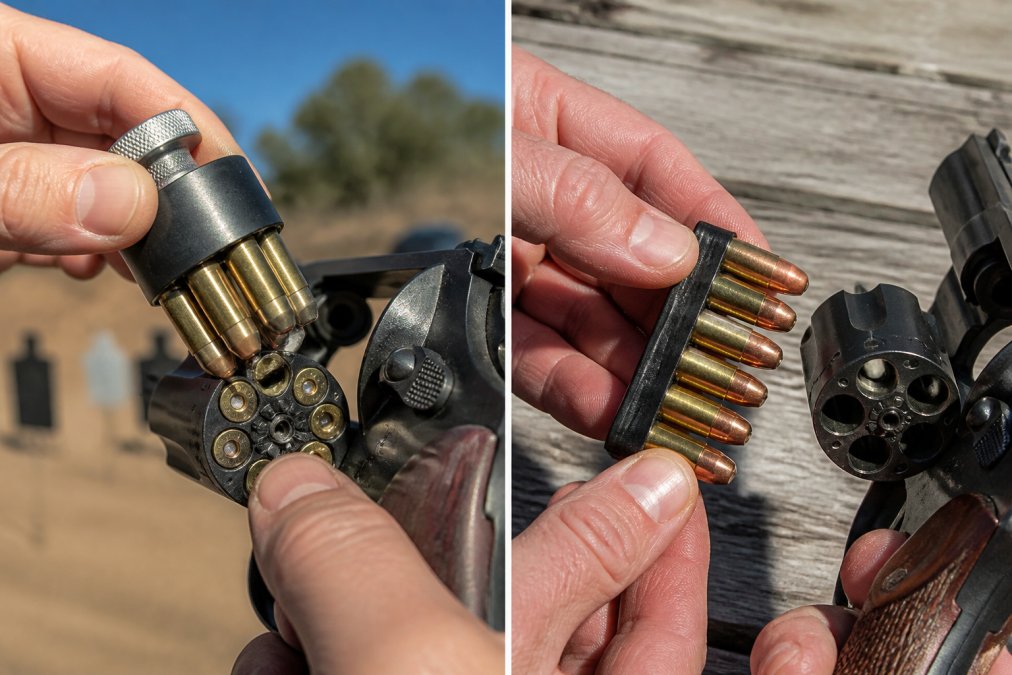
A speed loader is a mechanical device that holds multiple cartridges in proper alignment, allowing you to insert them all into the cylinder simultaneously. A speed strip is a flexible carrier that holds cartridges in a single row, requiring you to feed rounds individually or in pairs. Speed loaders typically complete a full reload in 3-5 seconds, while speed strips take 8-12 seconds.
Speed loaders dominate in competitive shooting environments where every fraction of a second matters. They're the standard for IDPA, USPSA revolver divisions, and practical shooting matches. Once you've practiced the motion, reloading becomes automatic.
Speed strips excel in concealed carry and backup scenarios where compact size and simplicity matter more than raw speed. They're significantly smaller, fit easily in a pocket or small pouch, and require no special holster setup. For someone carrying a snub-nose revolver as a backup gun, a speed strip offers practical versatility that a bulky speedloader doesn't.
The real decision point comes down to your shooting context. If you're training seriously or competing, a speed loader with proven retention and compatibility to your specific caliber is essential. If you're carrying concealed and reloading is a low-probability contingency, a speed strip's compact profile may align better with your actual needs.
High-Capacity Revolver Loaders: Mechanical Advantage and Reload Speed
High-capacity revolver loaders are engineered specifically for shooters who need to load more rounds faster, particularly those working with larger calibers like .44 Magnum or .45 Colt where hand strength becomes a limiting factor.

The mechanical advantage in modern loaders comes from the lever system that compresses the cylinder's spring tension and the button mechanism that releases rounds into proper alignment. A well-designed push-button release requires minimal hand strength while delivering maximum control. Poor designs force you to squeeze hard, fatigue your fingers within 50 rounds, and cause misalignment that leads to jams.
Bulletproof Speed Loaders engineered the DELTA Model with 6160 aircraft aluminum construction specifically to address this problem. The solid aluminum lever distributes force across a wider surface, reducing the finger pressure needed per round. Compared to polymer-only designs, this makes a measurable difference after 200+ rounds of practice or competition shooting.
Competitive shooters using optimized high-capacity loaders consistently achieve 3-4 second reloads with six rounds. The same shooter with an inferior loader might take 6-8 seconds, losing critical time in a match stage or defensive scenario.
The retention mechanism is where most loaders fail. A loader that doesn't grip cartridges securely will drop rounds during the reload motion. Bulletproof's models use a spring-tension design that holds cartridges firmly without deforming the brass, a detail that separates reliable tactical gear from equipment that performs poorly under real conditions.
How to Choose a Revolver Speed Loader for Your Caliber and Carry Style
Selecting the right speed loader requires evaluating three critical variables: your revolver's caliber and cylinder size, your primary shooting context, and your carry method.
Caliber compatibility is non-negotiable. A loader designed for .38 Special won't work reliably with .357 Magnum because the cartridge dimensions differ slightly. Before purchasing any loader, verify that it's explicitly rated for your specific caliber. Universal loaders exist, but they perform poorly across the entire range.
Your shooting context determines whether you need a competition-grade loader or a carry-oriented system. Competitive shooters benefit from larger, more ergonomic designs that prioritize speed and comfort during extended shooting sessions. Concealed carry users need compact loaders that fit in a pocket or small pouch without printing. Bulletproof's EZ-MAG pistol speed loader addresses the carry segment specifically, designed for shooters with smaller hands who need reliability in a compact package.
Carry method influences loader selection significantly. If you're using an inside-the-waistband holster, your loader pouch needs to be accessible without removing your shirt or jacket. Pocket carry demands the smallest possible profile. Tactical gear setups can accommodate larger, heavier loaders if the speed and reliability justify the added weight.
Hand size and strength are practical factors most guides ignore. Shooters with smaller hands often struggle with full-sized loaders designed for average-to-large hands. Testing before purchasing is critical. If you can't find a local retailer with demo units, order from companies with reasonable return policies.
| Factor | Competitive Shooting | Concealed Carry | Range Training |
|---|---|---|---|
| Size Priority | Speed and comfort | Compact and discreet | Ergonomics and durability |
| Reload Speed | 3-4 seconds critical | 6-8 seconds acceptable | 4-5 seconds preferred |
| Caliber Flexibility | Single caliber optimized | May need multiple loaders | Single or dual caliber |
| Retention Requirement | Maximum, no dropped rounds | High, rounds stay secure | High, consistent performance |
Bulletproof Speed Loaders: Combat-Ready Performance for Tactical Use
Combat-ready speed loaders must function reliably under stress, in low light, with wet hands, and after hundreds of rounds of training. Law enforcement and serious tactical practitioners demand equipment that performs when conditions are worst.
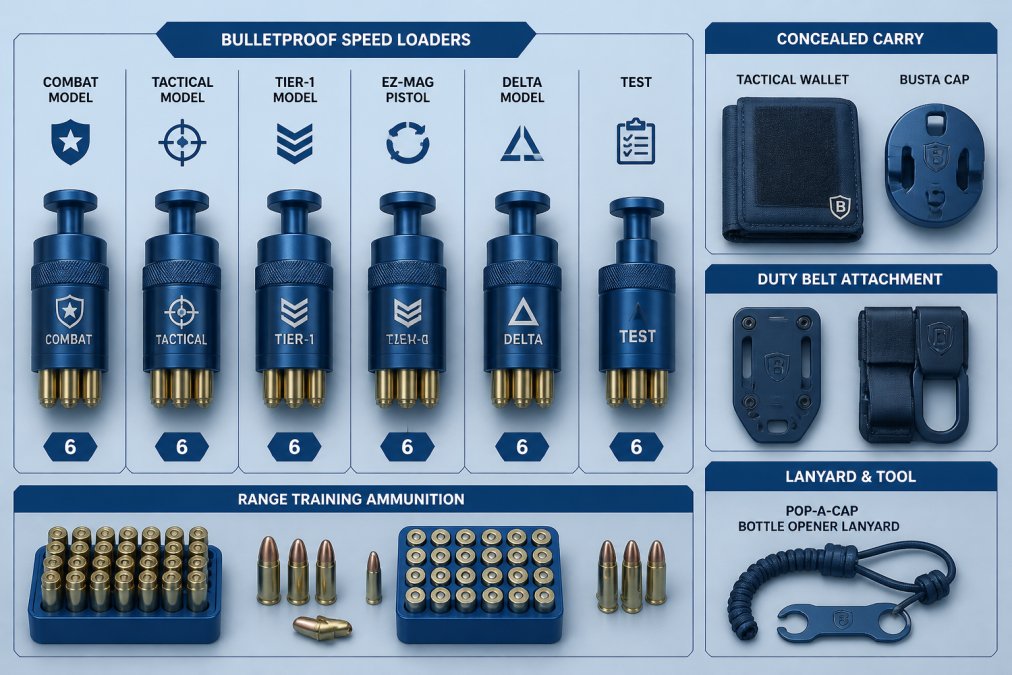
Bulletproof Speed Loaders engineered their tactical lineup specifically for professionals and serious shooters who can't afford failures. The COMBAT Model in durable polymer construction delivers reliability in harsh environments without the weight penalty of full aluminum designs. Polymer withstands temperature extremes, resists corrosion from sweat and environmental exposure, and maintains spring tension consistency across thousands of reload cycles.

The TACTICAL Model bridges the gap between entry-level and premium equipment. It uses anodized aluminum for the lever and button mechanisms, the components that wear fastest, while maintaining polymer construction for weight and cost efficiency. This hybrid approach delivers combat reliability at a practical price point.

Combat scenarios demand specific performance characteristics that recreational shooting doesn't test. Your loader must work with a wet, gloved hand and function after your revolver has been carried in a holster for hours with dust and debris potentially affecting the mechanism. Most loaders fail these tests. Bulletproof's tactical models are designed to pass all of them.
The retention mechanism in tactical loaders requires particular attention. A loader that drops a round during training is inconvenient. A loader that drops a round during a defensive encounter is potentially catastrophic. Bulletproof's spring-tension design holds cartridges securely through the entire reload motion while remaining easy to insert and remove.
Durability, Retention, and Pocket Carry: What Separates Premium Loaders
Long-term durability separates loaders you'll use for years from equipment that degrades after a few months of regular training. Spring fatigue, polymer brittleness, and mechanical wear accumulate with every reload cycle.
Retention quality determines whether your loader is reliable or frustrating. A weak retention mechanism allows cartridges to shift during insertion, causing misalignment and jams. Strong retention without excessive force requires precision engineering. The spring tension must be calibrated to your specific caliber, too loose and rounds fall out, too tight and you need excessive hand strength to load.
Bulletproof's retention design uses a calibrated spring system that holds cartridges firmly without deforming brass. This matters because deformed cartridges won't chamber properly, forcing you to discard rounds or spend time straightening them. Over hundreds of rounds, the cost of wasted ammunition exceeds the price difference between a quality loader and a cheap alternative.
Pocket carry requires a loader that fits in standard jean or cargo pockets without excessive bulk. The Bulletproof EZ-MAG at $34.95 represents the pocket-carry segment, engineered for compact performance without sacrificing reliability. Its two-step loading process works with one hand if necessary, a practical advantage in defensive scenarios.
Spring fatigue is the overlooked durability factor. Springs lose tension over time with constant compression cycles. A loader with poor spring design will feel looser after 500 rounds than when new. Premium loaders use springs engineered to maintain consistent tension across 5,000+ reload cycles, determining whether your loader remains reliable for years or becomes unreliable within months.
Comparison Table: Speed Loader Options for Different Shooting Disciplines
| Model | Best For | Starting Price | Key Advantage | Trade-off |
|---|---|---|---|---|
| Bulletproof TIER-1 | Competitive shooters demanding maximum performance | $199.95 | Precision engineering for consistent 3-4 second reloads | Premium cost limits accessibility |
| Bulletproof DELTA | Serious trainers and tactical users | $179.95 | Hybrid aluminum/polymer design balances durability and weight | Mid-range price may feel steep for casual shooters |
| Bulletproof TACTICAL | Law enforcement and professional training | $89.95 | Combat-tested reliability in harsh conditions | |
| Bulletproof COMBAT | Range training and casual use | $69.95 | Affordable entry point with proven reliability | |
| Bulletproof EZ-MAG Pistol | Concealed carry and compact needs | $34.95 | Smallest footprint, works with limited hand dexterity | Slower reload speed than revolver loaders |
Choosing a speed loader alternative requires matching your equipment to your actual shooting context. Competitive shooters need precision and speed. Concealed carry users need compact reliability. Tactical professionals need durability under stress.
Bulletproof Speed Loaders' lineup addresses these segments directly. The TIER-1 and DELTA models serve competitive shooters who demand consistent performance. The TACTICAL and COMBAT models meet professional and training needs. The EZ-MAG solves the pocket-carry problem that standard revolver loaders can't address.
The real cost of a poor loader isn't the money you waste on the equipment, it's the training time you lose to failures and the confidence you sacrifice by carrying gear you don't trust. Invest in a loader that matches your actual needs, practice with it consistently, and it becomes invisible, just part of how you shoot. That's when you know you've made the right choice.
Frequently Asked Questions
Are speed loader alternatives better than traditional speedloaders for competitive shooting?
Speed loaders remain the fastest reloading method for revolver shooters in competitive environments. Alternatives like speed strips offer portability and concealment but sacrifice reload speed significantly. For USPSA, IDPA, and 3-Gun competition, a quality speed loader delivers superior mechanical advantage and reloading cycle efficiency. Choose based on your specific discipline: speed loaders dominate timed stages, while alternatives serve concealed carry or backup roles.
What's the difference between a speed loader and a speed strip for concealed carry?
Speed strips are flat, compact alternatives that fit easily in pockets or small pouches, making them ideal for concealed carry permit holders prioritizing minimal bulk. Speed loaders require dedicated holster or pouch compatibility but provide faster tactical reloads with better retention. For daily concealed carry, speed strips offer ergonomic advantages; for law enforcement or tactical training, speed loaders provide superior deployment speed and reliability under pressure.
How do I choose a revolver speed loader for my .45 ACP or 9mm high-capacity magazines?
Match your speed loader to your cylinder capacity and caliber. The Bulletproof COMBAT Model ($69.95) handles standard calibers, while the TACTICAL Model ($89.95) offers enhanced durability for high-capacity cylinders. Verify spring compression capability for your specific ammunition; some universal loaders struggle with high-capacity springs. Test retention and push-button release mechanism responsiveness. For .45 ACP shooters with high-capacity mags, verify the loader's mechanical advantage can fully compress your magazine springs without stripping feed lips.
What makes a speed loader worth the investment over cheaper alternatives?
Premium speed loaders deliver consistent mechanical advantage, reliable push-button release mechanisms, and durability under heavy use. Cheaper loaders often fail at feed lip retention or spring fatigue after months of training. Law enforcement and competitive shooters report equipment reliability directly impacts performance under pressure. Bulletproof models engineered for tactical use maintain precision and ergonomics through thousands of reloading cycles, justifying the investment for serious shooters who train regularly.
This article was written using GrandRanker
Frequently Asked Questions
Are speed loader alternatives better than traditional speedloaders for competitive shooting?
Speed loaders remain the fastest reloading method for revolver shooters in competitive environments. Alternatives like speed strips offer portability and concealment but sacrifice reload speed significantly. For USPSA, IDPA, and 3-Gun competition, a quality speed loader delivers superior mechanical advantage and reloading cycle efficiency. Choose based on your specific discipline: speed loaders dominate timed stages, while alternatives serve concealed carry or backup roles.
What's the difference between a speed loader and a speed strip for concealed carry?
Speed strips are flat, compact alternatives that fit easily in pockets or small pouches, making them ideal for concealed carry permit holders prioritizing minimal bulk. Speed loaders require dedicated holster or pouch compatibility but provide faster tactical reloads with better retention. For daily concealed carry, speed strips offer ergonomic advantages; for law enforcement or tactical training, speed loaders provide superior deployment speed and reliability under pressure.
How do I choose a revolver speed loader for my .45 ACP or 9mm high-capacity magazines?
Match your speed loader to your cylinder capacity and caliber. The Bulletproof COMBAT Model ($69.95) handles standard calibers, while the TACTICAL Model ($89.95) offers enhanced durability for high-capacity cylinders. Verify spring compression capability for your specific ammunition; some universal loaders struggle with high-capacity springs. Test retention and push-button release mechanism responsiveness. For .45 ACP shooters with high-capacity mags, verify the loader's mechanical advantage can fully compress your magazine springs without stripping feed lips.
What makes a speed loader worth the investment over cheaper alternatives?
Premium speed loaders deliver consistent mechanical advantage, reliable push-button release mechanisms, and durability under heavy use. Cheaper loaders often fail at feed lip retention or spring fatigue after months of training. Law enforcement and competitive shooters report equipment reliability directly impacts performance under pressure. Bulletproof models engineered for tactical use maintain precision and ergonomics through thousands of reloading cycles, justifying the investment for serious shooters who train regularly.