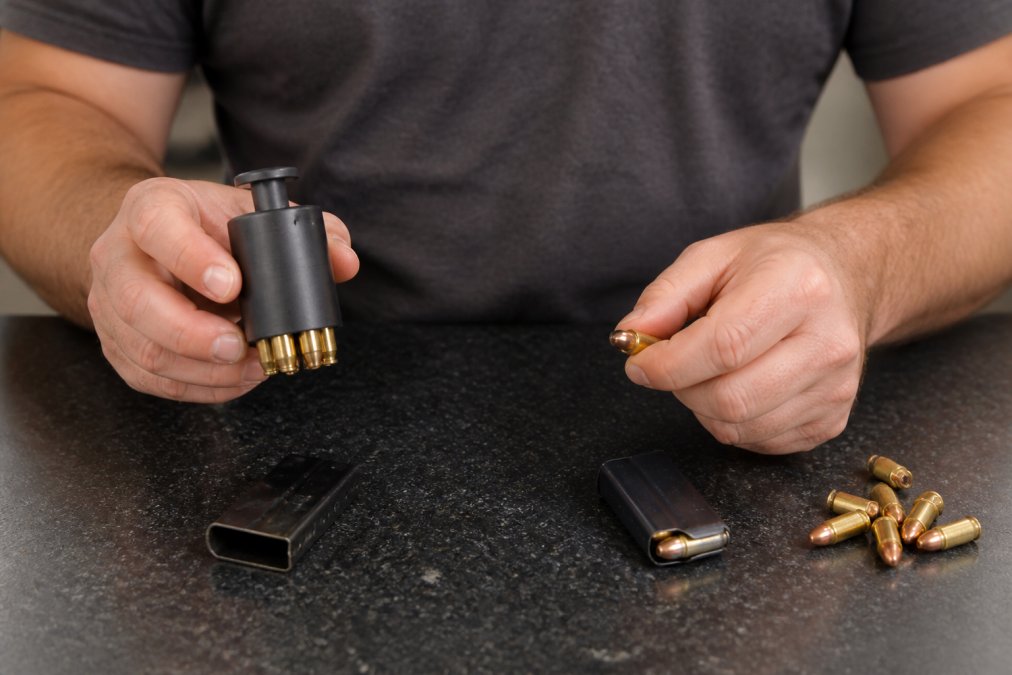
 comparison
Speed Loader vs Manual Loading: Which Is Faster?
Table of Contents
- Speed Loader vs Manual Loading: The Core Difference
- Speed Loaders for Revolvers vs Semi-Automatic Magazines
- Speed Loader vs Speed Strip: Which Tool Wins
- How to Use a Speed Loader for Maximum Efficiency
- Best 9mm Magazine Speed Loader Options
- Ergonomics and Hand Fatigue: Speed Loaders Win
- Range Day Efficiency and Long-Term Durability
- Conclusion
Last Updated: August 16, 2026
Speed Loader vs Manual Loading: The Core Difference
A speed loader is a mechanical device that compresses multiple rounds simultaneously and seats them into a revolver cylinder or magazine with a single pushing motion. Manual loading requires feeding each round individually using thumb pressure alone.
The practical difference is immediate. Manual loading forces your thumb to compress the magazine spring with every round, causing hand fatigue. A speed loader distributes compression across a wider surface area and lever mechanism, reducing the force required. At the range, fatigue compounds over hundreds of rounds. In a defensive scenario, tired hands make mistakes.
BULLETPROOF SPEED LOADERS has engineered solutions specifically designed to eliminate this friction point. The EZ-MAG Pistol Speed Loader requires only two steps to load a full magazine: insert the magazine into the loader, then push. No thumb fatigue, no fumbling with individual rounds, no misaligned ammunition that jams the feed lips.

Speed Loaders for Revolvers vs Semi-Automatic Magazines
Revolvers and semi-automatic pistols have fundamentally different loading mechanics, which means speed loaders designed for one won't work for the other.
Revolver Speed Loaders hold six rounds in a circular pattern matching the cylinder. You push all six rounds into the cylinder simultaneously with a single motion, rotate the loader slightly, and it releases. This is the fastest possible reload for a revolver, typically 3-5 seconds for a complete cylinder change.
Semi-Automatic Magazine Speed Loaders work with the spring-loaded feed lips of a pistol magazine. The Bulletproof EZ-MAG Pistol Speed Loader uses a two-step process: insert the magazine into the loader, then push down to compress the spring and seat ammunition without forcing your thumb to do the work. Most shooters load a full magazine in 15-25 seconds with a speed loader versus 40-60 seconds by hand.
The key difference comes from magazine capacity and spring tension. A 9mm magazine typically holds 15-17 rounds, and the spring becomes progressively harder to compress as you add more rounds. A speed loader handles that increasing spring tension mechanically, which is why thumb fatigue becomes a real issue in manual loading scenarios.
| Loader Type | Best For | Loading Time | Spring Tension Handling |
|---|---|---|---|
| Revolver Speed Loader | Six-chamber revolvers | 3-5 seconds | N/A (cylinder, not spring) |
| Magazine Speed Loader | Pistol magazines (9mm, .40, .45) | 15-25 seconds | Excellent (mechanical advantage) |
| Manual Loading | Backup method, low-volume shooting | 40-60 seconds | Poor (thumb fatigue) |
| Speed Strip | Emergency reload, deep concealment | 20-30 seconds | N/A (sequential loading) |
Speed Loader vs Speed Strip: Which Tool Wins
A speed strip is a flat, flexible rubber or polymer strip that holds six rounds in two staggered rows. You press the strip against your revolver cylinder, align the rounds with empty chambers, then twist slightly to release them. Speed strips are incredibly compact and work with any revolver regardless of cylinder size.
A speed loader holds all six rounds in a circular pattern matching your cylinder. You insert it fully into the cylinder opening, push down firmly, twist, and all six rounds are seated instantly. It's faster and more intuitive than a speed strip, but bulkier and requires a dedicated loader for your specific revolver model.
For range day shooting, a speed loader wins decisively. It's faster, more reliable, and doesn't require fine motor control. For concealed carry or emergency backup, a speed strip wins because it's compact enough to carry without printing or adding bulk. Many serious shooters carry both.
How to Use a Speed Loader for Maximum Efficiency
Loading with a speed loader is straightforward, but technique matters. Rushing or using improper hand positioning will slow you down and potentially damage your magazine feed lips or loader mechanism.
Step 1: Position Your Magazine Hold your magazine vertically with the feed lips facing up and slightly toward you. Insert it into the speed loader's magazine catch or slot. For the Bulletproof EZ-MAG Pistol Speed Loader, the magazine sits in a defined pocket that aligns the feed lips perfectly with the loader's round channels. Don't force the magazine in; it should seat smoothly with minimal pressure.
Step 2: Load Your Rounds Drop rounds into the loader's top opening one at a time. Most speed loaders have visible channels or guides that align each round as you add it. The loader will feel heavier and more resistant as you add rounds, which is normal as the spring underneath compresses.
Step 3: Push and Release Press down firmly on the loader's push button or lever. This action compresses the magazine spring and seats all rounds simultaneously. The push should be smooth and controlled, not jabbed. A smooth, deliberate push takes about 2-3 seconds and ensures every round seats properly without stripping the feed lips.
Step 4: Verify and Remove Check that all rounds are seated flush with the magazine top. Twist the loader slightly or press the release button to disengage from the magazine. Remove the loader and inspect the magazine. All rounds should be visible and aligned with the feed lips.
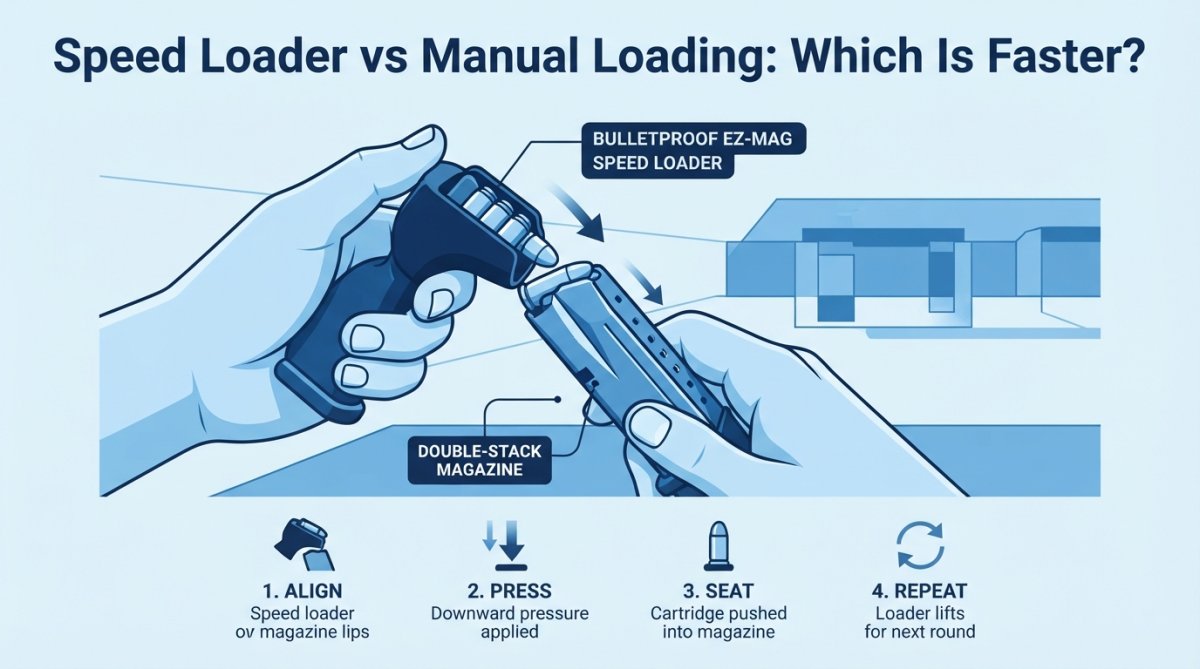
Common mistakes slow you down significantly. Forcing the magazine into the loader damages the feed lips. Jabbing the push button instead of pressing smoothly can misalign rounds. Trying to load too quickly without verifying each round causes double-feeds and jams downrange.
The rhythm becomes automatic after 20-30 repetitions. Once you've loaded a few magazines, your hands learn the motion and you'll move faster without thinking about it. At that point, you're looking at 15-20 seconds per magazine consistently, roughly three times faster than manual loading.
Best 9mm Magazine Speed Loader Options
The 9mm is the most common pistol caliber, which means the market for 9mm magazine speed loaders is competitive. Your choice depends on whether you prioritize affordability, durability, or specialized features.
Bulletproof EZ-MAG Pistol Speed Loader works with virtually any 9mm magazine, regardless of brand. It's designed to fit Glock magazines (17, 19, 22, 23, 26, 27, 34, 35, 45, 47), but also works with Sig P365, P320, P229, Hellcat, Springfield XD, Ruger SR9, CZ P10, Beretta 92, and many single-stack magazines. The two-step design eliminates the learning curve. At $34.95, it's an entry-level option that delivers serious value.
For shooters who demand premium construction, the Bulletproof TACTICAL Model ($89.95) upgrades to anodized aluminum components (lever, mag release button, catch) while maintaining the polymer body. This hybrid construction handles harsh conditions and heavy use without wearing out.

The Bulletproof DELTA Model ($179.95) is built from solid 6160 aircraft aluminum with customizable finishes. This is the loader for shooters who want a tool that feels as premium as it performs. The aluminum construction means zero flex under spring tension, and the precision engineering ensures perfect round alignment every time.
For 9mm shooters with smaller hands, the EZ-MAG is specifically engineered to reduce thumb strain. The loader does the work, not your hand. This matters when you're loading 10+ magazines in a training session.
The real differentiator between these options isn't speed (all three load equally fast), but durability and build quality. Premium loaders from Bulletproof are engineered to last years of heavy use without degradation.
Ergonomics and Hand Fatigue: Speed Loaders Win
Your hands are not designed to compress magazine springs repeatedly for extended periods. Manual loading creates measurable fatigue that compounds across hundreds of rounds.
When you load manually, your thumb bears 100% of the spring compression force. As you add rounds to a magazine, the spring becomes progressively stiffer. By round 12-15 in a typical 9mm magazine, you're fighting significant resistance. The last 2-3 rounds demand maximum thumb force, and many shooters report genuine pain or soreness after loading 10+ magazines by hand.
A speed loader distributes this force across a larger mechanical surface. The loader's lever or push button multiplies your hand's mechanical advantage, meaning you apply less force to achieve the same result. More importantly, the force is distributed across your entire hand, not concentrated on your thumb.
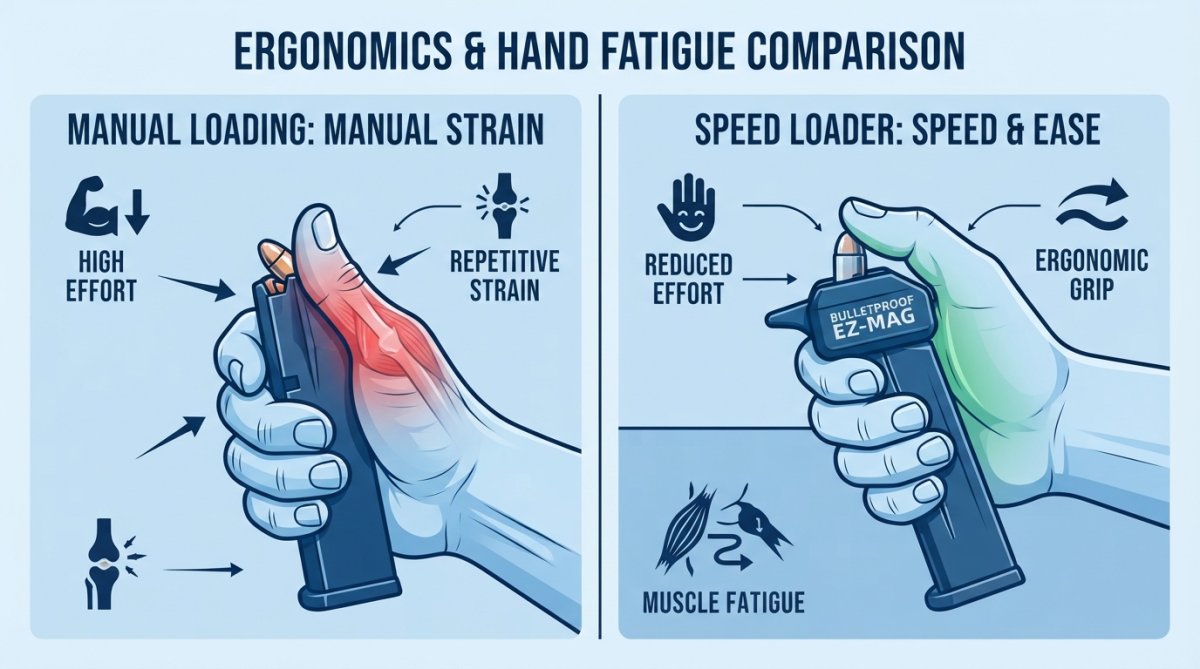
Competitive shooters and law enforcement officers who run regular training courses understand this viscerally. A shooter loading 15 magazines manually will have sore thumbs by magazine 10. The same shooter using a speed loader can load 30 magazines with zero fatigue.
Shooters with smaller hands, arthritis, or previous hand injuries find speed loaders transformative. What's impossible or painful to do manually becomes effortless with a loader. The Bulletproof EZ-MAG is specifically designed with accessibility in mind.
Long-term wear also matters. Repetitive manual loading creates cumulative strain on your thumb joint and tendon. A speed loader eliminates this risk entirely by removing the repetitive strain from the equation.
Range Day Efficiency and Long-Term Durability
Range day efficiency isn't just about loading speed, it's about cumulative time savings across an entire training session and the durability of your equipment to handle that volume.
A typical range day for a serious shooter involves 200-500 rounds, which means 12-30 magazines to load. At 40-60 seconds per magazine manually, you're spending 8-30 minutes just loading magazines. With a speed loader at 15-25 seconds per magazine, that same task takes 3-12 minutes. You've gained 5-20 minutes of actual shooting time for drills, accuracy work, or tactical practice.
Over a year of regular range visits, those minutes compound into hours. A shooter who visits the range twice monthly and loads 20 magazines per visit saves roughly 20-30 hours annually by using a speed loader instead of manual loading.
Durability becomes critical when you're using the same loader hundreds of times per year. Cheap loaders wear out. The feed lip guides become misaligned. The spring mechanism loses tension. The push button cracks.
Bulletproof speed loaders are engineered for this volume. The polymer models handle standard use indefinitely. The aluminum models (TACTICAL, DELTA) are built to withstand extreme use without degradation. The feed lip guides remain perfectly aligned after years of heavy use. The spring mechanisms don't fatigue. The anodized aluminum doesn't corrode.
This durability difference matters most to competitive shooters and law enforcement who run hundreds of rounds weekly. A quality loader becomes part of your permanent kit, something you trust completely. A cheap loader becomes a frustration you eventually replace.
The long-term value calculation is straightforward: a Bulletproof speed loader costs between $34.95 and $199.95 depending on the model. It will last 5-10 years of heavy use. That's roughly $3-40 per year in equipment cost, versus countless hours saved and the eliminated frustration of hand fatigue or loader failure.
Speed loader vs manual loading speed isn't actually a close comparison once you've experienced both. Speed loaders cut your loading time by 60-75%, eliminate thumb fatigue entirely, and let you focus on what matters: shooting accurately and efficiently. If you're serious about training, competition, or daily carry readiness, a speed loader isn't optional.
The Bulletproof EZ-MAG Pistol Speed Loader ($34.95) is the entry point, working with virtually any 9mm magazine and delivering genuine value. For shooters who demand premium construction and maximum durability, the TACTICAL Model ($89.95) or DELTA Model ($179.95) provide tools engineered to last years of heavy use. Add one to your range bag today and experience the difference in your next training session.

National Shooting Sports Foundation guidelines on range safety and equipment
American Firearms Association research on training efficiency
Tactical training standards from professional law enforcement organizations
Frequently Asked Questions
Is a speed loader faster than manual loading?
Yes, speed loaders are significantly faster. Manual loading requires positioning each round individually and pressing it into the magazine against spring tension, a repetitive process that takes 20-30 seconds per magazine. A speed loader compresses multiple rounds simultaneously and seats them with one or two motions, cutting that time to 5-10 seconds. For competitive shooters or high-volume range days, this speed difference compounds into substantial time savings across dozens of magazines.
What's the difference between a speed loader and a speed strip?
A speed strip holds rounds in a flexible polymer or rubber carrier that lets you load 2-3 rounds at once into a magazine or revolver cylinder, but you still position each group manually. A speed loader uses mechanical advantage through a lever or cam system to compress the magazine spring and seat an entire magazine's worth of ammunition in seconds. Speed loaders are faster and reduce hand fatigue significantly, while speed strips are more compact and portable for carry or backup use.
Can I use the same speed loader for different calibers?
Most speed loaders are caliber and platform-specific because magazine dimensions, spring tensions, and feed lip geometry vary between 9mm, .40 S&W, .45 ACP, and other calibers. The Bulletproof EZ-MAG Pistol Speed Loader works across multiple platforms including Glock, Sig, Springfield XD, and Ruger models in 9mm, 10mm, .380, and .40 S&W, but you'll need a dedicated loader for .45 ACP high-capacity magazines or rifle platforms like the AR-15.
Will a speed loader damage my magazine springs or feed lips?
Quality speed loaders like the Bulletproof models are engineered to compress springs safely without stripping feed lips or causing premature wear. They distribute pressure evenly across multiple rounds and use smooth polymer or aluminum contact surfaces. Cheaper, poorly designed loaders can catch or pinch feed lips if misaligned. The mechanical advantage of a speed loader actually reduces cumulative stress on your hands and fingers compared to manual loading, which involves repetitive thumb pressure on individual rounds over years of shooting.
What should I look for in a 9mm magazine speed loader?
Choose a 9mm speed loader that fits your specific magazine platform (Glock, Sig, Springfield XD, etc.), has smooth polymer or aluminum surfaces to protect feed lips, and offers a comfortable grip that works for your hand size. The Bulletproof EZ-MAG ($34.95) handles most common 9mm platforms with a two-step design that eliminates thumb fatigue. For higher-volume shooters or tactical use, the COMBAT ($69.95) or TACTICAL ($89.95) models provide anodized aluminum components for enhanced durability during heavy range sessions or training.
This article was written using GrandRanker
Frequently Asked Questions
Is a speed loader faster than manual loading?
Yes, speed loaders are significantly faster. Manual loading requires positioning each round individually and pressing it into the magazine against spring tension, a repetitive process that takes 20-30 seconds per magazine. A speed loader compresses multiple rounds simultaneously and seats them with one or two motions, cutting that time to 5-10 seconds. For competitive shooters or high-volume range days, this speed difference compounds into substantial time savings across dozens of magazines.
What's the difference between a speed loader and a speed strip?
A speed strip holds rounds in a flexible polymer or rubber carrier that lets you load 2-3 rounds at once into a magazine or revolver cylinder, but you still position each group manually. A speed loader uses mechanical advantage through a lever or cam system to compress the magazine spring and seat an entire magazine's worth of ammunition in seconds. Speed loaders are faster and reduce hand fatigue significantly, while speed strips are more compact and portable for carry or backup use.
Can I use the same speed loader for different calibers?
Most speed loaders are caliber and platform-specific because magazine dimensions, spring tensions, and feed lip geometry vary between 9mm, .40 S&W, .45 ACP, and other calibers. The Bulletproof EZ-MAG Pistol Speed Loader works across multiple platforms including Glock, Sig, Springfield XD, and Ruger models in 9mm, 10mm, .380, and .40 S&W, but you'll need a dedicated loader for .45 ACP high-capacity magazines or rifle platforms like the AR-15.
Will a speed loader damage my magazine springs or feed lips?
Quality speed loaders like the Bulletproof models are engineered to compress springs safely without stripping feed lips or causing premature wear. They distribute pressure evenly across multiple rounds and use smooth polymer or aluminum contact surfaces. Cheaper, poorly designed loaders can catch or pinch feed lips if misaligned. The mechanical advantage of a speed loader actually reduces cumulative stress on your hands and fingers compared to manual loading, which involves repetitive thumb pressure on individual rounds over years of shooting.
What should I look for in a 9mm magazine speed loader?
Choose a 9mm speed loader that fits your specific magazine platform (Glock, Sig, Springfield XD, etc.), has smooth polymer or aluminum surfaces to protect feed lips, and offers a comfortable grip that works for your hand size. The Bulletproof EZ-MAG ($34.95) handles most common 9mm platforms with a two-step design that eliminates thumb fatigue. For higher-volume shooters or tactical use, the COMBAT ($69.95) or TACTICAL ($89.95) models provide anodized aluminum components for enhanced durability during heavy range sessions or training.