 comparison
Tactical Speed Loaders vs Speed Strips for Self-Defense
Last Updated: November 5, 2026
Quick Summary
Tactical speed loaders reload a full revolver cylinder in one motion but carry bulky, while speed strips lie flat and conceal easily but feed rounds two at a time. For self-defense, carry method and hand size decide the winner: speed strips suit pocket carry, compact speed loaders suit belt pouches, and full-size loaders suit home defense.
- Lucky Gunner tested 16 loading devices and RevolverGuy compared nine in published reviews.
- A revolver speedloader must match chamber count, caliber, and chamber spacing or it will bind.
- HKS loaders suit belt pouches and range bags better than deep concealment because of bulk.
- The front pocket is the speed strip's home turf; the belt pouch is where a compact speedloader earns its keep.
- The TACTICAL Model costs $89.95 and uses anodized aluminum lever, mag release, and catch.
Table of Contents
- Tactical Speed Loaders vs Speed Strips: What Self-Defense Actually Demands
- How We Evaluated Tactical Speed Loaders for Self-Defense
- Best Speed Loaders for Revolvers: What Fits Your Cylinder and Carry
- HKS Speed Loaders: The Baseline Most Revolver Shooters Compare Against
- Speed Loader vs. Speed Strip: Carry, Concealment, and Reload Speed
- 9mm Magazine Speed Loader Options for Pistol Carriers
- Bulletproof Speed Loaders: Combat, Tactical, and EZ-MAG Compared
- Match Your Speed Loader to Your Carry Setup
- Frequently Asked Questions
Tactical Speed Loaders vs Speed Strips: What Self-Defense Actually Demands
That question separates real tactical gear from range toys. Below, we compare tactical speed loaders by the criteria that decide the outcome: reload speed under stress, cartridge retention, carry bulk, and fit.
A fast loader left at home because it bulged in your pocket is slower than a modest one already in your hand, so a self-defense evaluation should weigh portability and speed together.
How We Evaluated Tactical Speed Loaders for Self-Defense
Published comparisons give useful starting points. Lucky Gunner's revolver speedloader showdown tested 16 loading devices side by side, and RevolverGuy's speedloader comparison put nine through an in-depth review. Both are worth reading, and both focus mainly on bench performance rather than carry. That gap is where self-defense shooters get let down.
Our evaluation adds the missing layer: how the device behaves when it lives in a pocket, belt pouch, or range bag for weeks. For the full breakdown of the performance features we score, see our guide to 5 tactical speed loader performance features to compare.
Best Speed Loaders for Revolvers: What Fits Your Cylinder and Carry
Fit comes before speed. A revolver speedloader must match your cylinder's chamber count, caliber, and chamber spacing, or it will bind, tilt, or drop rounds.
The three fit dimensions that decide compatibility
Chamber count. Five-shot cylinders use a smaller body and tighter chamber circle than six-shot cylinders. A six-shot loader will not seat in a five-shot gun, and a five-shot loader will rattle loose in a six-shot cylinder.
Body diameter and grip clearance. Some loaders sit proud enough that they contact oversized grips, grip adapters, or laser grips before the rounds fully seat.
A model-and-cartridge starting point
Use this as a starting point, then confirm against the manufacturer's current model list, makers revise fitments.
| Revolver family | Common chamber counts | Typical cartridge | Fit note |
|---|---|---|---|
| J-frame style compact revolvers | 5 | .38 Special / .357 Magnum | Small body; confirm .357-cut if you carry Magnums |
| K-frame style medium revolvers | 6 | .38 Special / .357 Magnum | Standard six-shot body; watch grip clearance |
| L-frame style medium-large revolvers | 6 | .38 Special / .357 Magnum | Six-shot body; heavier guns tolerate bulk better |
| N-frame style large revolvers | 6 | .357 Magnum / .44 Special / .44 Magnum | Caliber-specific bodies; do not cross .44 and .357 |
| Compact five-shot .44 and .45 revolvers | 5 | .44 Special / .45 Colt | Niche bodies; availability is thinner, buy spares |
| Seven- and eight-shot revolvers | 7 / 8 | .357 Magnum and others | Dedicated bodies only; six-shot loaders will not work |
Two practical rules fall out of that table. First, never assume a loader that fits one revolver in a family fits another, a five-shot .38 and a five-shot .44 may share a chamber count but not a body. Second, if you carry a niche caliber or a seven- or eight-shot cylinder, buy spare loaders when you find them.
How the main revolver options sort out by use case
| Use Case | Device Type | Strength | Trade-off |
|---|---|---|---|
| Concealed carry, deep cover | Speed strip | Flat, pocketable, quiet | Slower, one or two rounds at a time |
| Belt-carried backup | Compact speedloader | Fast full-cylinder charge | Bulkier than a strip |
| Home defense, nightstand | Full-size speedloader | Fastest reload, easy to grab | Poor for pocket carry |
| Range and training | Any quality loader | Builds muscle memory | None, this is where you learn |
The best speed loaders for revolvers are sized exactly to your gun, cartridge, and carry method. Buying a universal loader and hoping it fits is the most common mistake we see.
Watch out: a loader that seats on the bench but binds when you tilt the gun is usually a grip-clearance problem, not a defective loader, check the body against your grips first.
HKS Speed Loaders: The Baseline Most Revolver Shooters Compare Against
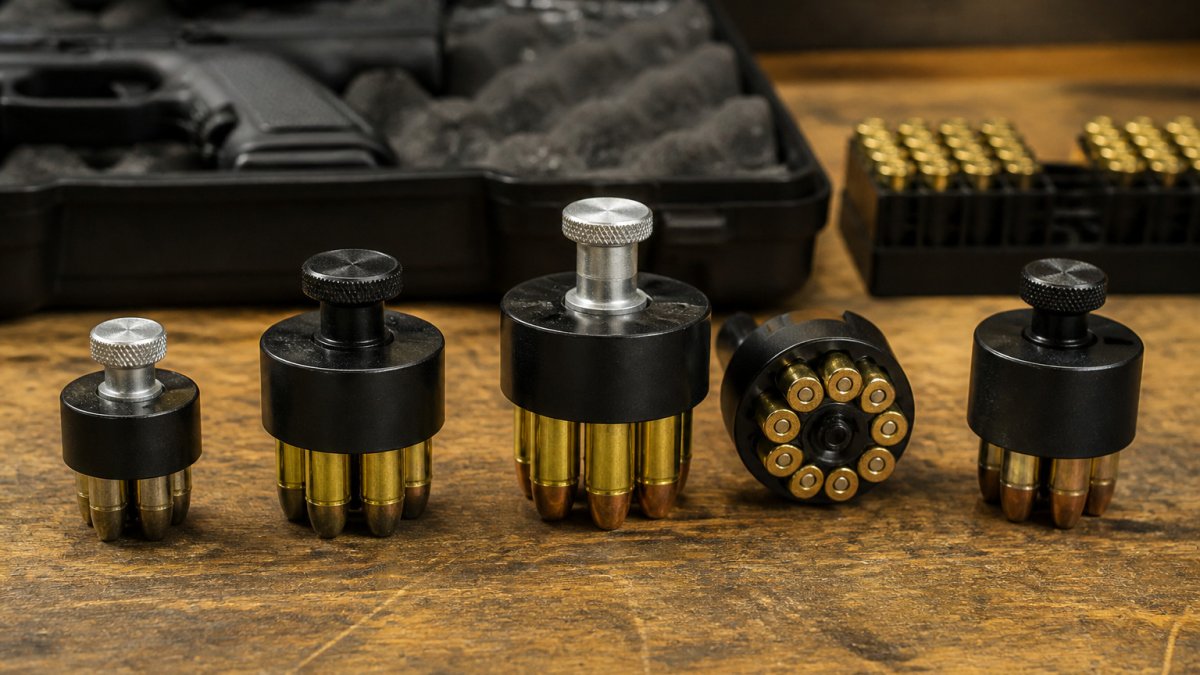
HKS speed loaders are the reference point for revolver reloads: widely available for decades, with a twist-knob release most shooters have handled at least once.
Their limitation is bulk. The knob-and-body design stands proud in a pocket, so HKS loaders suit belt pouches and range bags better than deep concealment.
Watch out: a worn or dirty HKS body can release rounds early in your pocket, so inspect the retention star and keep the device clean.
Speed Loader vs. Speed Strip: Carry, Concealment, and Reload Speed
The speed loader vs. speed strip decision comes down to a straight trade: speed loaders reload the whole cylinder in one motion but carry bulky, while speed strips lie flat and conceal easily but feed rounds two at a time.
What most comparisons skip is that the trade is not fixed, it changes with the carry setup and the shooter's hands.
Carry setup comparison
| Carry setup | Speed strip | Compact speedloader | Full-size speedloader |
|---|---|---|---|
| Front pocket | Best, lies flat, prints little | Marginal, bulges and prints | Poor, too bulky |
| Back pocket or wallet holster | Good, flat and quiet | Poor, sits awkwardly | Poor |
| Belt pouch | Good, low profile | Best, fast access, protected | Good, fast but bulky |
| Jacket pocket | Good | Good | Fair, heavy and prints |
| Ankle rig | Fair, flat but slow to reach | Poor, bulk and weight | Poor |
| Off-body bag | Good | Good | Good, bulk is not a concern |
| Nightstand or home defense | Fair | Good | Best, fastest grab and reload |
Three patterns stand out. First, the front pocket is the speed strip's home turf; almost nothing else conceals as flat or draws as quietly. Second, the belt pouch is where a compact speedloader earns its keep, because the pouch protects the loader and puts it where your hand already goes. Third, the full-size loader is a home-defense and range tool, the fastest reload, but not a concealed-carry device for most people.
Bulletproof Speed-Loader COMBAT Model →
How hand size and dexterity change the answer
Fine-motor demands matter more than most guides admit. A speed strip asks you to peel two rounds at a time and index them into chambers, a sequence that rewards feel and finger strength. A speedloader asks for one gross motion, align and release, easier under stress but demanding enough hand span to grip the body and work the release.
- Small hands: a compact speedloader is often easier than a full-size one because the body is shorter and the release is closer to the palm. A speed strip can be harder than expected because peeling rounds requires fingertip strength.
- Large hands: a full-size loader is comfortable, but a compact loader can feel cramped and slow to release. Test before you commit.
- Reduced grip strength or arthritis: the gross-motion speedloader usually wins, provided the release is not stiff. A light, positive release beats a faster design you cannot actuate.
The self-defense verdict
For self-defense, carry method and hand decide the winner, not raw speed:
- Pocket carry or deep concealment: speed strip wins on concealment and comfort.
- Belt pouch or jacket pocket: a compact speedloader wins on reload speed.
- Home defense: a full-size speedloader wins, since bulk does not matter on a nightstand.
If you carry a revolver for concealed carry, our guide to reloading a revolver for concealed carry walks through the draw, index, and insertion steps that make either device work under pressure. For a model-by-model efficiency comparison, see comparing tactical speed loader models for efficiency.
Watch out: a speed strip that lives loose in a pocket can shed rounds or collect lint in the case mouths, carry it in a dedicated strip pouch or a pocket that holds nothing else, and inspect it before you rely on it.
9mm Magazine Speed Loader Options for Pistol Carriers
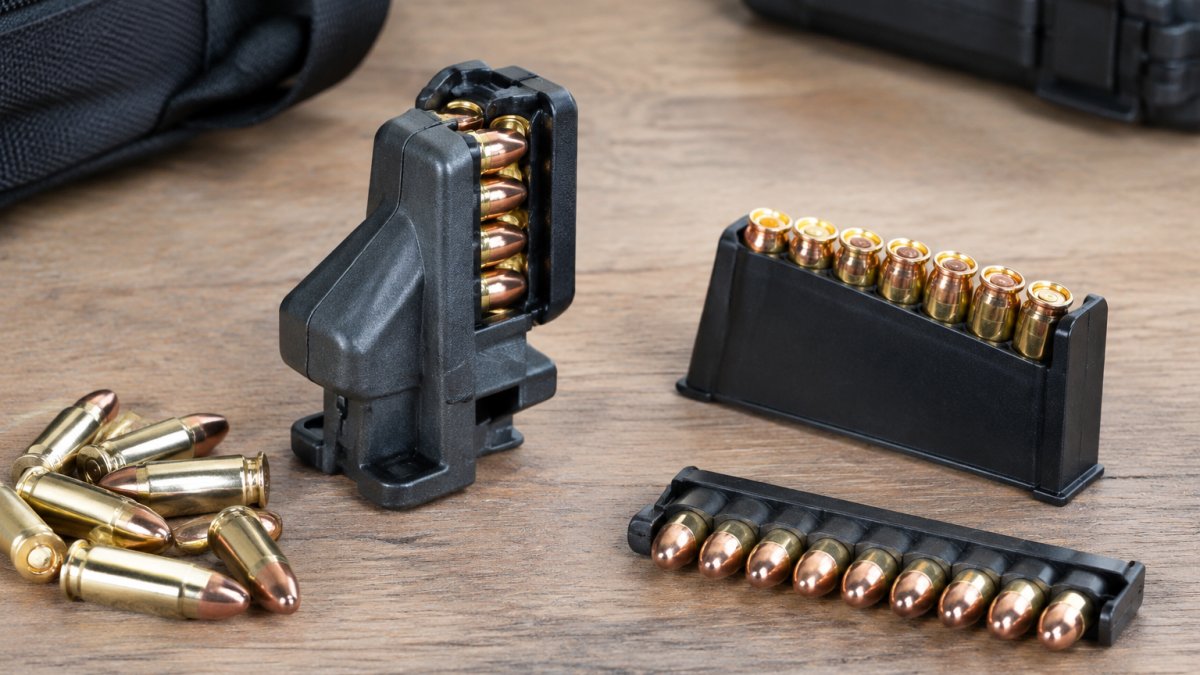
A 9mm magazine speed loader solves a different problem: compressing stiff magazine springs so rounds seat without thumb pain. These devices hold the magazine upright and let you push each round down and back with a lever or feed ramp. Pew Pew Tactical's hands-on magazine loader test names several popular loaders and highlights how much easier they make high-capacity magazines.
Fit is the whole game here. A loader built for double-stack 9mm magazines may struggle with single-stack bodies or larger calibers. Check the model list before buying. Our Bulletproof Pistol Speed Loader fits Glock 17 through 47 models in 9mm and .40 S&W, plus many Sig, Springfield, Ruger, CZ, and Beretta magazines.

Bulletproof Speed Loaders: Combat, Tactical, and EZ-MAG Compared
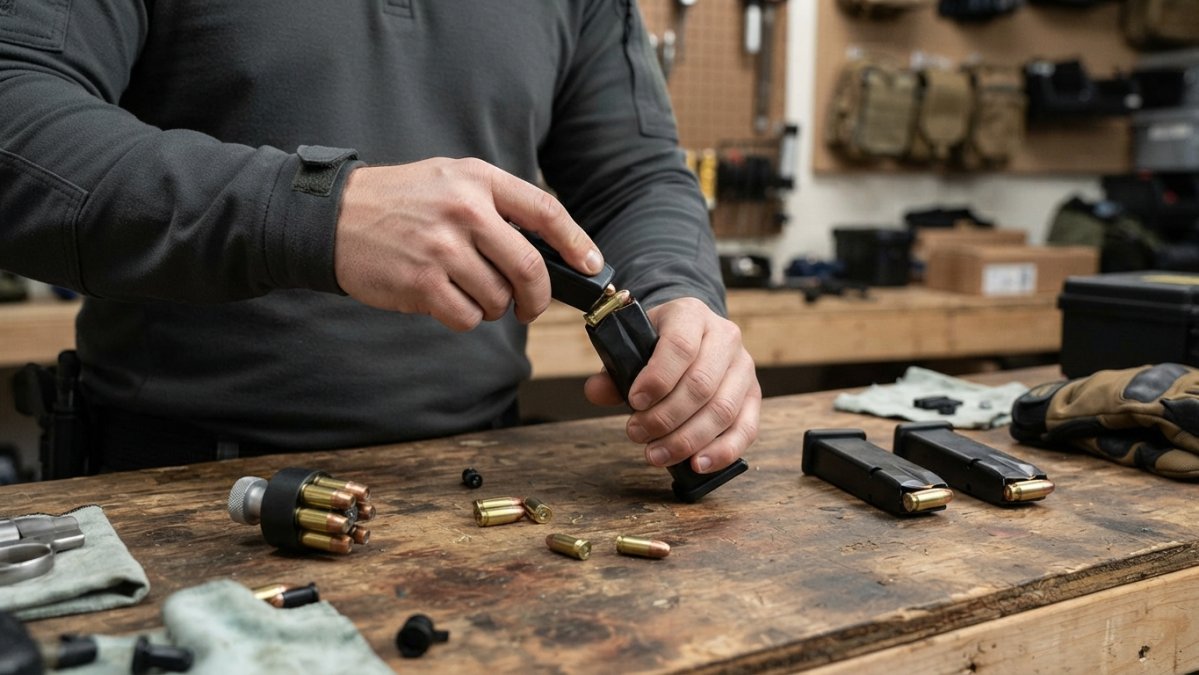
Our three loaders cover three distinct jobs, so the right pick depends on what you carry and how hard you run it. Here is how they compare on price and construction.
| Model | Price | Build | Best For |
|---|---|---|---|
| COMBAT Model | $69.95 | Durable polymer | Range trips and everyday carry |
| TACTICAL Model | $89.95 | Polymer with anodized aluminum lever, mag release, and catch | Hard use and hostile conditions |
| Pistol Speed Loader (EZ-MAG) | $34.95 | Heat- and scratch-resistant polymer | Pistol magazine loading |
The COMBAT Model is a compact, easy-to-carry loader made from durable polymer, suited to everyday trips to the range.

The Pistol Speed Loader carries our lifetime Repair, Replace, Refund warranty with US-based customer support available 24/7.
Match Your Speed Loader to Your Carry Setup
Match the device to the way you actually carry. A pocket-carried revolver pairs with a speed strip or compact loader.
Then train the reload until it is automatic. Dry practice with snap caps builds the index and insertion motion without live ammunition, and it costs nothing.
For pistol carriers, the Bulletproof Pistol Speed Loader is built for a wide range of magazines. Revolver shooters should confirm cylinder fit before ordering anything.
Frequently Asked Questions
What should you look for when comparing speed loaders for self-defense?
Prioritize retention, release speed, and carry bulk over range-only convenience. A self-defense loader has to hold cartridges securely in a pocket or pouch, release them cleanly into the cylinder or magazine without fumbling, and survive being carried daily. Check compatibility with your exact model and caliber, then test it under stress with dummy rounds. The best speed loaders for revolvers balance all three traits rather than winning on one.
Are speed loaders or speed strips better for revolver reloads?
Speed loaders release all rounds into the cylinder at once, which makes them faster, but they are bulkier and harder to conceal. Speed strips lie flat in a pocket and carry more comfortably, yet you load two rounds at a time. For concealed carry, many shooters pair a compact speed strip with a speedloader as backup. The right answer depends on whether your priority is reload speed or daily concealability.
What is the difference between a magazine loader and a revolver speed loader?
A magazine loader compresses a pistol magazine spring so you can push rounds in without thumb fatigue, while a revolver speed loader holds revolver cartridges and drops them into the cylinder. They solve different problems. A 9mm magazine speed loader such as the Bulletproof Pistol Speed Loader fits Glock 17, 19, 26, and similar double-stack magazines. A revolver speed loader is model and caliber specific, so fit matters more.
Which speed loaders work with 9mm magazines?
The Bulletproof Pistol Speed Loader lists compatibility with Glock 17, 18, 19, 22, 23, 24, 26, 27, 34, 35, 45, and 47 in 9mm and .40 S&W, plus Sig P229, P320, P365, Hellcat, Springfield XD, Ruger SR9, CZ P10, and Beretta 92 magazines. It does not work well with most Canik or H&K models. Always confirm your magazine fits before relying on a loader for carry or competition.
How can you check whether a speed loader fits your firearm?
Match the loader to your exact model and caliber first, then test with dummy rounds before live ammunition. Insert a loaded magazine or cylinder and confirm the loader seats fully, releases smoothly, and does not bind. For pistols, check that the loader contacts the follower and not the feed lips. For revolvers, verify the cartridge spacing matches your cylinder. A loader that fits one model often fails on a near-identical variant.
The gear is only half the reload. The other half is repetition under realistic conditions, with a device that fits your gun and your pocket. BULLETPROOF SPEED LOADERS builds combat-ready loaders with durable polymer construction, a lifetime Repair, Replace, Refund warranty, and US-based support, so your equipment holds up when it counts. Get started with BULLETPROOF SPEED LOADERS and carry a reload you can trust.