 ultimate-guide
Best Concealed Carry Drills for Beginners: 2026 Guide
Table of Contents
- Why Dry Fire Practice for Beginners Builds Real Skill
- Concealed Carry Draw Stroke Technique: The 5-Step Process
- 5 Best Concealed Carry Drills for Beginners at the Range
- Concealed Carry Range Training Plan: A 4-Week Progression
- Gear Essentials for Beginner Concealed Carry Drills
- Mental Preparation and Situational Awareness for Beginners
- Troubleshooting: When Your Drills Stop Improving
- Conclusion: Your First 30 Days of Concealed Carry Drills
- Frequently Asked Questions
Last Updated: September 11, 2026
Why Dry Fire Practice for Beginners Builds Real Skill
The single most effective concealed carry drill costs nothing and happens in your living room. Dry fire practice, the act of manipulating and firing a handgun without live ammunition, is how beginners build the muscle memory that live fire alone can't deliver. At BULLETPROOF SPEED LOADERS, we've watched shooters plateau for months because they only trained with live rounds, then break through within weeks of adding a consistent dry fire routine.
Dry fire practice for beginners is the foundation of every other skill you'll develop, including draw stroke, trigger press, and sight alignment. You can run hundreds of repetitions in fifteen minutes without spending a dollar on ammunition or driving to a range.
Setting Up a Safe Dry Fire Routine at Home
Safety comes first, every session. A common mistake is treating dry fire casually because no live ammunition is involved. That's how negligent discharges happen.
- Clear the firearm and verify it's empty, twice
- Remove all live ammunition from the room, not just the gun
- Choose a backstop that would stop a bullet anyway
- Designate one room for dry fire and never load a gun there
Three Dry Fire Drills to Start Tonight
- Wall Drill: Face a blank wall, press the trigger slowly, and watch for front sight movement. Ten perfect reps beat fifty sloppy ones.
- Draw to First Shot: From concealment, draw and dry fire at a small target. Build speed only after accuracy holds.
- Tactical Reload Rep: Swap magazines smoothly without looking down. This is where a speed loader pays for itself in saved thumb fatigue.
Concealed Carry Draw Stroke Technique: The 5-Step Process
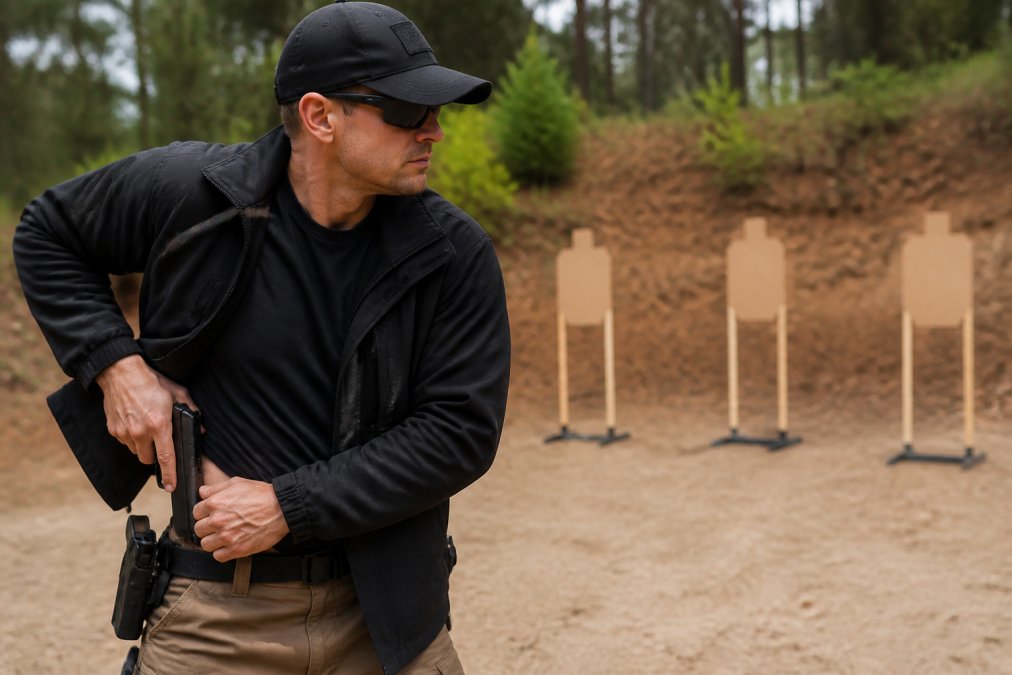
The draw stroke is a five-step sequence: grip, clear the garment, rotate the muzzle toward the target, join the hands at center chest, and press out to a firing position. Each step should be distinct, not blended into one rushed motion.

Beginners who skip steps under stress tend to flag their own body or miss the first shot entirely. Slow is smooth, and smooth becomes fast.
Common Draw Stroke Mistakes Beginners Make
The most frequent error is grabbing the gun before clearing the concealment garment cleanly, which causes a snag mid-draw. The second is pressing out with the support hand too early, which costs first shot accuracy.
- Looking down at the holster instead of the target
- Death-gripping during the draw, which kills trigger control
- Practicing only from an open holster, never from concealment
5 Best Concealed Carry Drills for Beginners at the Range
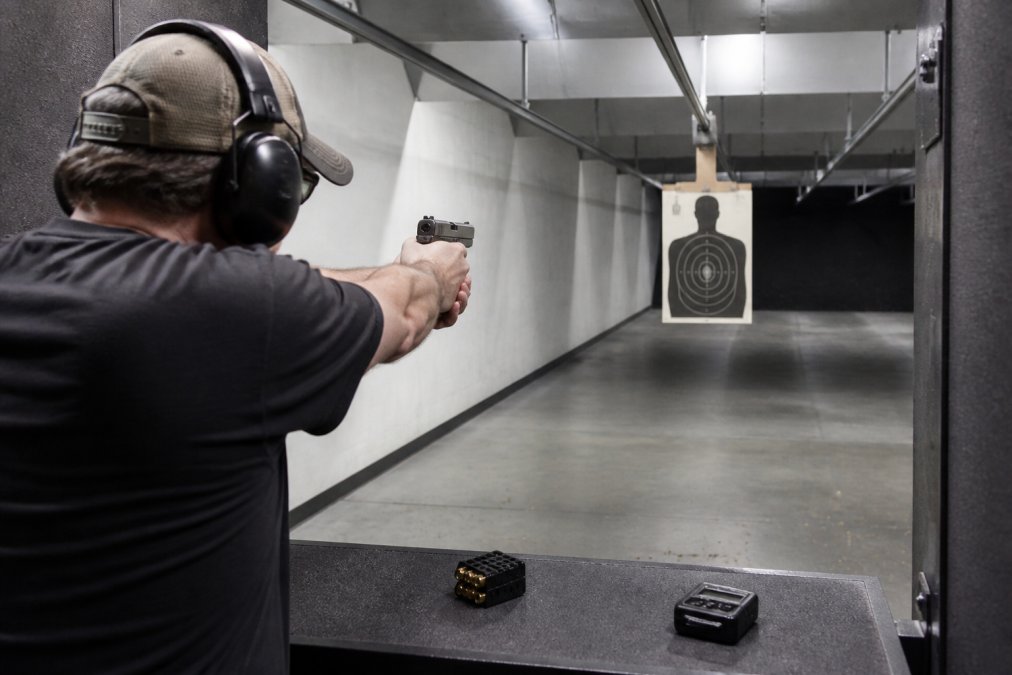
The best concealed carry drills for beginners combine a clear objective, a measurable standard, and a shot timer. Without a timer, you're guessing. With one, you get data you can actually improve against.
Drill 1: The 5-Yard Dot Torture
The dot torture drill uses ten small circles on one target, each with a specific instruction. You shoot slowly, aiming for clean hits, not speed. It exposes grip consistency and trigger press flaws fast.
Drill 2: Controlled Pairs and Failure to Stop
Fire two rounds to center mass, then one to the head, all under par time. This builds recoil management and follow-through. Start at three yards and move back only when you're clean.
Drill 3: Emergency Reload Under Par Time
Empty a magazine, reload, and re-engage. Beginners lose whole seconds fumbling magazines. A speed loader makes range prep faster so you spend more time shooting and less time thumbing rounds.
| Drill | Distance | Rounds | Focus |
|---|---|---|---|
| Dot Torture | 5 yards | 50 | Trigger control |
| Failure to Stop | 3-7 yards | 30 | Recoil control |
| Emergency Reload | 5 yards | 20 | Reload speed |
Concealed Carry Range Training Plan: A 4-Week Progression
A concealed carry range training plan should move from static accuracy to dynamic shooting in measurable steps. Most beginners try to do everything at once and master nothing. The plan below is built around two weekly touchpoints: short daily dry fire at home (10-15 minutes) and one live-fire range session per week (roughly 60-90 minutes, 100-150 rounds). That keeps weekly round counts realistic at a time when factory 9mm commonly runs well north of a quarter per round, so you are not burning a case to learn a draw stroke (ammunitiontogo.com).
The structure follows a simple rule: earn the next skill with a measurable standard before adding speed or complexity. Each week lists a home block, a range block, and a pass/fail standard you can check with a shot timer or a phone timer app.
Week 1, Grip, Trigger, and Sight Picture (Static Only)
- Home (daily, 10 min): 25 wall-drill presses, 25 slow trigger presses on a small pasted dot, 10 presentations from the holster with no shot. No timer yet.
- Range (100 rounds): Dot Torture at 5 yards, then 20 slow-fire five-round groups at 7 yards on a 3x5 card.
- Standard to pass: All 50 Dot Torture hits inside the circles, and five consecutive five-round groups that stay on the card at 7 yards. If you cannot hold the card, stay here another week, do not advance.
Week 2, Draw Stroke From Concealment
- Home (daily, 12 min): 30 dry draws from your actual carry holster and cover garment, breaking the stroke into the five steps. Add 10 dry draws to a first-shot press.
- Range (120 rounds): 30 live draws to a single shot at 5 yards, then 20 controlled pairs at 5 yards.
- Standard to pass: First shot on a paper plate at 5 yards, from concealment, in under 2.0 seconds, clean, on 8 of 10 reps (PubMed). Most beginners land in the 2.5-3.5 second range on day one; 2.0 seconds is a reasonable four-week target, not a week-two guarantee.
Week 3, Reloads and Transitions
- Home (daily, 12 min): 20 emergency reloads (empty gun, magazine on the belt), 20 tactical reloads, 15 dry transitions between two targets.
- Range (150 rounds): Emergency reload under par, then failure-to-stop (two to the body, one to the head) at 5 and 7 yards.
- Standard to pass: Emergency reload from slide lock to first shot in under 3.0 seconds, and failure-to-stop strings clean at 7 yards under 2.5 seconds. Track every rep on a timer; if you cannot beat par, slow down rather than spray.
Week 4, Movement and Decision-Making
- Home (daily, 10 min): Dry draws while stepping laterally, plus 10 dry "scan and holster" reps, draw, press, then scan left and right before reholstering.
- Range (150 rounds): Two-step lateral movement into a controlled pair, then a failure-to-stop, then a reload and re-engage. Finish with 20 rounds of slow-fire accuracy to confirm fundamentals did not degrade under speed.
- Standard to pass: Movement string clean at 7 yards, no rounds outside the A-zone or the 8-inch circle, and no accuracy regression on the closing slow-fire block.
How to Log Each Session
Keep a one-page log with four columns: date, drill, par time or group size, and one note on what felt off. Over four weeks you will see which skill is actually lagging instead of guessing. A shot timer, a stack of 3x5 cards, and a notebook cost less than a single extra range trip and will tell you more about your progress than any single session can.
Gear Essentials for Beginner Concealed Carry Drills
Reliable gear removes variables so you can focus on technique. A quality holster, a shot timer, and a dependable speed loader top the list.
The Bulletproof EZ-MAG Pistol Speed Loader loads a magazine in two steps, which saves your thumbs during high-volume range sessions. For daily carry, the [Bulletproof Concealed Carry Tactical Wallet(/products/bulletproof-concealed-carry-tactical-wallet) | speed-loader.com] keeps essentials slim and accessible.
Mental Preparation and Situational Awareness for Beginners
Most guides skip the mental side, and that's a mistake. Threat assessment and situational awareness matter as much as shot placement. Train yourself to scan exits, maintain defensive posture, and recognize when to disengage rather than draw.
Troubleshooting: When Your Drills Stop Improving
Most guides tell you to "practice more" when progress stalls. That advice is useless because plateaus almost always have a specific, diagnosable cause. Use the symptom-to-fix table below before you add another drill or another hundred rounds. The goal is to change one variable at a time and confirm the fix with a timer or a target, not to feel like you are improving.
Symptom-to-Fix Diagnostic
| Symptom | Likely Cause | Fix to Try First |
|---|---|---|
| Groups open up low and left (right-handed) | Anticipating recoil / flinch | 10 slow wall-drill presses, then 10 ball-and-dummy reps at the range |
| First shot from the draw is a miss, later shots are fine | Rushing the press-out, support hand arriving late | Slow the draw to 50% speed for 20 reps, then rebuild to par |
| Hits drift as you speed up | Outrunning your sight picture | Reset the timer to your last clean par and hold it for a full session |
| Reloads feel fumbled under time | Looking at the magwell, weak index on the magazine | 20 dry reloads per day with eyes on the target, magazine indexed on the belt |
| Accuracy is fine in dry fire, falls apart live | Grip pressure changes under recoil | Confirm grip pressure in dry fire, then live-fire 5-round groups at 7 yards until they match |
| Everything feels flat for two or more sessions | Fatigue, or the same drill too long | Take 3-4 days off, then change one drill and re-baseline with a timer |
The Three Root Causes Behind Almost Every Plateau
- A flinch you cannot feel. Beginners rarely notice a flinch in live fire because the recoil masks it (peer-reviewed research). Dry fire exposes it, and a ball-and-dummy drill at the range confirms it. If the muzzle dips when the dummy chamber comes up, that is your answer.
- A par time you have outgrown, or never earned. If you have been shooting the same drill at the same par for weeks, you are rehearsing, not training. Move the par down by 0.2 seconds only after three consecutive clean sessions. If you never hit par clean, drop the par and rebuild.
- Skipped dry fire. This is the most common cause and the easiest to fix. A shooter who dry fires 10 minutes a day and live fires once a week will usually out-progress a shooter who only live fires twice a week, because dry fire lets you isolate the draw, the press, and the reload without recoil or cost.
How to Isolate a Problem in One Session
Change exactly one variable per session and log the result. If you change your grip, your par time, and your drill all at once, you will not know which one helped. A simple isolation session looks like this:
- Warm up with 10 slow dry presses.
- Run the suspect drill at your current par for 10 reps and record the result.
- Change one thing, grip pressure, draw speed, or target size.
- Run 10 more reps and compare.
- Keep the change only if the timer or the target confirms it.
Conclusion: Your First 30 Days of Concealed Carry Drills
Building real skill takes consistency, not intensity. Dry fire daily, live fire weekly, and track every session. When you're ready to make range prep faster and easier, BULLETPROOF SPEED LOADERS builds combat-ready gear designed for shooters who train seriously. Get started with BULLETPROOF SPEED LOADERS and load faster, train longer, and shoot better.
Frequently Asked Questions
What is the 333 rule for concealed carry training?
The 333 rule suggests practicing at 3 yards, 3 rounds, 3 times per session. It is a simple way for beginners to build consistency without overwhelming themselves. The short distance lets you focus on draw stroke and trigger press rather than sight alignment at distance. Many instructors use it as a warm-up before moving to longer drills. Pair it with dry fire practice for beginners to reinforce the same motor pattern without live ammunition.
How often should a beginner practice concealed carry drills?
Aim for 10 to 15 minutes of dry fire practice five days a week, plus one live-fire range session every two weeks. Consistency matters more than volume. Short daily repetitions build muscle memory faster than one long weekend session. Track your par times with a shot timer to measure progress.
What gear do I need to start practicing concealed carry drills?
You need a quality holster that covers the trigger guard, a sturdy belt, snap caps for dry fire, a shot timer or phone app, and a speed loader to save your thumbs during high-volume range sessions. The Bulletproof EZ-MAG Pistol Speed Loader ($34.95) loads magazines in two steps. A compact range bag or tactical wallet keeps essentials organized. Eye and ear protection are mandatory at any live-fire session.
How do I safely practice drawing from a holster at the range?
Start with dry fire at home until your draw stroke is automatic. At the range, confirm your firearm is loaded, keep your finger off the trigger until the sights are on target, and follow all range safety rules. Use a holster that stays open when you draw. Never rush. If your range does not allow drawing from concealment, practice the motion with an unloaded firearm in a designated safe area. Muzzle discipline is non-negotiable.