 ultimate-guide
Concealed Carry Reciprocity by State: Legal Requirements
Table of Contents
- How Concealed Carry Reciprocity Works
- How to Check CCW Reciprocity Before You Travel
- Constitutional Carry States List (2026 Update)
- Best Practices for Concealed Carry Travel
- State-by-State Reciprocity Comparison Table
- Common Mistakes That Create Legal Risk
- Frequently Asked Questions
Last Updated: September 12, 2026
How Concealed Carry Reciprocity Works
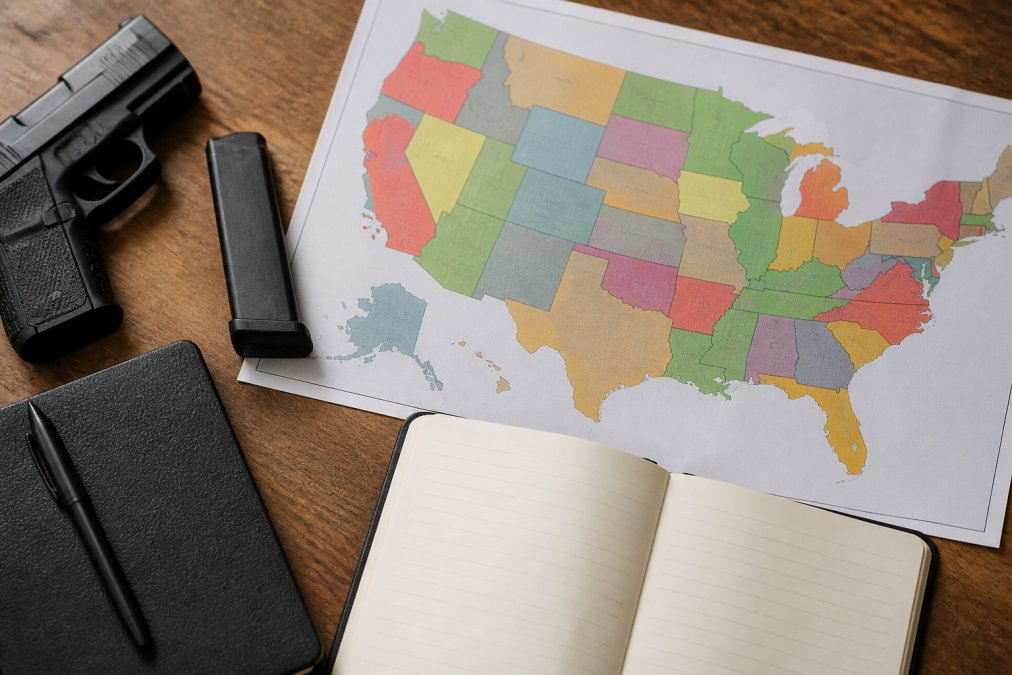
Concealed carry reciprocity is the legal principle that lets a valid handgun license from one state be recognized by another. It does not create a national license. Each state decides, through its own statutes, which out-of-state permits it will honor and under what conditions. This guide from BULLETPROOF SPEED LOADERS breaks down the legal requirements for concealed carry reciprocity by state so you can plan a trip without guessing.

The system runs on two mechanisms: statutory recognition and unilateral agreements. Understanding which one applies to your permit is the difference between a lawful stop and a criminal charge.
Statutory Recognition vs. Unilateral Agreements
Statutory recognition occurs when a state writes into law that it will honor any valid out-of-state concealed weapon license, sometimes with conditions such as minimum age or a training requirement. Unilateral recognition is when one state honors another's permit without the other state returning the favor.
Bilateral agreements, by contrast, are formal compacts between two states that recognize each other's licenses. Most maps you see online blend all three into a single "honored" list, which is why they frequently disagree. Check the official state statutes via the ATF state laws and published ordinances guide rather than a third-party app when the stakes are legal.
How to Check CCW Reciprocity Before You Travel
The fastest reliable method is to go straight to the issuing authority. Every state attorney general or state police agency publishes its own reciprocity list, and that list is the one a prosecutor will use.
Use this sequence:
- Identify your permit's issuing state and license type.
- Open the destination state's attorney general or state police reciprocity page.
- Confirm your specific license is named, not just your home state.
- Note any restrictions, such as "resident permits only."
- Screenshot the page with the date visible before you leave.
Using State Attorney General and Official Resources
A common mistake is trusting a reciprocity app built from outdated data. Statutes change mid-year, and apps lag. The USA.gov state government directory links to each state's official site, which is where the current statute citation lives. If a state page is unclear, call the state police licensing division directly and ask whether your non-resident permit is valid within its borders.
Constitutional Carry States List (2026 Update)
Permitless carry, often called constitutional carry, means an eligible adult may carry a concealed handgun without a government-issued license. It is the single fastest-moving area of carry law, and it is also the area where travelers most often misread their own eligibility.
The Two Questions That Decide Your Eligibility
Every permitless carry statute answers two separate questions, and they are not the same question:
- Who may carry without a permit? Most permitless statutes extend eligibility only to that state's own residents. A visitor from another state generally cannot rely on the host state's permitless law and must instead hold a permit the host state recognizes.
- What does the state still prohibit? Permitless carry removes the license requirement. It does not remove age thresholds, prohibited-person categories, or location bans. Federal prohibitions under 18 U.S.C. § 922(g) apply regardless of state law.
A common pattern is a state that grants permitless carry to its residents while continuing to honor out-of-state permits under a separate recognition statute. That means a visitor's lawful path is usually the recognition statute, not the permitless statute.
Why the List Changes Every Session
Permitless carry has expanded through a steady stream of state legislative sessions rather than a single federal action. Because each state amends its own statute on its own timetable, any published list is a snapshot with an expiration date. Two failure modes recur:
- A state expands permitless carry to non-residents, and older guides still say "residents only."
- A state narrows or conditions its recognition statute, and older guides still list the state as honoring all out-of-state permits.
How to Verify Your State in Under Ten Minutes
- Search the destination state's legislature bill-tracking system for the current session's firearms bills. The federal bill tracking and public law records is useful for federal proposals, but state-level changes live on the state legislature's own site.
- Open the destination state's attorney general or state police firearms page and read the statute citation, not the summary paragraph.
- Confirm whether the permitless provision is written as "residents" or "persons." That single word decides whether it applies to you.
- Check the effective date. Statutes passed in a session frequently take effect months later, so a law signed this year may not govern your trip this year.
The 2026 Tracker Habit
Treat permitless carry as a moving target with a maintenance schedule. Before any multi-state trip, spend ten minutes confirming three things for each state on your route: whether permitless carry exists, whether it applies to non-residents, and whether the state separately recognizes your permit. Record the statute citation and the date you checked it. That record is what turns a guess into a defensible position if you are ever asked to explain your carry authorization.
Best Practices for Concealed Carry Travel
Treat every border crossing as a legal reset. Your carry authorization is only as good as the state you are standing in at that moment, and the rules that applied at home may not follow you.
Vehicle Carry vs. Person Carry: The Distinction Most Guides Skip
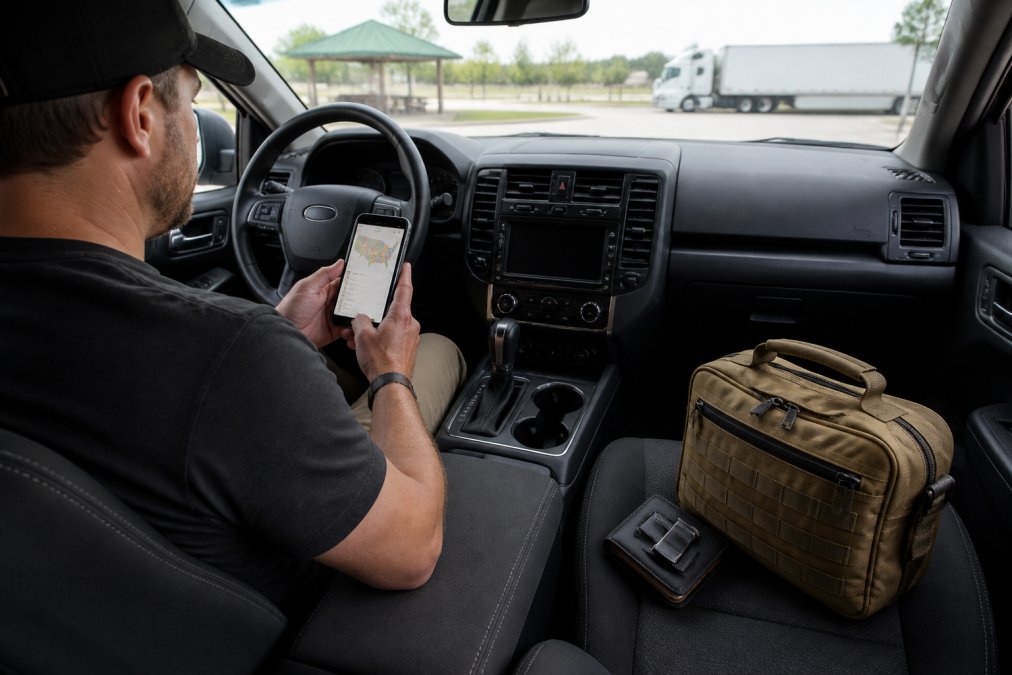
Most reciprocity content answers one question: can I carry here? That question is about person carry. It says nothing about what happens when the handgun is in the vehicle rather than on your body, and those are governed by different rules in most states.
The practical difference is access and condition. Person carry assumes the firearm is on you, concealed, and immediately available. Vehicle carry raises two separate state-law questions: whether the firearm must be unloaded, and whether it must be out of reach or secured in a container.
| Carry Context | What States Typically Regulate | What to Verify Before You Drive |
|---|---|---|
| Person carry (on body) | Whether your permit or permitless eligibility is recognized | The destination's recognition statute names your specific license |
| Vehicle carry (in the cabin) | Loaded status and accessibility; some states treat a loaded handgun in the cabin as concealed carry | Whether the state requires unloaded, cased, or locked storage |
| Vehicle carry (in the trunk) | Generally treated as transport rather than carry | Whether the state defines "trunk" to include a locked container or rear cargo area |
| Transport through a non-recognizing state | Federal transport protection under 18 U.S.C. § 926A | Whether the firearm is unloaded and not readily accessible |
The Federal Transport Protection, and Its Limits
18 U.S.C. § 926A provides a narrow protection: a person who may lawfully possess a firearm at the origin and destination may transport it between those places through an intervening state, provided the firearm is unloaded and neither the firearm nor ammunition is readily accessible from the passenger compartment. In a vehicle without a trunk, the firearm and ammunition must be in a locked container other than the glove box or console.
Three limits matter in practice:
- It protects transport, not carry. It does not authorize you to have the handgun on your person or within reach while driving through a state that does not recognize your permit.
- It requires lawful possession at both ends. If your permit is not valid at the destination, the protection does not apply to that trip.
- It does not override state location bans. A state may still prohibit firearms at specific places you pass through.
A Pre-Trip Routine That Holds Up
Build the same routine for every trip, and run it in this order:
- List every state on your route, including states you only cross.
- For each, confirm whether your permit is recognized and whether permitless carry applies to you as a non-resident.
- For each, confirm the vehicle storage rule: loaded or unloaded, accessible or secured.
- Confirm the destination's duty-to-inform requirement before any traffic stop.
- Store a printed copy of each state's relevant statute in the glovebox and a photo of it on your phone.
What Changes When You Cross Into a Non-Recognizing State
The moment you enter a state that does not recognize your permit, your person carry authorization ends. At that point you have two lawful options: stop carrying on your person and store the firearm under the transport rules, or avoid the state entirely. What you should not do is assume the permit that worked in the previous state continues to work in the next one. The border is the reset, and the vehicle storage rule is what carries you through.
State-by-State Reciprocity Comparison Table
Reciprocity status is not a yes-or-no field. The table below shows how the categories differ, so you can read any state's page correctly.
| Recognition Type | What It Means | What to Verify |
|---|---|---|
| Full statutory recognition | State honors all valid out-of-state permits | Age and training conditions |
| Resident-only recognition | Honors permits only from residents of the issuing state | Your state residency |
| Unilateral recognition | State honors others without return recognition | Whether your permit is named |
| No recognition | State does not honor out-of-state permits | Alternate transport rules |
Use this framework against the destination state's official list. If your permit falls under a category the state does not honor, assume it is not valid there.
Common Mistakes That Create Legal Risk
The mistakes that generate charges are predictable, and nearly all of them come from treating reciprocity as a national system rather than a state-by-state patchwork.
- Assuming your permit works everywhere because it works in most places.
- Confusing permitless carry eligibility for residents with visitor eligibility.
- Carrying in a state that recognizes your permit but ignoring that state's location restrictions.
- Failing to inform an officer when the state requires it.
- Leaving a loaded firearm accessible in the vehicle while passing through a non-reciprocal state.
For daily carriers, keeping your gear organized matters as much as knowing the law. A compact, durable option like the Bulletproof Concealed Carry Tactical Wallet keeps your permit and ID accessible without bulk, so you are not fumbling at a traffic stop.
Reciprocity law rewards preparation and punishes assumptions. Before your next trip, verify your permit against the destination state's own statutes, confirm your transport rules, and carry documentation you can produce on demand. BULLETPROOF SPEED LOADERS builds the tactical gear that keeps permit holders organized and ready, from the EZ-MAG pistol speed loader to our minimalist concealed carry wallet. Get started with BULLETPROOF SPEED LOADERS and carry with confidence, knowing your gear is as reliable as your preparation.
Frequently Asked Questions
What state has the most reciprocity for concealed carry?
States like Florida, Utah, and Arizona consistently issue permits with the broadest acceptance. A Florida non-resident permit is recognized by roughly 35 states, while Utah covers about 35 to 38. However, no single permit covers all 50 states. States like California, Oregon, Illinois, and several Northeast states do not recognize out-of-state permits, so you will need to research each state on your route.
Is there a CCW that covers all 50 states?
No. There is no concealed carry permit that is valid in all 50 states. Federal legislation has been proposed to create national reciprocity, but as of 2026 no such law has passed. The closest approach is holding multiple non-resident permits (for example, Florida and Utah) to maximize coverage, but you must still verify each state's rules before traveling.
How do I check if my concealed carry permit is valid in another state?
Start with your issuing state's official website, which usually publishes a reciprocity list. Then check the destination state's attorney general or state police website for their list of accepted permits. Use a reputable reciprocity map app for quick reference, but always confirm with the state's official source because laws change. Pay attention to whether the state recognizes resident permits only or also non-resident permits.
What happens if I carry a concealed weapon in a non-reciprocal state?
Carrying in a state that does not recognize your permit can lead to misdemeanor or felony charges, fines, and potential jail time. Penalties vary widely. Some states offer a brief grace period for travelers passing through, but most do not. If you are unsure, store your firearm unloaded and locked in a case in your vehicle's trunk, following federal transportation guidelines, until you reach a state where your permit is valid.