 how-to
Exercises to Reduce Hand Fatigue From Shooting
Table of Contents
- Understanding Hand Fatigue at the Shooting Range
- Grip Strength Exercises for Shooters
- Hand and Forearm Exercises for Shooting
- Hand Stretches for Shooters
- A Complete Weekly Routine to Reduce Hand Fatigue
- Common Mistakes to Avoid
- Frequently Asked Questions
Last Updated: October 10, 2026
Understanding Hand Fatigue at the Shooting Range
Hand fatigue weakens your grip, degrades trigger control, and reduces accuracy. This guide from BULLETPROOF SPEED LOADERS covers exercises to reduce hand fatigue from shooting so you can train longer and shoot better.
What Causes Hand Fatigue When Shooting
Hand fatigue occurs when grip muscles work harder than they're conditioned for. Repeated contractions accumulate metabolic waste and deplete energy stores, degrading your ability to maintain consistent grip pressure.
Gripping too tightly, poor wrist alignment, and high-capacity magazine loading all accelerate fatigue. New shooters or those returning after time away lack adapted hand strength.
Warning Signs You Need to Rest
Watch for trembling hands, inability to control the trigger smoothly, forearm or wrist pain, loss of grip strength, and shot drift, all signs you've pushed too hard.
Heed these signals: pushing through fatigue increases injury risk and builds poor habits. Rest prevents overuse injuries.
Grip Strength Exercises for Shooters
Stronger hands maintain consistent pressure longer and recover faster. These exercises target the muscles you use most when holding and firing a pistol.
Farmer's Carry and Dead Hangs
Farmer's carries build grip endurance: hold heavy weights and walk for distance, starting with 30-40 seconds. Dead hangs work fingers and forearms: hang from a bar with straight arms, starting at 10-15 seconds. Both are low-skill and effective; add them twice weekly.
Resistance Band Work
Resistance bands isolate the muscles that tire fastest during shooting. Loop a band around your fingers and practice opening your hand against resistance: three sets of 15 reps per hand, twice weekly. Wrist flexion and extension with bands prevent wrist pain from sustained shooting.
Progressive Training Schedule
Start light and increase intensity 10-15% every two weeks to prevent overuse injuries. Track progress and add weight or resistance when you hit target durations; progressive overload forces adaptation.
Hand and Forearm Exercises for Shooting
Your forearms contain muscles that directly control trigger finger movement and grip stability. Strengthening these muscles improves your shooting mechanics and reduces fatigue during long sessions.
Wrist Curls and Reverse Curls
Wrist curls isolate forearm muscles; reverse curls target the opposite side. Perform three sets of 12-15 reps with light weights, focusing on controlled movement. Results appear within 2-3 weeks.
Finger Isolation Drills
Finger isolation drills build trigger control: loop a rubber band around each finger and lift against resistance, 15 reps per finger, three times weekly. Better finger control reduces overall grip fatigue.
Hand Stretches for Shooters
Stretching improves recovery and prevents stiffness. Flexible muscles fatigue slower than tight ones. Stretch before and after every shooting session.
Pre-Range and Post-Range Stretching
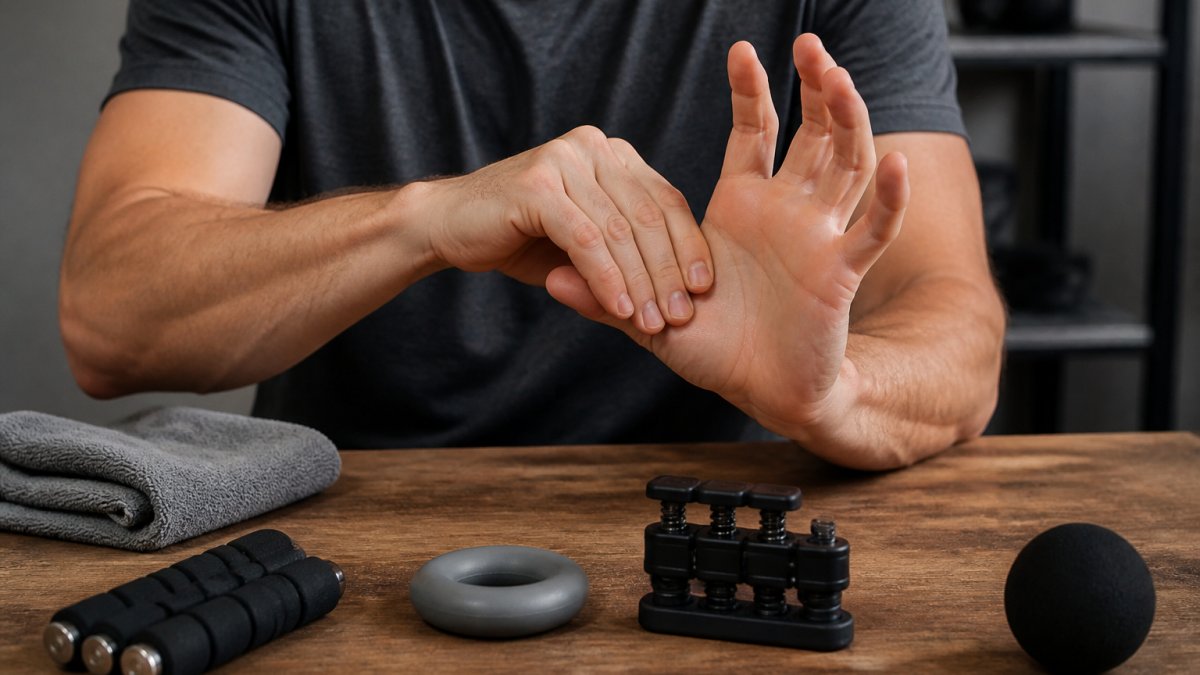
Before shooting: wrist circles (10 each direction) and finger spreads (5 seconds). After shooting: hold wrist, forearm, and palm-against-wall stretches for 20-30 seconds each to remove metabolic waste and reduce soreness.
Recovery Stretches Between Shooting Sessions
On non-shooting days, dedicate 5 minutes to stretching: wrist flexion, extension, and forearm stretches held 30 seconds each.
A Complete Weekly Routine to Reduce Hand Fatigue
This progressive program balances strength, endurance, recovery, and shooting practice for shooters training 2-3 times weekly. Adjust for higher volume by reducing intensity and adding rest days.
Program Structure and Progression
This 4-week cycle builds grip and forearm strength, then increases endurance. Weeks 1-2 focus on proper form with lighter weights; Weeks 3-4 increase intensity by 10-15%. After 4 weeks, repeat with 10-15% more weight or longer hold times.
Daily Warm-Up (All Training Days)
Warm-up (3-5 minutes): wrist circles (10 each direction), finger flexion/extension (10 reps), gentle wrist stretches (5 seconds each, 2 reps), and light grip activation (10 squeezes). This increases blood flow and prepares muscles.
Monday and Thursday: Grip Strength Focus
Farmer's Carries
- Hold a dumbbell or kettlebell in each hand (start with 25-35 lbs per hand; adjust based on your current strength)
- Walk for distance or time: 40 seconds for Week 1-2, 50 seconds for Week 3-4
- Rest 90 seconds between sets
- Perform 3 sets
- Cue: Maintain neutral wrist alignment; do not let your wrist bend backward or forward
Wrist Curls (Palms Up)
- Sit with your forearm resting on a table, hand hanging off the edge, palm facing up
- Hold a dumbbell (start with 5-8 lbs; adjust based on control)
- Curl your wrist upward, pause 1 second, lower slowly
- Perform 3 sets of 12 repetitions
- Rest 60 seconds between sets
- Cue: Move only at the wrist; keep your forearm still
Reverse Wrist Curls (Palms Down)
- Same position as wrist curls, but palm facing down
- Perform 3 sets of 12 repetitions
- Rest 60 seconds between sets
- Cue: Control the lowering phase; do not let gravity drop the weight
Finger Isolation Drills
- Place your hand flat on a table, palm down
- Loop a light resistance band around one finger (start with index finger)
- Lift that finger away from the others against band resistance
- Perform 15 repetitions per finger, one hand only
- Rest 45 seconds, then repeat on the other hand
- Cue: Isolate each finger; do not let other fingers lift
Daily Cool-Down (5 minutes)
- Hold each stretch for 20-30 seconds: wrist flexion, wrist extension, forearm flexion, forearm extension
- Perform 2 repetitions of each stretch
- Finish with 1 minute of gentle hand massage or foam rolling on your forearm
Total session time: 25-30 minutes
Tuesday and Friday: Endurance and Stability
Dead Hangs
- Hang from a pull-up bar with straight arms, feet off the ground
- Hold for maximum time: Week 1-2 target 15-20 seconds per set, Week 3-4 target 25-30 seconds per set
- Rest 2 minutes between sets (longer rest allows nervous system recovery)
- Perform 3 sets
- Cue: Grip firmly but not maximally; maintain shoulder engagement to protect your shoulder joint
- Modification: If you cannot hang, use a resistance band looped over the bar and under your feet for assistance
Resistance Band Finger Work
- Loop a light resistance band around all four fingers (not thumb)
- Open your hand against band resistance, spreading fingers wide
- Perform 3 sets of 15 repetitions
- Rest 60 seconds between sets
- Cue: Move slowly; do not snap your fingers open
Wrist Circles with Light Load (Optional)
- Hold a light dumbbell (2-3 lbs) in one hand, arm extended
- Rotate your wrist in slow circles, 10 clockwise, 10 counterclockwise
- Repeat on other hand
- Perform 2 rounds
Daily Cool-Down (5 minutes)
- Same as Monday/Thursday cool-down
Total session time: 20-25 minutes
Wednesday and Weekend: Active Recovery
Rest days are when your muscles adapt and grow stronger. Do not skip recovery.
Stretching Only (10 minutes)
- Wrist flexion stretch: 30 seconds, 2 repetitions per side
- Wrist extension stretch: 30 seconds, 2 repetitions per side
- Forearm flexor stretch (palm against wall, lean forward): 30 seconds, 2 repetitions per side
- Forearm extensor stretch (back of hand against wall, lean forward): 30 seconds, 2 repetitions per side
- Gentle wrist circles: 10 each direction, 2 rounds
Optional light activity:
- Easy walk, swimming, or yoga (low intensity only)
- Do not perform any grip or forearm strength work
Weekly Schedule at a Glance
| Day | Focus | Key Exercises | Duration | Rest Between Sets |
|---|---|---|---|---|
| Monday | Grip Strength | Farmer's carries, wrist curls, reverse curls, finger drills | 25-30 min | 60-90 sec |
| Tuesday | Endurance | Dead hangs, resistance band finger work, wrist circles | 20-25 min | 2 min (hangs), 60 sec (bands) |
| Wednesday | Recovery | Stretching only | 10 min | N/A |
| Thursday | Grip Strength | Farmer's carries, wrist curls, reverse curls, finger drills | 25-30 min | 60-90 sec |
| Friday | Endurance | Dead hangs, resistance band finger work, wrist circles | 20-25 min | 2 min (hangs), 60 sec (bands) |
| Saturday | Recovery | Light stretching or rest | 5-10 min | N/A |
| Sunday | Recovery | Light stretching or rest | 5-10 min | N/A |
Adjusting for Shooting Volume
If you shoot 3+ times per week or 200+ rounds per session, reduce training intensity:
- Perform grip strength work (Monday/Thursday) only once per week instead of twice
- Reduce sets by 1 (e.g., 2 sets instead of 3) on endurance days
- Add an extra recovery day if you notice persistent soreness or warning signs
If you shoot 1 time per week or fewer than 100 rounds per session, you can maintain this routine or add a third training day focused on grip endurance.
Progression and Tracking
Keep a simple log of your performance:
- Farmer's carries: Record weight and duration per set
- Wrist curls: Record weight and reps
- Dead hangs: Record duration per set
- Resistance band work: Record reps and band color/resistance level
Every 4 weeks, increase weight by 5-10 lbs, duration by 5-10 seconds, or reps by 2-3. Small, consistent increases prevent plateaus and overuse injury.
When to Deload
Every 8-12 weeks, reduce training volume by 40-50% for one week. Deload weeks allow your nervous system and connective tissues to fully recover. During a deload week:
- Perform only 2 sets instead of 3
- Use 50% of your normal weight
- Reduce duration by half
- Continue stretching and warm-ups
After a deload week, you will feel stronger and more resilient.
Common Mistakes to Avoid
Most shooters make preventable errors that cause unnecessary hand fatigue. Understanding these mistakes helps you train smarter.
Overtraining is the biggest mistake. Your hands need recovery time. Training grip muscles more than 3-4 days per week causes overuse injuries. Rest is where adaptation happens. More work doesn't always mean better results.
Gripping too tightly during shooting wastes enormous energy. A controlled, firm grip uses far less muscle effort than a white-knuckle squeeze. Practice relaxing between shots. Your accuracy won't suffer. Your endurance will improve dramatically.
Neglecting stretching creates tight, fatigued muscles. Flexibility prevents fatigue and injury. Ten minutes of daily stretching produces better results than hours of strength work without mobility.
Jumping into heavy training without building a foundation causes injury. Start light. Progress gradually. Your tendons and ligaments adapt slower than your muscles. Rushing this process leads to wrist pain and hand injuries that sideline your training.
Hand fatigue doesn't have to limit your shooting sessions. Consistent training with these exercises builds the grip strength and endurance you need for longer range time. At BULLETPROOF SPEED LOADERS, we understand that serious shooters demand gear that keeps pace with their training intensity. Our EZ-MAG pistol speed loader reduces hand fatigue during reloading by eliminating the need to manually compress magazine springs. Combined with the hand and forearm conditioning in this guide, you'll shoot longer, train harder, and perform better.
Frequently Asked Questions
Why do my hands get tired when shooting?
Hand fatigue from shooting results from sustained grip tension, repetitive trigger control, and the pressure of managing recoil across multiple rounds. Your forearm muscles work continuously to stabilize the weapon and maintain consistent hand placement, while your fingers maintain grip pressure to prevent the gun from shifting. Without adequate conditioning, these muscle groups fatigue quickly. Building grip strength and forearm endurance through targeted exercises reduces this fatigue and helps you shoot longer and more accurately.
What are the best grip strength exercises for shooters?
Farmer's carries, dead hangs, and resistance band exercises are the most effective grip-building drills for shooters. Farmer's carries involve holding heavy weights at your sides and walking; dead hangs mean gripping a pull-up bar for time. Resistance bands let you train individual finger and hand movements specific to shooting mechanics. Start with 2-3 sets of 30-45 seconds per exercise, 2-3 times per week, and gradually increase duration and resistance as your strength improves.
How often should I do hand-strength exercises for shooting?
Perform grip and forearm exercises 3-4 times per week for best results. This schedule allows adequate recovery between sessions while building consistent strength gains. Pair strength work with stretching on off-days to maintain flexibility and prevent stiffness.
Can stretching help prevent hand fatigue at the range?
Yes, stretching is essential for fatigue prevention and recovery. Pre-range stretches prepare your hands and forearms for the demands of shooting, while post-range stretches reduce muscle tightness and soreness. Dynamic stretches before shooting improve blood flow and mobility; static stretches after shooting promote recovery. Consistent stretching also improves grip comfort and reduces the risk of repetitive strain injuries, allowing you to train longer without discomfort.