 ultimate-guide
How to Choose Tactical Speed Loaders: 2026 Guide
Table of Contents
- What Makes a Tactical Speed Loader Worth Your Money
- Speed Loader vs Magazine Loader: Understanding the Difference
- Caliber Compatibility and Magazine Capacity Considerations
- Ergonomics and Thumb Fatigue: Finding Your Fit
- How to Use a Tactical Speed Loader Correctly
- Best 9mm Magazine Speed Loader Options
- Durability, Material Construction, and Long-Term Reliability
- Universal vs Model-Specific Speed Loaders
Last Updated: August 12, 2026
What Makes a Tactical Speed Loader Worth Your Money
A tactical speed loader is a mechanical device that rapidly loads rounds into magazines by applying mechanical advantage to compress springs and position cartridges. Quality differs from budget options in ergonomics, durability, and how well it handles your firearm platform.
A poor speed loader causes hand fatigue, bent feed lips, or jammed rounds. A quality one, like those from Bulletproof Speed Loaders, handles high-capacity magazines, reduces thumb fatigue, and maintains magazine integrity over hundreds of cycles. The real value is the mechanical advantage it provides, compressing springs efficiently, aligning ammunition properly, and distributing force in ways your thumb cannot.

Speed Loader vs Magazine Loader: Understanding the Difference
A speed loader is designed for pistol and rifle magazines, using a lever to compress the magazine spring while you insert rounds one at a time. The mechanical advantage does the heavy lifting, allowing dozens of magazines to load in a session without significant hand fatigue.
A magazine loader typically loads multiple rounds simultaneously using stripper clips or feeding mechanisms. Magazine loaders prioritize speed over ergonomic comfort and are more common in competitive shooting.
For most shooters, a tactical speed loader is better. It's more versatile across calibers, easier to control, and gentler on magazine feed lips. The Bulletproof Speed Loaders EZ-MAG Pistol Speed Loader exemplifies this, engineered for single-round loading with maximum mechanical advantage.
Caliber Compatibility and Magazine Capacity Considerations
Not all speed loaders work with all calibers. A 9mm single-stack magazine has minimal spring tension compared to a .45 ACP high-capacity magazine. A speed loader that works for 9mm might not generate enough mechanical advantage for .45 ACP or .40 S&W.
Before purchasing, verify your specific caliber and magazine model, whether magazines are single-stack or double-stack, maximum capacity you load, and magazine manufacturer. Bulletproof Speed Loaders offers caliber-specific models because this matters. The TACTICAL Model and COMBAT Model handle standard pressure loads across common pistol calibers. The DELTA Model, built from aircraft aluminum, provides mechanical advantage for high-capacity magazines and tougher spring tensions.

Single-Stack vs Double-Stack Magazines
Single-stack magazines arrange rounds in a single column with lower spring tension. Double-stack magazines use a staggered two-column pattern, allowing higher capacity but requiring significantly more mechanical advantage. A 17-round Glock 19 magazine requires substantially more force than a 10-round single-stack.
Many universal speed loaders fail here, optimized for easier single-stack loading and lacking the leverage needed for double-stack magazines. When evaluating a loader for double-stack magazines, look for a longer lever arm, rigid construction, and a secure catch system.
High-Capacity Magazine Loading
High-capacity magazines present the most demanding loading scenario. A fully compressed 30-round AR-15 magazine or 21-round 9mm magazine requires significant force. A poorly designed speed loader will slip, require excessive hand force, or damage feed lips.
The Bulletproof TIER-1 Model, built from solid aircraft aluminum with precision-machined components, provides the mechanical advantage needed for maximum-capacity magazines without flex or failure.
Ergonomics and Thumb Fatigue: Finding Your Fit
Hand fatigue is the silent killer of efficient reloading. After 20 magazines, your thumb is strained. After 50, your hand strength is compromised.
A quality tactical speed loader eliminates thumb fatigue by transferring work from your hand to the mechanical system. Instead of pressing with your thumb, you use a lever. Your hand position is neutral, and force is distributed across your palm rather than concentrated on your thumb joint.
The best speed loaders have ergonomic lever designs that fit naturally in your hand, require minimal grip pressure, and engage smoothly. Test any loader by loading at least 10 magazines, your thumb will tell you whether this is a tool you'll actually use.
Hand Strength and Arthritis Considerations
Shooters with arthritis or limited grip strength face real challenges with standard speed loaders. Look for loaders with longer lever arms, smooth engagement, large easy-to-grip buttons, and designs using multiple fingers rather than thumb pressure alone.
The Bulletproof EZ-MAG Pistol Speed Loader is specifically designed with this consideration. The two-step design minimizes force required per cycle, and the mechanical advantage is optimized for shooters with limited hand pressure.
How to Use a Tactical Speed Loader Correctly
Loading a magazine with a speed loader is straightforward, but technique matters. Poor technique damages magazines and defeats the purpose of having the tool.
The fundamental principle: the speed loader compresses the magazine spring, creating space for the round to seat. You insert the round, release the compression, and the spring pushes it into place.
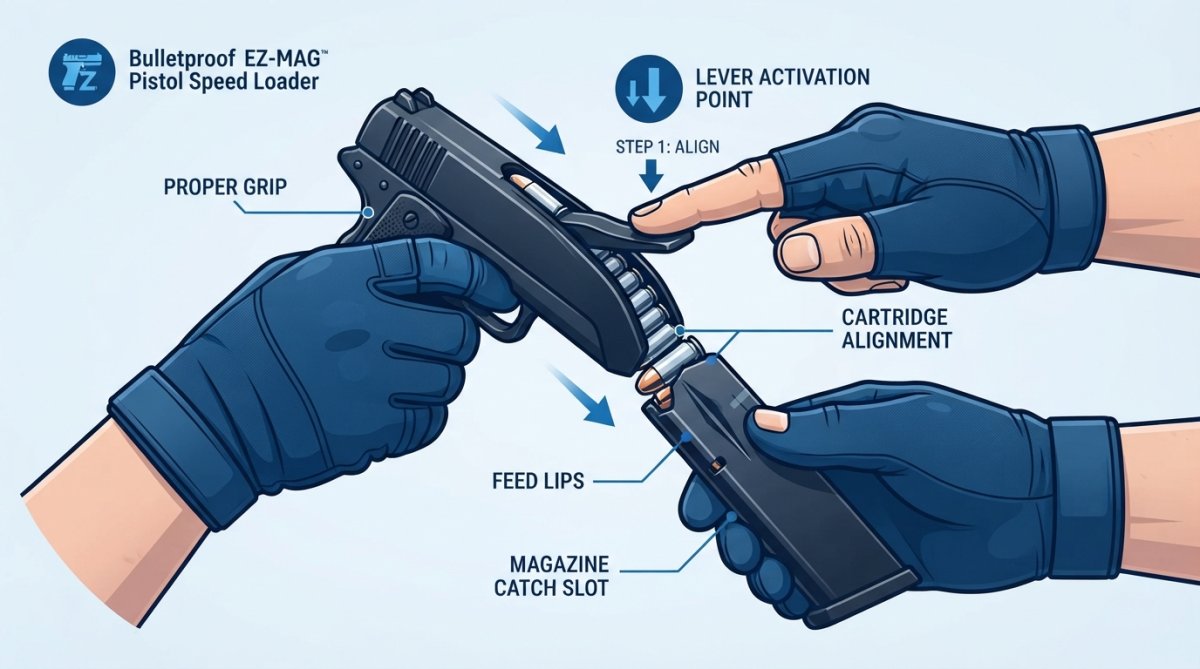
Step-by-Step Loading Process
Step 1: Position the Magazine Insert the magazine into the speed loader's catch system. The magazine should be seated firmly and straight, with feed lips facing toward you.
Step 2: Engage the Loader Press down on the lever. You should feel steady resistance, not a sudden drop. The spring should compress smoothly.
Step 3: Insert the Round Place a cartridge on top of the magazine, aligned with the feed lips.
Step 4: Release and Seat Release the lever gradually, allowing the spring to push the round into place. You'll feel the round seat with a slight click. Don't jerk the lever, smooth, controlled release prevents damage.
Step 5: Repeat Remove the guide and position the next round. Maintain consistent pressure and speed.
Step 6: Final Rounds The last two to three rounds require extra attention. Spring pressure is highest when the magazine is nearly full. Ensure the lever is fully compressed and the round is properly aligned.
Common Loading Mistakes to Avoid
Forcing the Loader onto the Magazine The loader should slide smoothly. If you're forcing it, stop and reposition. Forcing causes bent feed lips and loader damage.
Inadequate Spring Compression If the round doesn't drop smoothly, the spring isn't compressed enough. Press the lever firmly and steadily.
Crooked Magazine Insertion A magazine inserted at an angle won't load properly. Ensure the magazine is straight and fully seated.
Releasing the Lever Too Quickly Jerking the lever instead of releasing gradually causes rounds to bounce or jam. Control the release.
Ignoring Magazine Condition Damaged feed lips, bent followers, or worn springs prevent proper loading. If a magazine loads hard with a quality speed loader, the magazine is damaged.
Best 9mm Magazine Speed Loader Options
The 9mm is the most common pistol caliber. Bulletproof EZ-MAG Pistol Speed Loader at $34.95 is the top choice for 9mm shooters prioritizing reliability and ergonomics. The two-step design minimizes hand fatigue and handles both single-stack and double-stack 9mm magazines.
The COMBAT Model at $69.95 offers upgraded durability with reinforced polymer construction, better suited for high-capacity magazines or stiffer springs.
The TACTICAL Model at $89.95 combines durable polymer with anodized aluminum components, ideal for competitive shooters or professionals requiring maximum reliability.

The DELTA Model at $179.95 is built from solid aircraft aluminum, providing maximum durability and mechanical advantage. It's ideal for law enforcement training, military use, or competitive shooters loading hundreds of magazines monthly.
| Model | Price | Best For | Construction | Mechanical Advantage |
|---|---|---|---|---|
| EZ-MAG Pistol | $34.95 | Casual shooters, 9mm | Polymer | Standard |
| COMBAT | $69.95 | Range volume, harsh use | Reinforced polymer | Improved |
| TACTICAL | $89.95 | Competitive shooters, 9mm | Polymer + aluminum | High |
| DELTA | $179.95 | Law enforcement, professionals | Aircraft aluminum | Maximum |
Durability, Material Construction, and Long-Term Reliability
A speed loader is an investment meant to last years. Material construction directly determines longevity.
Quality polymer resists wear, doesn't corrode, and handles mechanical stress of repeated loading. Budget polymer uses thin-walled plastic that flexes, cracks, or breaks after heavy use. Quality polymer, like Bulletproof loaders, is reinforced for thousands of cycles.
Aluminum construction offers superior durability and mechanical advantage. Aluminum doesn't flex under pressure and won't crack or break. It resists corrosion and wear. The trade-off is weight and cost. An aluminum loader will function identically after 10,000 cycles as on day one.
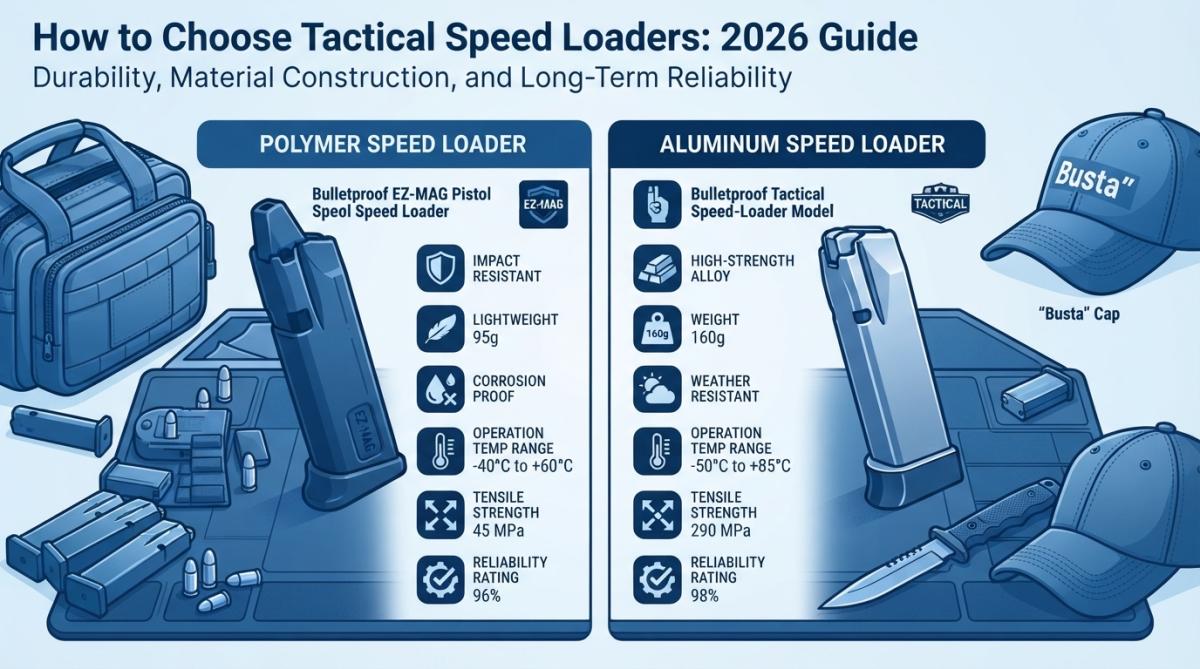
Polymer vs Aluminum Construction
Polymer speed loaders are practical for most shooters. They're lightweight, affordable, and durable for regular range use. A quality polymer loader lasts 5-10 years with normal use.
Polymer's weakness is under extreme conditions. Heavy use, high heat, or harsh environments accelerate wear. After 5,000+ cycles, polymer loaders show visible wear.
Aluminum construction eliminates these concerns. An aluminum loader shows minimal wear after 10,000+ cycles. The lever remains tight, the catch retains its grip, and mechanical advantage remains consistent.
For law enforcement, military, or competitive shooters loading hundreds of magazines monthly, aluminum is logical. For recreational shooters loading 10-20 magazines monthly, quality polymer is sufficient.
Cold Weather and Tactical Gear Integration
Your speed loader needs to fit in your range bag, tactical vest, or concealed carry setup without bulk. Cold weather affects speed loader function. Polymer can become brittle in extreme cold. Aluminum is unaffected by temperature.
Bulletproof speed loaders are designed with tactical integration in mind. The DELTA Model's aircraft aluminum handles extreme temperatures. The TACTICAL Model's anodized aluminum resists corrosion. The EZ-MAG's compact design fits easily in a range bag or tactical vest.
Consider where you'll actually use the loader. If exclusively at an indoor range, polymer is fine. If in your carry bag or field kit, invest in a loader designed for those conditions.
Universal vs Model-Specific Speed Loaders
A universal speed loader claims to work with multiple calibers and magazine types. In reality, universal loaders are compromises, they work adequately with many magazines but optimally with none. They typically underperform with high-capacity magazines.
A model-specific speed loader is engineered for a particular magazine type or caliber, providing maximum mechanical advantage. The trade-off is needing multiple loaders for multiple firearms.
For most shooters, a hybrid approach works best. Own a quality universal loader for general use and travel. Own a model-specific loader for your primary firearms.
Bulletproof Speed Loaders offers both options. The EZ-MAG and COMBAT models work across multiple 9mm platforms. The TACTICAL and DELTA models are optimized for specific magazine types, providing maximum performance.
If you own only one firearm, invest in a model-specific loader. If you own multiple firearms, start with a quality universal loader and add model-specific tools as your collection grows.
Choosing a tactical speed loader comes down to understanding your actual needs. The best loader is one you'll use consistently because it fits your hand, loads reliably, and lasts through years of range sessions. Bulletproof Speed Loaders provides options from the affordable EZ-MAG Pistol Speed Loader at $34.95 for recreational shooters to the professional-grade DELTA Model at $179.95 for law enforcement and competitive professionals. Start with a loader matched to your primary firearm and use case. You'll load faster, experience less hand fatigue, and keep your magazines functioning properly for years to come.
Frequently Asked Questions
Are tactical speed loaders actually worth buying, or can I just load magazines by hand?
Speed loaders cut reloading time significantly and reduce thumb fatigue during range sessions or competitive shooting. If you fire 200+ rounds regularly, a speed loader pays for itself in comfort and efficiency. For casual shooters firing fewer than 100 rounds per session, the benefit is smaller but still noticeable over time. The real value emerges during high-volume training or match scenarios where you reload dozens of magazines.
What's the difference between a speed loader vs magazine loader, and which should I choose?
A speed loader uses mechanical advantage (lever or screw mechanism) to compress spring tension and feed cartridges rapidly into the magazine. A magazine loader typically refers to any device that assists loading. Speed loaders are faster and reduce hand strain, making them ideal for competitive or duty use. Magazine loaders are a broader category. For tactical use, a dedicated speed loader outperforms generic loading aids.
Will a speed loader work with my 9mm handgun, or do I need a model-specific loader?
Most modern 9mm pistols use single-stack or double-stack magazines with similar dimensions, so universal speed loaders work across many platforms. However, some high-capacity or proprietary magazines (like certain AR-platform magazines) require specific loaders. Check your magazine type first. The Bulletproof EZ-MAG handles standard 9mm single and double-stack magazines effectively, making it compatible with most common 9mm platforms.
Can speed loaders damage magazine feed lips or cause long-term wear?
Quality speed loaders with smooth, rounded contact surfaces and proper spring tension don't damage feed lips when used correctly. Cheap loaders with sharp edges or excessive pressure can cause wear over time. Bulletproof's polymer and aluminum designs distribute pressure evenly to prevent feed lip deformation. Inspect your magazines regularly and ensure the loader engages smoothly without forcing the magazine into position.
What's the best speed loader for high-capacity magazines like .45 ACP with 15+ rounds?
High-capacity magazines require loaders with strong mechanical advantage to compress heavy spring tension. The Bulletproof DELTA Model, made from aircraft aluminum, handles high-capacity magazines effectively with its superior leverage design. Universal loaders sometimes struggle with .45 ACP or other larger calibers carrying 15+ rounds. Test your specific magazine type before committing, or choose a model-specific loader for guaranteed compatibility and performance.
I have small hands and arthritis in my thumbs. Will a tactical speed loader actually help me?
Speed loaders are specifically designed to reduce hand strain and thumb fatigue by using mechanical advantage instead of finger strength. Users with arthritis or limited hand strength see the most benefit. The Bulletproof EZ-MAG requires only two steps and minimal force, making it ideal for reduced hand strength. Ergonomic designs with larger lever handles reduce strain compared to manual loading. Test the loader's grip comfort before purchasing if possible.
How do I know if a speed loader will hold up to heavy training or duty use?
Look for loaders made from durable materials like aircraft aluminum or reinforced polymer with metal components at stress points. Bulletproof's TACTICAL and COMBAT models use durable polymer construction tested for heavy use. Check warranty terms and customer feedback from competitive shooters or law enforcement users. Quality loaders should handle thousands of loading cycles without mechanical failure. Avoid loaders with plastic levers or weak spring mechanisms if heavy use is planned.
This article was written using GrandRanker
Frequently Asked Questions
Are tactical speed loaders actually worth buying, or can I just load magazines by hand?
Speed loaders cut reloading time significantly and reduce thumb fatigue during range sessions or competitive shooting. If you fire 200+ rounds regularly, a speed loader pays for itself in comfort and efficiency. For casual shooters firing fewer than 100 rounds per session, the benefit is smaller but still noticeable over time. The real value emerges during high-volume training or match scenarios where you reload dozens of magazines.
What's the difference between a speed loader vs magazine loader, and which should I choose?
A speed loader uses mechanical advantage (lever or screw mechanism) to compress spring tension and feed cartridges rapidly into the magazine. A magazine loader typically refers to any device that assists loading. Speed loaders are faster and reduce hand strain, making them ideal for competitive or duty use. Magazine loaders are a broader category. For tactical use, a dedicated speed loader outperforms generic loading aids.
Will a speed loader work with my 9mm handgun, or do I need a model-specific loader?
Most modern 9mm pistols use single-stack or double-stack magazines with similar dimensions, so universal speed loaders work across many platforms. However, some high-capacity or proprietary magazines (like certain AR-platform magazines) require specific loaders. Check your magazine type first. The Bulletproof EZ-MAG handles standard 9mm single and double-stack magazines effectively, making it compatible with most common 9mm platforms.
Can speed loaders damage magazine feed lips or cause long-term wear?
Quality speed loaders with smooth, rounded contact surfaces and proper spring tension don't damage feed lips when used correctly. Cheap loaders with sharp edges or excessive pressure can cause wear over time. Bulletproof's polymer and aluminum designs distribute pressure evenly to prevent feed lip deformation. Inspect your magazines regularly and ensure the loader engages smoothly without forcing the magazine into position.
What's the best speed loader for high-capacity magazines like .45 ACP with 15+ rounds?
High-capacity magazines require loaders with strong mechanical advantage to compress heavy spring tension. The Bulletproof DELTA Model, made from aircraft aluminum, handles high-capacity magazines effectively with its superior leverage design. Universal loaders sometimes struggle with .45 ACP or other larger calibers carrying 15+ rounds. Test your specific magazine type before committing, or choose a model-specific loader for guaranteed compatibility and performance.
I have small hands and arthritis in my thumbs. Will a tactical speed loader actually help me?
Speed loaders are specifically designed to reduce hand strain and thumb fatigue by using mechanical advantage instead of finger strength. Users with arthritis or limited hand strength see the most benefit. The Bulletproof EZ-MAG requires only two steps and minimal force, making it ideal for reduced hand strength. Ergonomic designs with larger lever handles reduce strain compared to manual loading. Test the loader's grip comfort before purchasing if possible.
How do I know if a speed loader will hold up to heavy training or duty use?
Look for loaders made from durable materials like aircraft aluminum or reinforced polymer with metal components at stress points. Bulletproof's TACTICAL and COMBAT models use durable polymer construction tested for heavy use. Check warranty terms and customer feedback from competitive shooters or law enforcement users. Quality loaders should handle thousands of loading cycles without mechanical failure. Avoid loaders with plastic levers or weak spring mechanisms if heavy use is planned.