 how-to
How to Maintain Pistol Magazine Speedloaders: 2026 Guide
Table of Contents
- Why Magazine Speedloader Maintenance Directly Affects Reliability
- Tools for Cleaning Firearm Accessories: What You Actually Need
- How to Clean Pistol Magazines: Step-by-Step Disassembly and Cleaning
- How to Maintain Pistol Magazine Speedloaders: Material-Specific Care
- Preventing Speedloader Jams: Visual Inspection Checklist
- Lubrication Do's and Don'ts for Magazines and Speedloaders
- How Often to Clean Your Magazines and Environmental Impact
- Common Mistakes to Avoid During Magazine Speedloader Maintenance
Last Updated: August 3, 2026
Neglected magazines are one of the most common causes of preventable malfunctions at the range and in the field. Knowing how to maintain pistol magazine speedloaders is not optional for anyone who depends on their gear. This guide from BULLETPROOF SPEED LOADERS covers every step of the process, from disassembly to material-specific care, so your equipment stays mission-ready.
Why Magazine Speedloader Maintenance Directly Affects Reliability
Dirty or damaged magazines are a primary source of failure to feed malfunctions in semi-automatic pistols. A magazine spring that has lost tension, a follower that drags against a debris-coated body, or feed lips that have been spread by a worn speedloader will cause cycling failures regardless of how well-maintained the pistol itself is.
Pistol magazine reliability is a system problem. A speedloader with worn loading tray surfaces can exert uneven lateral pressure on feed lips during every loading cycle, gradually deforming them over hundreds of repetitions. Regular cleaning removes carbon residue, lint, and grit that increase friction between the follower and magazine body walls. Routine inspection catches feed lip deformation and spring fatigue before they cause a stoppage.
Tools for Cleaning Firearm Accessories: What You Actually Need
Core cleaning kit:
- Solvent designed for firearms (CLP or dedicated bore solvent)
- Dry lubricant or light gun oil
- Cotton swabs and cotton patches
- A nylon brush or old toothbrush
- Compressed air canister
- Clean lint-free cloths
- Flathead screwdriver or magazine disassembly tool for base plate removal
Solvents, Lubricants, and Dry Alternatives
Solvent choice depends on magazine material. For polymer magazines and speedloaders, avoid petroleum-based solvents that can swell or degrade the material. Water-based CLP products or dedicated polymer-safe solvents are correct. For stamped steel magazines, standard firearms solvent works well if wiped dry before lubrication.
Lubrication should be minimal. Excess gun oil attracts debris and can cause primer contamination if it migrates into loaded ammunition. A dry lubricant, such as a PTFE-based spray applied sparingly, is often the better choice for both magazine bodies and speedloader moving parts.
Ultrasonic Cleaner: Worth It or Overkill?
An ultrasonic cleaner is useful for high-volume shooters with ten or more magazines. It excels at removing stubborn carbon residue without manual scrubbing. For casual range use, a cotton swab and solvent are sufficient.
How to Clean Pistol Magazines: Step-by-Step Disassembly and Cleaning
Knowing how to clean pistol magazines correctly starts with complete disassembly. Partial cleaning leaves the components that matter most untouched.
Total Time: 10-15 minutes per magazine Difficulty: Beginner
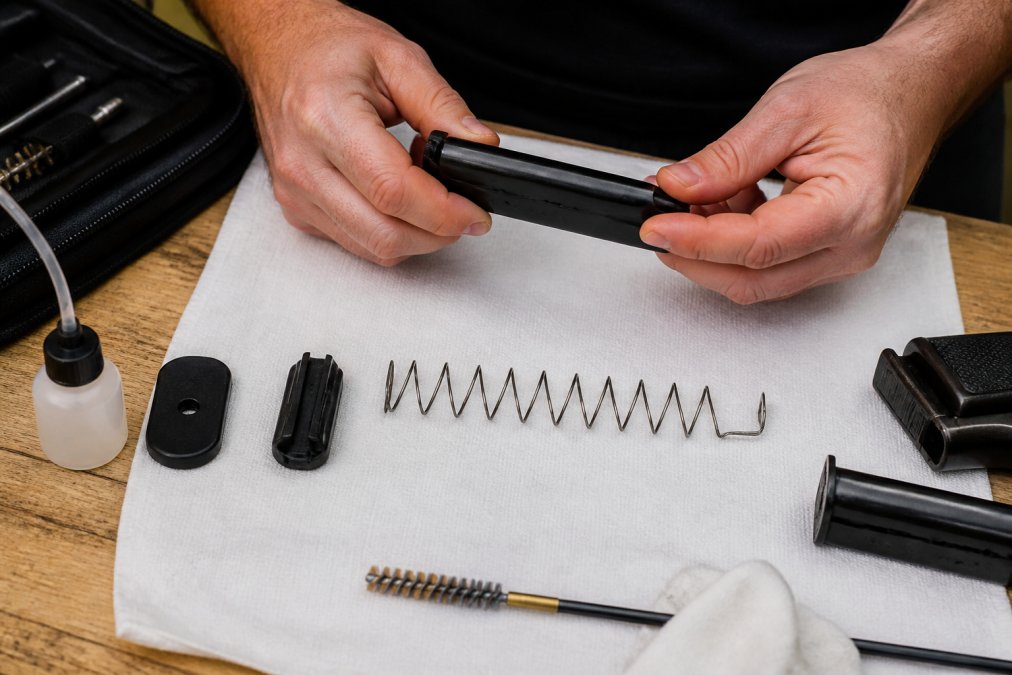
Step 1: Remove the Base Plate and Floor Plate
Verify the magazine is unloaded. With the magazine pointed in a safe direction, depress the magazine spring through the base plate hole using a punch or pen tip, then slide the floor plate forward. Some designs require a flathead screwdriver to depress a retention tab. Apply controlled pressure, the spring is under tension and the floor plate can eject sharply.
Step 2: Remove the Follower and Magazine Spring
Tip the magazine body and allow the spring and follower to slide out together. Do not force them. Note the orientation of the follower before removal so you reinstall it correctly.
Step 3: Clean the Magazine Body, Feed Lips, and Internal Components
- Spray solvent into the magazine body and allow it to dwell for 60 seconds
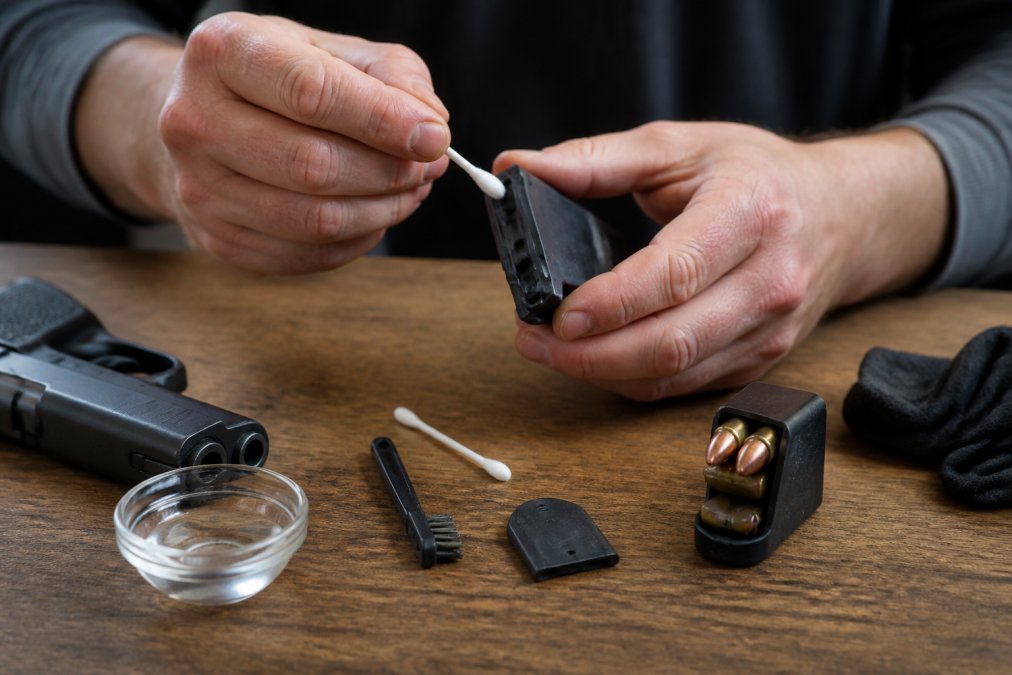
- Run a cotton swab along all four interior walls to remove carbon residue and lint
- Use compressed air to blow debris out from the base toward the feed lips
- Clean the feed lips specifically with a cotton swab, removing any grit from the inner channel where rounds seat
- Wipe the follower with a lint-free cloth and inspect it for cracks or deformation
- Clean the magazine spring with a dry cloth; do not soak it in solvent
- Wipe the base plate clean and inspect for cracks
Step 4: Reassemble and Function-Check
Slide the spring and follower back into the magazine body with the follower oriented correctly. Seat the base plate by pressing it into position until the retention tab clicks. Cycle the follower up and down by hand several times. It should travel smoothly with consistent resistance. Any binding or uneven resistance indicates debris remains or the follower is seated incorrectly.
How to Maintain Pistol Magazine Speedloaders: Material-Specific Care
Understanding how to maintain pistol magazine speedloaders correctly requires treating polymer and metal models differently.
Polymer Speedloaders and Magazines
Polymer is the dominant material in modern pistol magazines and most consumer speedloaders, including the BULLETPROOF SPEED LOADERS lineup. Polymer resists corrosion and is lighter than steel, but it is vulnerable to UV degradation and chemical damage from incompatible solvents.

For polymer speedloaders and magazines:
- Use polymer-safe CLP or isopropyl alcohol for cleaning
- Avoid acetone, brake cleaner, or petroleum-based solvents
- Inspect for stress cracks around the feed lips and base plate tabs after every 500 rounds
- Store away from direct sunlight to slow UV degradation
The loading tray on a polymer speedloader contacts the round and feed lips on every load. Residue accumulates in the loading tray channel and increases friction, making loading harder and putting more lateral stress on the feed lips.
Stamped Steel and Aircraft Aluminum Models
Stamped steel magazines require different care because corrosion is a genuine threat that polymer does not face.
For stamped steel magazines:
- Dry them completely after solvent cleaning before applying lubricant
- Apply a thin coat of gun oil to all exterior and interior metal surfaces
- Inspect for dents in the magazine body, which can cause follower drag
- Check the seam weld at the base of the body for separation
The BULLETPROOF SPEED LOADERS DELTA Model, machined from solid 6061 aircraft aluminum, requires specific care: aluminum does not rust, but it can oxidize and pit if left wet or exposed to acidic residue from certain ammunition. After cleaning, apply a thin coat of dry lubricant rather than oil, which can attract debris in the precision-machined channels.
Preventing Speedloader Jams: Visual Inspection Checklist
Preventing speedloader jams starts with knowing what to look for before a jam happens. A structured visual inspection takes less than two minutes and catches the problems that cause failures during loading.
Visual Inspection Checklist:
- Feed lips are parallel and symmetrical, with no visible spreading or pinching
- Loading tray channel is free of debris and residue
- No visible cracks in the magazine body, especially near the feed lips
- Magazine spring has consistent coil spacing with no collapsed sections
- Follower moves freely without binding when pressed by hand
- Base plate is fully seated with no gaps
- Speedloader loading tray shows no wear grooves or rough edges
- Speedloader lever or button operates smoothly with no sticking

Feed Lips: Wear Patterns and Damage Signs
Feed lips are the most structurally critical part of a pistol magazine. They control the angle and position of each round as it strips from the magazine into the chamber. According to ATF firearms technology resources, feed lip geometry is caliber-specific with tight tolerances. Even minor deformation changes the round presentation angle enough to cause failure to feed.
Look for lateral scoring on the inside of the feed lips where the speedloader's loading tray contacts them. This scoring indicates the speedloader is exerting side pressure during loading, which spreads the feed lips incrementally over time. If you see this pattern, the speedloader's loading tray may be worn or misaligned.
Speedloader-Specific Wear Patterns to Watch
Over thousands of loading cycles, the loading tray channel develops friction grooves that catch the case rim and slow the loading stroke. Check the lever or actuating mechanism on mechanical speedloaders. Worn pivot points allow lateral slop that translates to imprecise round placement. The BULLETPROOF SPEED LOADERS TACTICAL Model uses an anodized aluminum lever and mag release button specifically to resist this type of wear.

Lubrication Do's and Don'ts for Magazines and Speedloaders
More lubrication is not better. A magazine loaded with oil will fail.
Do:
- Apply dry lubricant to the interior magazine body walls after cleaning
- Lubricate the follower lightly where it contacts the body
- Apply a thin film of gun oil to stamped steel exterior surfaces to prevent corrosion
- Lubricate speedloader pivot points with a single drop of light oil
Don't:
- Apply heavy oil to the interior of any magazine
- Lubricate the magazine spring with oil (attracts debris, accelerates wear)
- Use WD-40 as a long-term lubricant (it is a water displacer, not a durable lubricant)
- Lubricate the loading tray channel of a speedloader with oil (causes round slippage)
As documented in NRA Firearm Safety and Maintenance guidelines, over-lubrication of feeding components is a consistent contributor to range malfunctions. The goal is a dry, clean surface with minimal friction.
How Often to Clean Your Magazines and Environmental Impact
How often you clean your magazines depends directly on how and where you shoot.
| Condition | Cleaning Frequency | Priority Components |
|---|---|---|
| Indoor range, low humidity | Every 500-1,000 rounds | Magazine body, follower |
| Outdoor range, dry/dusty | Every 200-300 rounds | All components |
| Outdoor range, humid/wet | After every session | Spring, body, feed lips |
| Storage only (no shooting) | Every 6 months | Spring, exterior surfaces |
| Concealed carry magazines | Monthly minimum | All components, loading tray |
High humidity accelerates corrosion in stamped steel magazines and promotes oxidation on aluminum components. Dust and grit from outdoor ranges pack into the magazine body and between spring coils, increasing friction and reducing cycling reliability. Lint from clothing is the primary contamination source for concealed carry magazines.
Concealed carry magazines deserve special attention. Inspect them monthly and rotate your carry ammunition periodically, as recommended in USCCA concealed carry best practices.
Common Mistakes to Avoid During Magazine Speedloader Maintenance
The most common mistake is skipping disassembly entirely. Wiping down the exterior and running a patch through the interior without removing the spring and follower leaves the follower channel, the base of the magazine body, and the spring coils uncleaned.
The second most common mistake is reassembling a wet magazine. Solvent left inside can leave residue, and if the magazine is loaded immediately after cleaning, solvent can migrate onto primer surfaces. Always dry all components completely before reassembly.
A third mistake specific to speedloader maintenance: ignoring the loading tray after the speedloader starts to feel stiff. Stiffness in the loading stroke is the first sign of tray wear or debris accumulation. Many shooters compensate by applying more force, which accelerates feed lip damage. The correct response is to clean the loading tray channel and inspect it for wear grooves.
For shooters who run high-capacity magazines in calibers like .45 ACP with heavy spring tension, a quality speedloader is not optional. The [Bulletproof EZ-MAG Pistol Speed Loader](https://speed-loader.com/products/bulletproof-ez-mag-pistol-speed-loader) is designed specifically to handle the spring tension of high-capacity magazines, reducing the finger fatigue that leads to rushed, imprecise loading technique. Rushed loading is one of the primary mechanisms behind feed lip damage in high-use scenarios.

New magazine springs are at their stiffest, and new polymer bodies have tighter tolerances. Running a new magazine through 50-100 cycles before trusting it in a defensive or competitive role allows the spring to settle and the follower to smooth out against the body walls. Maintain it through that break-in period and it will serve reliably for years.
Frequently Asked Questions
How often should you clean your pistol magazine speedloader?
A good rule of thumb is to clean your speedloader every 500 to 1,000 rounds, or any time you notice debris, lint buildup, or stiffness in the cycling action. If you shoot in dusty, humid, or sandy environments, clean after every range session. For concealed carry use, a monthly inspection is smart practice regardless of round count, since pocket lint and moisture accumulate faster than most shooters expect.
Should you use lubricant on a magazine speedloader?
Yes, but sparingly and in the right places. A dry lubricant or very light coat of gun oil on the internal loading tray and moving parts reduces friction without attracting debris. Avoid applying heavy gun oil inside the magazine body itself, since excess lubricant traps carbon residue and lint, which causes failure to feed. Polymer speedloaders generally need less lubrication than stamped steel or aluminum models.
What is the best way to remove debris from a speedloader?
Compressed air is the fastest first step: blow out loose debris, lint, and carbon residue from the loading tray and internal channels. Follow with a cotton swab lightly dampened with solvent to scrub stubborn residue. For heavy fouling, an ultrasonic cleaner works well on metal components. Avoid submerging polymer speedloaders in solvent baths for extended periods, as prolonged exposure can degrade the material over time.
Do plastic speedloaders require different maintenance than metal ones?
Yes. Polymer speedloaders are generally more resistant to corrosion but can develop stress cracks at the feed lips and loading tray if exposed to harsh solvents or extreme temperature swings. Use mild cleaners and dry lubricants. Stamped steel and aircraft aluminum models like the Bulletproof DELTA resist physical wear better but need more attention to corrosion prevention, especially in humid climates. Always dry metal components fully before storage to prevent rust.
How do you know when a speedloader needs to be replaced?
Replace your speedloader if you notice cracked or deformed feed lips, a bent or weakened loading tray that no longer seats rounds cleanly, or persistent failure to feed even after thorough cleaning. Visible dents, cracks in the magazine body, or a follower that tilts instead of riding straight are also clear signs. A speedloader that strips rounds or causes feeding malfunctions during cycling has exceeded its service life and should be retired.
Can I use the same cleaning process for both my magazine and my speedloader?
The general steps overlap: disassemble where possible, remove debris with compressed air and cotton swabs, apply solvent to stubborn residue, dry thoroughly, and apply light lubrication. However, speedloaders have fewer removable parts than magazines, so focus cleaning on the loading tray, internal channel, and any moving levers. Magazine maintenance also includes inspecting the magazine spring tension and follower alignment, which are separate from speedloader wear patterns.
Maintaining your pistol magazines and speedloaders is straightforward when you have a structured approach, but the details matter. BULLETPROOF SPEED LOADERS builds its equipment, from the EZ-MAG to the DELTA Model aircraft aluminum speedloader, to handle the demands of heavy training cycles and real-world carry. Get started with BULLETPROOF SPEED LOADERS and build the maintenance habits that keep your gear functioning when it counts most.
This article was written using GrandRanker