 how-to
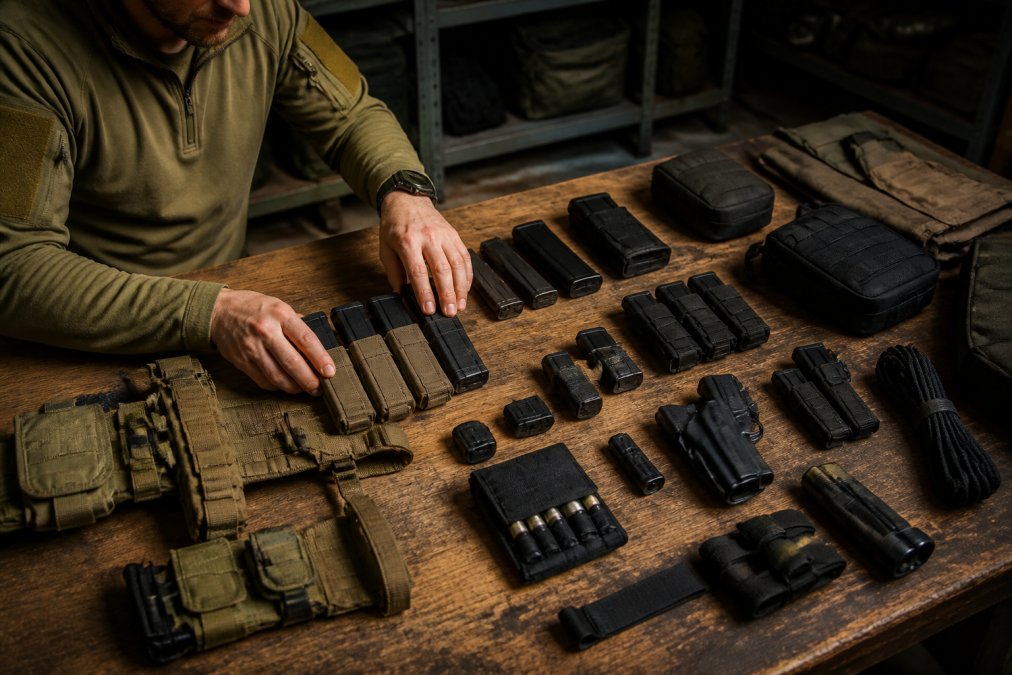
How to Organize Your Tactical Loadout Efficiently
Table of Contents
- Step 1: Define Your Mission Requirements and Gear List
- Step 2: Choose the Best Tactical Vest Configuration
- Step 3: Pack Essential Items for Your Tactical Backpack
- Step 4: Balance Weight Distribution and Center of Gravity
- Step 5: Use Tactical Gear Storage Ideas for Home and Range
- Step 6: Maintain and Scale Your Tactical Loadout
- Common Mistakes That Ruin Tactical Loadout Efficiency
- Frequently Asked Questions
Last Updated: September 14, 2026
Step 1: Define Your Mission Requirements and Gear List
The most efficient tactical loadout starts with a written gear list tied to a specific mission, not a pile of gear you happen to own. A tactical loadout is the complete set of equipment a shooter carries, organized by purpose, priority, and access speed. At BULLETPROOF SPEED LOADERS, we see the same pattern constantly: shooters buy gear first and define the mission later.
Start by answering three questions:
- What is the primary role? Range training, competition, duty, or concealed carry.
- What is the expected duration? A two-hour range day needs far less sustainment than a full-day course.
- What is the environment? Indoor ranges, outdoor fields, and vehicle-based work each change what you carry.
Write the answers down. Then build your list in three tiers: primary (firearm, magazines, eye and ear protection), secondary (IFAK, multitool, hydration), and sustainment (spare batteries, snacks, weather layer). Anything that doesn't fit a tier doesn't come.
A common mistake is treating every range trip like a deployment. Your mission requirements should shrink the list, not justify everything you own.
Step 2: Choose the Best Tactical Vest Configuration
The best tactical vest configuration matches your magazine count and drawstroke to the vest's real estate, not to what looks impressive online. For most shooters, that means a low-profile plate carrier for rifle work and a chest rig for lightweight pistol or carbine setups.
Plate Carrier vs. Chest Rig: Which Setup Fits Your Loadout
A plate carrier holds armor plates and distributes weight across the shoulders and torso, suiting duty, training, and any role where protection is part of the mission (Ballistic Resistance of Body Armor, NIJ Standard 0101.07). A chest rig carries magazines and small essentials with no armor, keeping it lighter and cooler for competition or quick range sessions.
| Setup | Best For | Weight Profile | Typical Pouch Count |
|---|---|---|---|
| Plate carrier | Duty, armor-rated training | Heavier, shoulder-borne | 3-6 rifle mags |
| Chest rig | Competition, light range days | Lighter, chest-centered | 2-4 mags |
| Belt-mounted rig | Concealed carry, USPSA | Lowest, hip-borne | 1-3 mags |
Whichever you pick, keep your reload on your support side and your primary access point on your dominant side. Consistency beats cleverness.
Step 3: Pack Essential Items for Your Tactical Backpack
Essential items for a tactical backpack fall into four groups: reloading, medical, tools, and sustainment. Pack them in that order of priority, with the fastest-access items closest to your back.
- Reloading: spare magazines, a speed loader, and loose ammunition in a sealed pouch.
- Medical: a tourniquet and pressure dressing staged where either hand can reach them (Shop).
- Tools: a multitool, weapon-specific hex keys, and a small light.
- Sustainment: water, electrolytes, and a weather layer for outdoor days.
The item most shooters forget is the one that saves their hands: a quality speed loader. The Bulletproof Speed-Loader TACTICAL Model is built from durable polymer with an anodized aluminum lever, mag release button, and catch, so it holds up to range trips and rough conditions alike. It loads fast, carries compact, and keeps your thumbs intact on high-volume days. Pack the backpack so the heaviest items sit against your spine, that habit prevents most fatigue complaints we hear from shooters running long strings.

Step 4: Balance Weight Distribution and Center of Gravity
Balanced weight distribution keeps your center of gravity near your natural midline, protecting both speed and endurance. Load too much on one side and your body compensates: your stance shifts, your drawstroke slows, and your split times climb. Most guides stop there and tell you to "balance your rig," skipping what the load actually does to your body over a full day, and how to measure it.
Why Load Placement Matters More Than Total Weight
A load carried high and tight against the torso moves with your skeletal frame; a load carried low, loose, or off to one side must be stabilized by muscle instead. That muscle work is the fatigue you feel at hour four, showing up as slower transitions, a shorter natural stance, and reduced mobility over uneven ground. Among shooters who run long strings, the first thing to degrade is often footwork, not accuracy, the stabilizing muscles around the hips and lower back are already working overtime.
Two principles drive most of the benefit:
- Keep mass close to the spine. The farther a pouch sits from your midline, the more leverage it has to pull you off balance. A heavy pouch on the front of a belt is worse than the same pouch tight against the back plate.
- Keep mass high on the torso, not low on the hips. High placement rides on the frame; low placement swings and has to be caught by the core on every step.
A Practical Method You Can Repeat
- Weigh your loaded vest or rig on a kitchen scale. Record the number.
- Weigh it again with the belt or chest rig removed, so you know how the load splits between torso and hips.
- Keep the heaviest pouches centered on your chest or back plate, within a few inches of your spine.
- Mirror your belt setup so left and right carry comparable weight, within a magazine or two of each other.
- Move rarely-touched items to a rear or side pouch, but keep the heaviest ones as close to center as the layout allows.
- Re-weigh after every change and write the number down.
Ergonomics degrade quickly with small additions: adding a full IFAK and two extra mags to one side is enough to change how you stand. Recheck your balance any time you change the configuration, not just when you build it.
The Ergonomic Cost of an Unbalanced Load
You do not need a lab to notice the effects. Watch for these signals during a long range day or full training course:
- One shoulder rides higher than the other at the end of the day, or one strap digs in harder.
- Your natural stance drifts, you start favoring one foot forward without deciding to.
- Transitions get sloppy before accuracy does. If your reloads slow down but your groups hold, the problem is usually load, not technique.
- Lower-back tightness after a few hours of standing, which points to a load sitting too low or too far from the spine.
If you see any of these, the fix is almost always redistribution, not lighter gear. Move the mass toward the midline before you spend money.
Step 5: Use Tactical Gear Storage Ideas for Home and Range
Good tactical gear storage ideas separate three things: daily-carry gear, range gear, and long-term storage. Mixing them is how magazines end up in the wrong bag and plate carriers end up on the floor. But physical organization only solves half the problem, the other half is knowing what you have, where it is, and when it expires.
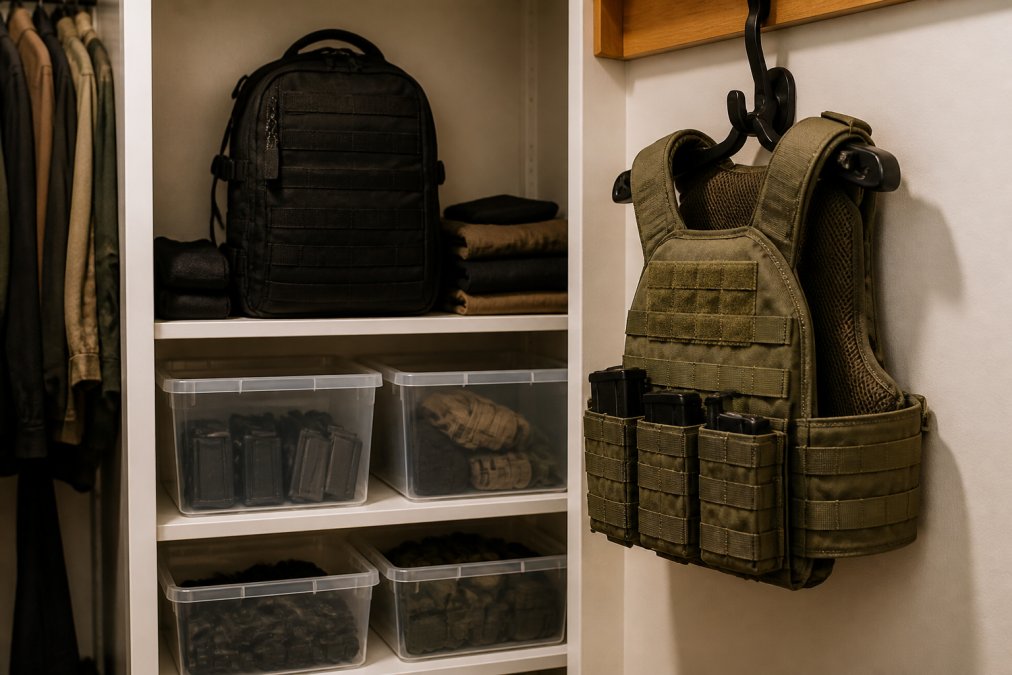
Physical Storage: Home, Closet, and Locker Layouts
At home, hang plate carriers and duty vests on wide hooks so the shoulder pads keep their shape, a narrow hanger creases the padding and shortens the carrier's life. Store loose magazines in labeled bins by caliber, labels facing out so you can read them without pulling bins off the shelf.
For a closet or locker layout, work top to bottom by frequency of use:
- Top shelf: long-term storage, spare plates, seasonal layers, sealed ammunition.
- Eye level: daily and weekly gear, your primary rig, belt, and range bag.
- Below eye level: heavy items, ammunition cans, tools, cleaning supplies.
- Floor: nothing you need to reach quickly. Floor storage is where gear goes to be forgotten.
For range days, use a simple rule: one bag, one purpose. A dedicated range bag means you never unpack your daily setup to go shooting. If you carry a concealed-carry wallet daily, keep it out of the range bag entirely. The Bulletproof Concealed Carry Tactical Wallet is machined from lightweight aircraft-grade aluminum or carbon fiber, making it a natural daily item rather than range equipment.
Digital Inventory Tracking: A System, Not a Suggestion
Digital inventory tracking replaces the mental list most shooters carry with a simple spreadsheet or app entry. The difference between a real system and a vague intention is the columns you track: four are mandatory, and two more make the system actually useful.
The four core columns:
- Item: exact name, including caliber or model. "9mm" is not enough, write "9mm 124gr FMJ, 500-round case."
- Location: which bag, pouch, bin, or shelf. Be specific enough that someone else could find it.
- Quantity: how many you own and how many are staged in a given loadout.
- Last inspection date: when you last checked function or expiration.
The two columns that make it work:
- Expiration or service date: the date a consumable or wear item needs to be replaced. This is the column no physical organization system can replace.
- Replacement interval: how often the item should be checked or rotated, so the sheet can flag it before it fails.
What Actually Expires in a Loadout
Most shooters track ammunition and stop. The items that quietly go bad are the ones that matter most in an emergency:
- Medical supplies. Tourniquets themselves do not expire, but the components around them do. Hemostatic gauze, chest seals, and sterile dressings carry a manufacturer expiration date. Check the packaging, not your memory.
- Batteries. Alkaline batteries lose capacity over time and can leak; lithium holds a charge far longer but still has a shelf life (Battery Care - Dos Don'ts). Rotate them on a schedule rather than waiting for a light to dim.
- Adhesive items. Tape, moleskin, and anything with an adhesive backing dries out. If it has been in a pouch for two years, replace it.
- Chemicals and lubricants. CLP, thread locker, and similar products separate or thicken. A quick shake and a look at the date tells you whether it is still serviceable.
- Elastic and rubber. Bungee retention, rubber bands, and elastic pouch inserts lose tension. This is the most commonly missed category, and it fails silently.
A practical cadence: set a recurring calendar reminder every six months to open every medical pouch, check every expiration date, and update the sheet. Twice a year is enough for most shooters, and it takes less than an hour.
Why This Makes Loadout Scalability Easier
Once your inventory lives in a sheet, scaling a loadout stops being a memory exercise. You can copy a working configuration for a second bag instead of rebuilding from scratch, and see at a glance which items are staged where. Moving from a range-day setup to a longer sustainment setup, the sheet tells you exactly what to add and what is already covered.
Step 6: Maintain and Scale Your Tactical Loadout
Maintenance and scalability separate a loadout that works for years from one you rebuild every season. Gear maintenance is straightforward: inspect straps and stitching monthly, wipe down metal components, and replace anything showing wear before it fails at the range. For scalability, build around a core kit that never changes and modular pouches you add or remove by mission, a compact base setup for a quick range trip should expand into a full training configuration without repacking from scratch.
Speed loaders are a good example of gear that scales with volume. The Bulletproof Speed-Loader DELTA Model is machined from a solid block of 6160 aircraft aluminum with a polymer lever, button, and catch, and it's available in multiple finishes. For high-volume AR-15 work, the Bulletproof Speed-Loader Tier-1 Model handles 5.56 NATO.223 REM, 300 BLACKOUT, 7.62x39mm, and 6mm ARC, one tool covers most of what a serious shooter loads.


Common Mistakes That Ruin Tactical Loadout Efficiency
The mistakes that hurt tactical loadout efficiency are rarely about gear quality. They're about decisions made before anything gets packed.
- Buying gear before defining the mission. The list should drive the purchase, not the reverse.
- Overloading one side. Uneven weight distribution wrecks your center of gravity and slows every movement.
- No dedicated storage. Gear spread across closets and bags guarantees missing items on range day.
- Skipping inventory tracking. Without a record, you rebuy what you already own and forget what needs inspection.
- Treating the loadout as permanent. A setup that never changes can't scale to a new mission.
Fix the process and the gear mostly takes care of itself.
Frequently Asked Questions
Can civilians legally own tactical gear?
Yes, civilians can legally own most tactical gear, including plate carriers, chest rigs, and MOLLE pouches. However, some states and localities restrict certain items like body armor or high-capacity magazines. Always check your local laws before purchasing. For example, while a plate carrier itself is legal federally, some states require a permit for body armor purchases. Focus on gear that supports your range or training needs and stays within your jurisdiction's rules.
What should I keep in my tactical backpack?
A tactical backpack should carry mission-essential items: first-aid supplies (IFAK), water, extra ammunition, a multitool, and weather-appropriate layers. For a range day, include ear and eye protection, a speed loader like the Bulletproof Speed-Loader TACTICAL Model, and a small cleaning kit. Keep the loadout scalable: a light day pack might only need water and ammo, while a sustainment pack adds food and spare batteries. Organize with modular pouches so you can adjust quickly.
What is the best configuration for a tactical vest?
The best tactical vest configuration depends on your mission. For most range or duty use, a plate carrier with front and side MOLLE webbing works well. Place your primary magazine pouches on your non-dominant side for quick access, and your IFAK on the dominant side or small of the back. Keep the heaviest items close to your center of gravity. A chest rig is lighter and better for mobility. Adjust retention so pouches stay secure but you can still grab gear fast.
How do you store tactical gear to prevent damage?
Store tactical gear in a cool, dry place away from direct sunlight. Hang plate carriers and vests on sturdy hooks to maintain their shape. Use labeled bins for loose items like pouches, magazines, and tools. Avoid compressing body armor for long periods. For ammunition and speed loaders, keep them in a dedicated range bag. A digital inventory app can help you track what you have and where it's stored, reducing the chance of losing or damaging critical components.
Building a tactical loadout that stays efficient takes discipline, repetition, and gear you can trust under pressure. BULLETPROOF SPEED LOADERS builds combat-ready equipment for shooters who need durable construction and faster reloading, including the TACTICAL, DELTA, and Tier-1 speed loaders and a lineup of tactical carry accessories. Get started with BULLETPROOF SPEED LOADERS and build a loadout that's organized, balanced, and ready the moment you need it.