 how-to
Loading .45 ACP Mags With Ease: A Tactical Guide
Table of Contents
- Why Loading .45 ACP Magazines Demands a Different Approach
- Manual Loading Techniques for .45 ACP Magazines
- Breaking In 1911 Magazines: Spring Tension and Stiff Followers
- Best Pistol Magazine Speed Loader Options
- Preventing Thumb Pain While Loading Magazines
- Common Loading Mistakes and How to Fix Them
- Conclusion
Last Updated: August 21, 2026
Why Loading .45 ACP Magazines Demands a Different Approach
The .45 ACP round is substantially larger and heavier than 9mm or .40 S&W, which means magazine spring tension works harder, feed lips sit tighter, and your hands take a genuine beating without proper technique. A .45 ACP double-stack magazine under full compression creates significant resistance, your thumb lacks mechanical advantage, and cartridges want to tilt.
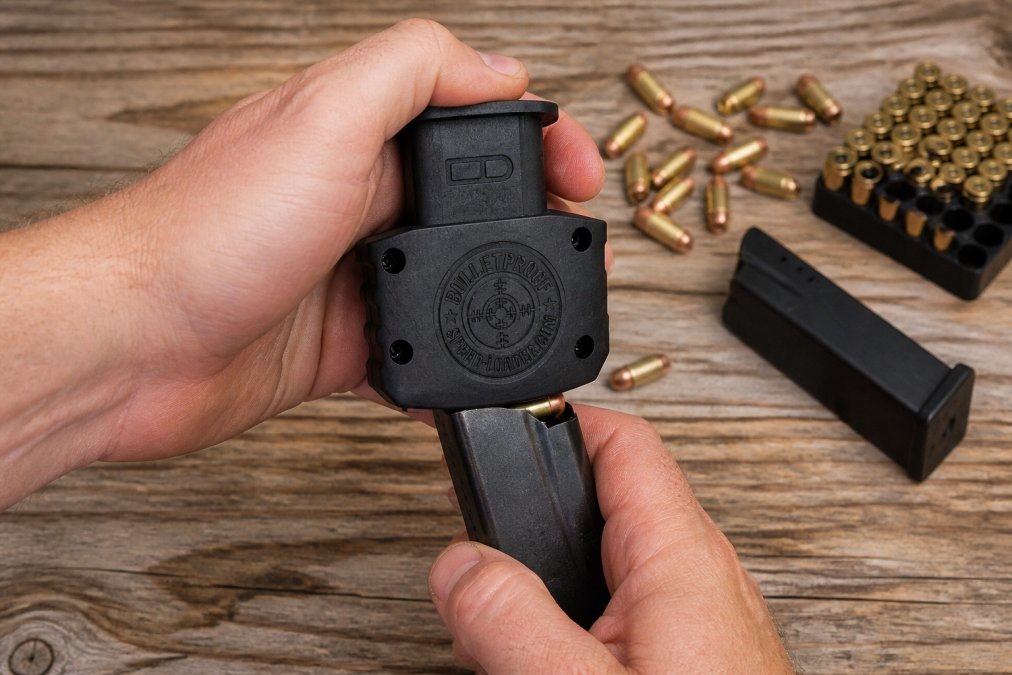
This guide from BULLETPROOF SPEED LOADERS covers practical techniques that work, tools that matter, and mistakes that cost shooters weeks of frustration. Whether you're loading for the range, competition, or daily carry, these methods will cut your time in half and eliminate the finger pain that prevents most people from practicing enough.
Manual Loading Techniques for .45 ACP Magazines
Manual loading is the foundation. Understanding hand technique prevents injuries and teaches you what your magazines actually need.
The Pez Loading Method
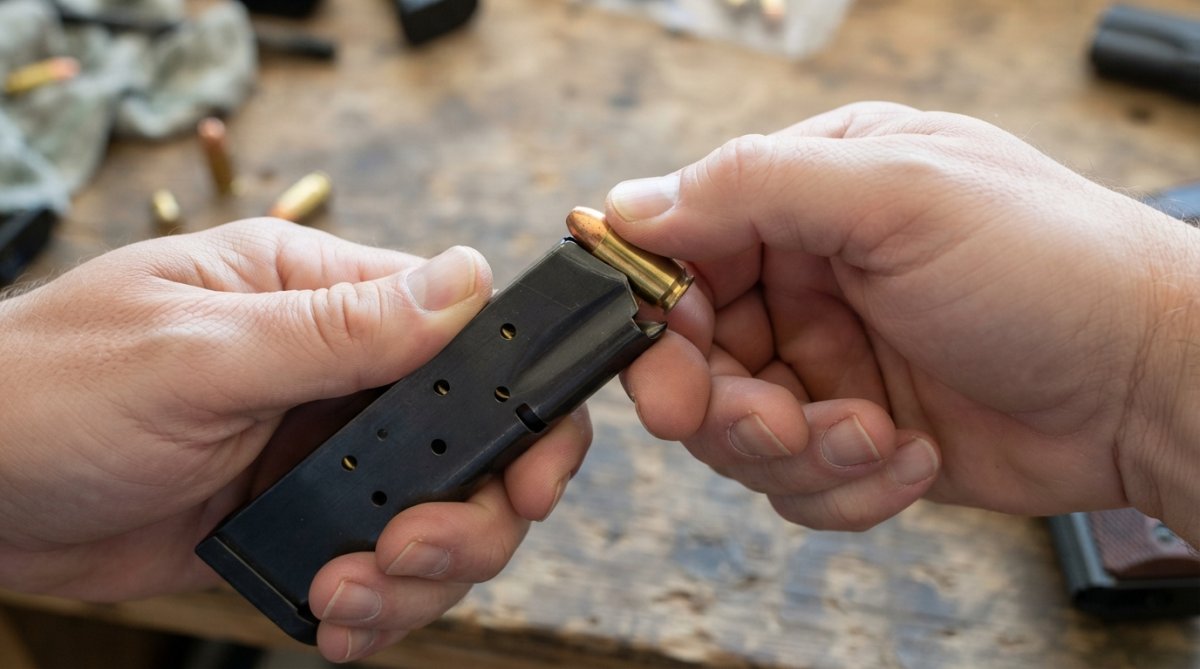
The Pez method is the most intuitive approach. Hold the magazine firmly at the base with your non-dominant hand, opening facing upward. Take a single round between your thumb and index finger, rest it on the follower, and press straight down with steady, even pressure. You'll feel resistance increase as the spring compresses. Don't jab, use controlled pressure until the cartridge settles into position.
This method gives you direct feedback about what's happening inside the magazine. You can feel when a cartridge isn't seating properly and adjust your angle if a round tilts. For shooters with smaller hands or those new to the .45 ACP platform, this builds confidence through complete control.
The downside: it's slow. Loading a full 8-round magazine takes 45-60 seconds, and your thumb will fatigue after two or three magazines.
The Cross Loading Method
The cross method distributes pressure more efficiently across your hand and wrist. Hold the magazine tilted slightly away from your body at roughly 30 degrees. Instead of pressing straight down, press at an angle that aligns with the magazine's natural feed direction, creating a rocking motion rather than a pure downward press.
This spreads the load across more of your hand. Your thumb does less isolated work. Many shooters report less fatigue, especially during extended loading sessions. The trade-off is precision, the angled approach means less direct feedback about cartridge seating.
Proper Cartridge Alignment and Seating
Cartridge alignment is where most loading problems originate. A round that's even slightly tilted will bind on the feed lips or fail to feed when chambered. Watch the cartridge as it enters the magazine, the case should sit flush against the follower, and the bullet should point straight up, parallel to the magazine's centerline.
For double-stack magazines, pay special attention to how cartridges nest together. Each cartridge presses against two neighbors. If one is misaligned, it affects the ones around it. Spending an extra two seconds per round to verify alignment prevents frustration downrange.
Breaking In 1911 Magazines: Spring Tension and Stiff Followers
New 1911 magazines are notoriously stiff. The springs are manufactured to tight tolerances and haven't been compressed thousands of times yet.
Understanding Spring Tension and Break-In Periods
The spring inside a magazine is a precision component designed to maintain consistent pressure across the magazine's entire capacity range. When new, the spring material is at maximum tension. Every compression slightly reduces that tension. Break-in typically takes 300-500 compressions per magazine, roughly 40-60 full-capacity loads (peer-reviewed research).
If you shoot regularly, a magazine breaks itself in within a few range sessions. Forcefully loading new magazines or leaving them fully loaded for extended periods doesn't accelerate this. The spring needs dynamic compression, the actual work of loading, to settle properly.
A properly broken-in magazine loads smoothly and maintains consistent feed reliability. The follower moves freely, and cartridges seat without excessive pressure.
Troubleshooting Stiff Magazine Followers
If a magazine remains stiff after 500+ compressions, something else is wrong. A stiff follower usually indicates the follower is binding on magazine walls, the spring isn't seating properly, or the base plate is warped.
Remove the base plate and inspect the follower, it should move smoothly inside the magazine tube. Check that the spring coil rests flat against the base plate. If it's twisted or folded, straighten it and reassemble. Inspect the base plate itself; if warped or bent, it won't seat flush, and the follower won't move freely. Replacing the base plate often solves the problem.
For 1911 magazines, ensure you're using magazines designed for your platform. Single-stack and double-stack versions have different geometry. Using the wrong type creates binding issues that break-in won't fix.
Best Pistol Magazine Speed Loader Options
Speed loaders eliminate hand fatigue and provide mechanical advantage, allowing you to load magazines quickly without cumulative stress.
Speed Loader vs. Manual Loading: When to Use Each
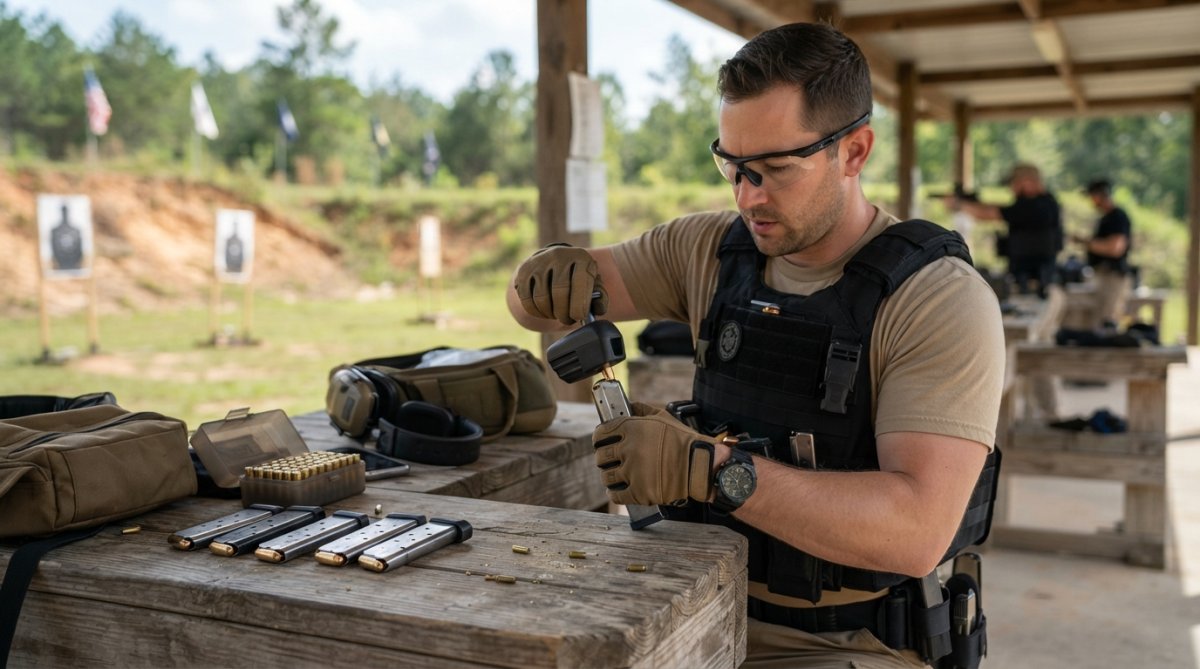
Speed loaders excel when loading 10-15 magazines for a practice session or 20+ magazines in competition. The real advantage isn't just speed, it's consistency. A quality speed loader loads every cartridge to the same depth and angle. Manual loading introduces variables: your angle changes slightly with each round, and your pressure varies.
A speed loader compresses the magazine spring using leverage, not direct thumb pressure (osha.gov). This is transformative for shooters with smaller hands, arthritis, or hand injuries. The trade-off is cost ($30-180) and a learning curve, though most shooters master it within a few loads.
Bulletproof Speed Loaders: Combat-Ready Solutions
BULLETPROOF SPEED LOADERS manufactures several models designed for tactical and competitive shooting, all sharing the same core principle: mechanical advantage through intelligent design.
The Bulletproof EZ-MAG Pistol Speed Loader ($34.95) is the entry point for most shooters. It's straightforward, reliable, and handles standard single-stack and double-stack magazines. The two-step loading process is intuitive: insert the magazine, load cartridges, release. For shooters new to speed loaders or those who load occasionally, this is the right choice.

The Bulletproof Speed-Loader COMBAT Model ($69.95) is built for shooters who run high round counts. The reinforced polymer construction performs consistently across hundreds of loading cycles. Law enforcement and security professionals who train regularly gravitate toward this model.
The Bulletproof Speed-Loader TACTICAL Model ($89.95) adds refinements for competitive shooters. The anodized aluminum lever and mag release button provide tactile, responsive feedback. Competitive shooters prefer this model because mechanical feedback helps them load faster and more consistently.
The Bulletproof Speed-Loader DELTA Model ($179.95) represents the premium option. Built from solid 6160 aircraft aluminum, it's overbuilt for durability and represents the fastest-loading option across the Bulletproof lineup.
Each model works with .45 ACP magazines, handling both single-stack and double-stack configurations.
Preventing Thumb Pain While Loading Magazines
Thumb pain from magazine loading is preventable. It's not weakness, it's a sign you're using the wrong technique or tool.
Ergonomic Techniques to Reduce Repetitive Strain
Your thumb is designed for fine motor control, not repetitive heavy loading. When loading manually, you're asking your thumb to exert significant force repeatedly, creating inflammation over time.
Keep your wrist neutral, not bent forward, backward, or to the side. A bent wrist concentrates force on a smaller area. Use your whole hand to support the magazine; your thumb provides primary downward force, but your other fingers stabilize and help distribute pressure.
Take breaks every 5-10 magazines. Shake out your hands, rotate your wrist gently, and flex your fingers. Load at a controlled pace, slower loading with proper technique causes less strain than fast, forceful loading.
Physical Therapy Tips for Shooters
Thumb flexion exercises work the muscles that bend your thumb (the NIH). Hold your hand out with palm up, slowly bend your thumb toward your palm, then straighten it. Do 15-20 repetitions twice daily.
Wrist flexion and extension exercises support the entire hand. Hold your arm out with palm down, slowly bend your wrist upward and downward. Do 15-20 repetitions in each direction, twice daily.
Grip strength exercises build stabilizing muscles. Use a hand gripper or therapy putty, squeeze and hold for 5 seconds, then release. Do 10-15 repetitions twice daily.
Apply ice for 15 minutes after loading sessions. Avoid loading for 24-48 hours if pain is significant. Most shooters find pain resolves within a week or two once they address the underlying cause. If pain persists beyond two weeks, consult a hand specialist.
Common Loading Mistakes and How to Fix Them
Cartridge tilt: The cartridge sits at an angle instead of straight up. Look at each cartridge before pressing and ensure it's centered on the follower. Press straight down, not at an angle.
Incomplete seating: A cartridge isn't fully compressed into the magazine. Increase pressure gradually until you feel the cartridge seat fully. If pressure doesn't help, check that the follower moves freely.
Feed lip damage: You force a cartridge against the feed lips instead of between them, bending them permanently. Slow down and position each cartridge carefully so it enters between the feed lips.
Magazine binding: A cartridge in one position prevents the next cartridge from seating. Remove the offending cartridge, reseat it properly, then try the next one.
Spring fatigue: Loading becomes progressively harder as you add more cartridges. This is normal. If the magazine becomes impossible to load at capacity, check for binding first. If the follower moves freely, the spring may need replacement.
Loading .45 ACP mags with ease is achievable when you understand the mechanics and use the right tools. These techniques work because they align with how magazines are designed to function. If you're still experiencing pain or struggling with your current method, consider a speed loader. The Bulletproof Speed-Loader COMBAT Model ($69.95) handles .45 ACP double-stack magazines reliably and costs less than a box of premium ammunition. Add a Bulletproof speed loader and experience the difference that mechanical advantage makes.

Frequently Asked Questions
Why are .45 ACP magazines so hard to load?
.45 ACP magazines require significant spring tension to feed reliably through the pistol's chamber. Double-stack magazines compress cartridges tightly, creating friction between rounds and the feed lips. New magazines have the stiffest springs; they gradually loosen during the break-in period. Single-stack magazines are easier to load but hold fewer rounds. The combination of high spring pressure and cartridge size makes manual loading physically demanding, which is why many shooters choose speed loaders for extended range sessions.
Do I need a speed loader for my 1911 magazines?
Speed loaders aren't mandatory, but they're highly valuable if you load magazines frequently or shoot competitively. Manual loading works fine for casual range trips, but speed loaders reduce thumb fatigue and load rounds faster during high-volume training or matches. If you have hand strength limitations, arthritis, or shoot more than 200 rounds per session, a speed loader like the Bulletproof EZ-MAG ($34.95) or Tactical Model ($89.95) pays for itself in comfort and efficiency.
How do you break in a stiff new pistol magazine?
New 1911 magazines have tight spring tension. Break them in by loading and unloading rounds repeatedly over several sessions, aim for 50-100 cycles per magazine. Avoid forcing cartridges or using excessive pressure, which can damage feed lips or bend the follower. After 3-5 range sessions of normal use, spring tension normalizes significantly, making loading much easier.
Can a universal speed loader handle high-capacity .45 ACP magazines?
Not all universal loaders compress springs enough for high-capacity .45 ACP magazines. Cheaper loaders often lack sufficient mechanical advantage to seat rounds against heavy spring tension. Bulletproof's Combat Model ($69.95) and Tactical Model ($89.95) are specifically engineered for .45 ACP double-stack magazines and provide the leverage needed to load reliably without stripping feed lips or jamming cartridges. Always verify compatibility with your magazine type before purchasing.
This article was written using GrandRanker
Frequently Asked Questions
Why are .45 ACP magazines so hard to load?
.45 ACP magazines require significant spring tension to feed reliably through the pistol's chamber. Double-stack magazines compress cartridges tightly, creating friction between rounds and the feed lips. New magazines have the stiffest springs; they gradually loosen during the break-in period. Single-stack magazines are easier to load but hold fewer rounds. The combination of high spring pressure and cartridge size makes manual loading physically demanding, which is why many shooters choose speed loaders for extended range sessions.
Do I need a speed loader for my 1911 magazines?
Speed loaders aren't mandatory, but they're highly valuable if you load magazines frequently or shoot competitively. Manual loading works fine for casual range trips, but speed loaders reduce thumb fatigue and load rounds faster during high-volume training or matches. If you have hand strength limitations, arthritis, or shoot more than 200 rounds per session, a speed loader like the Bulletproof EZ-MAG ($34.95) or Tactical Model ($89.95) pays for itself in comfort and efficiency.
How do you break in a stiff new pistol magazine?
New 1911 magazines have tight spring tension. Break them in by loading and unloading rounds repeatedly over several sessions—aim for 50-100 cycles per magazine. Avoid forcing cartridges or using excessive pressure, which can damage feed lips or bend the follower. After 3-5 range sessions of normal use, spring tension normalizes significantly, making loading much easier.
Can a universal speed loader handle high-capacity .45 ACP magazines?
Not all universal loaders compress springs enough for high-capacity .45 ACP magazines. Cheaper loaders often lack sufficient mechanical advantage to seat rounds against heavy spring tension. Bulletproof's Combat Model ($69.95) and Tactical Model ($89.95) are specifically engineered for .45 ACP double-stack magazines and provide the leverage needed to load reliably without stripping feed lips or jamming cartridges. Always verify compatibility with your magazine type before purchasing.