 how-to
Prevent Finger Fatigue at the Shooting Range: 2026 Guide
Table of Contents
- Why Finger Fatigue at the Shooting Range Happens
- Warm-Up and Cool-Down Routines for Range Day
- Pistol Grip Strength Exercises for Forearm Endurance
- Proper Pistol Grip Technique to Reduce Fatigue
- Best Shooting Gloves for Recoil and Hand Protection
- Equipment Adjustments That Prevent Finger Fatigue at the Shooting Range
- Intentional Rest Intervals and Smart Training Structure
- Conclusion
Last Updated: August 5, 2026
Why Finger Fatigue at the Shooting Range Happens
Finger fatigue results from repetitive muscle contractions, grip pressure, and recoil absorption over extended sessions. Every trigger pull engages fine motor muscles not designed for high-repetition loading. Add the grip pressure required for muzzle control and the strain of reloading magazines by hand, and you have a recipe for muscle fatigue that derails marksmanship training before the ammo runs out.
How Trigger Pull Weight and Repetitive Stress Add Up
Trigger pull weight is the force required to fire a round. A standard factory trigger on a full-size pistol requires meaningful resistance, and multiplied by 200 or 300 trigger pulls in a single session, the cumulative load on your trigger finger becomes significant.
Repetitive stress is the core problem. The same small muscle group, primarily the flexor digitorum superficialis, fires every time you pull the trigger. Over time, this causes micro-fatigue in muscle fibers, reducing accuracy and increasing overuse injury risk. This is the same mechanism behind tendonitis, which develops when tendons are loaded repeatedly without adequate recovery.
Warning Signs: From Muscle Strain to Tendonitis
Muscle strain presents as a dull ache in the forearm or tightness in the fingers. Hand tremors during precision shooting drills and declining grip strength mid-session signal forearm endurance failure.
Tendonitis develops when repetitive stress outpaces the tendon's ability to recover, causing inflammation and pain that can sideline a shooter for weeks. According to American Society for Surgery of the Hand's patient education resources, trigger finger and flexor tendon inflammation are among the most common overuse injuries in activities requiring repetitive gripping.
The difference between strain and tendonitis comes down to recovery. Strain resolves with rest. Tendonitis requires structured rehabilitation.
Warm-Up and Cool-Down Routines for Range Day
Most shooters go straight from the car to the firing line. Cold muscles and tendons are less elastic, more susceptible to strain, and slower to respond, exactly what you don't want when building trigger control and forearm endurance.
Pre-Session Hand and Forearm Warm-Up Exercises
A five-minute warm-up before your first magazine dramatically reduces injury risk and improves early shooting drill quality. The goal is to increase blood flow to forearm flexors and extensors, loosen finger joints, and prime the fine motor skills you'll rely on for pistol marksmanship.
Effective pre-session exercises include:
- Wrist circles, 15 rotations in each direction.
- Finger extensions, Spread all five fingers wide, hold three seconds, close into a fist. Repeat 10 times per hand.
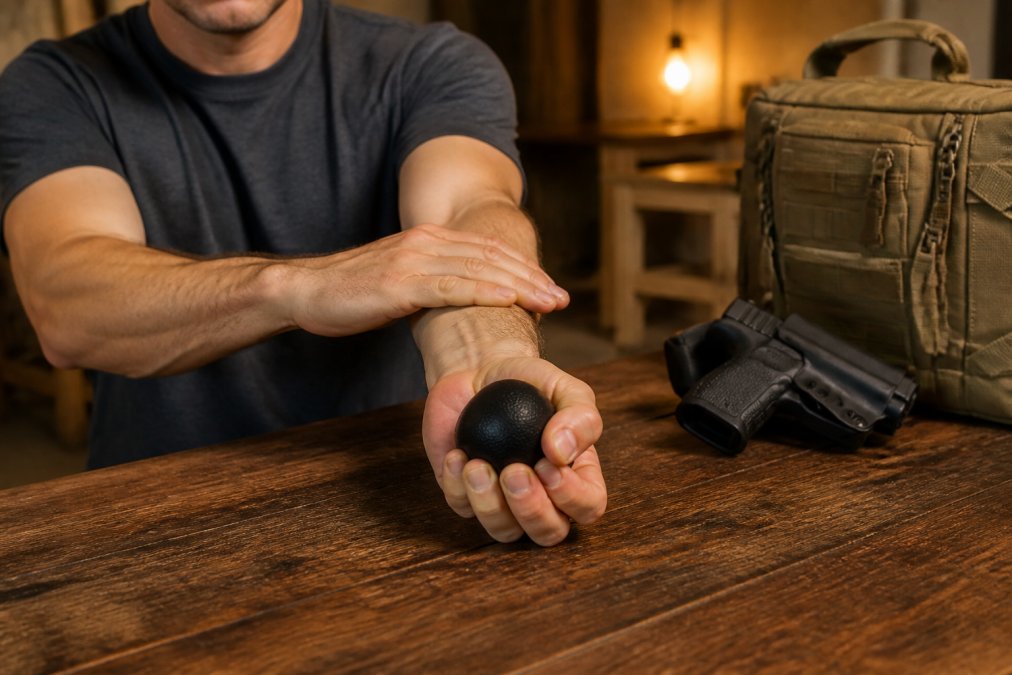
- Forearm flexor stretch, Extend your arm straight, palm up, and gently pull the fingers back toward your body. Hold 20 seconds per side.
- Forearm extensor stretch, Same position, palm down. Hold 20 seconds per side.
- Grip squeeze, Use a stress ball or squeeze your hand into a tight fist, hold two seconds, release. 15 repetitions per hand.
Post-Range Recovery Protocols to Reduce Muscle Fatigue
Post-range recovery reduces muscle fatigue, prevents overuse injuries, and prepares you for the next session. Immediately after your session, repeat the stretching sequence from the warm-up. Follow it with cold water immersion for the hands and forearms (10 minutes in cold water reduces acute inflammation), contrast therapy (alternating warm and cold water for 60 seconds each over five cycles), elevation of forearms above heart level for 10 minutes, and gentle foam rolling of the forearm to release tension.
For heavy training days or competitions, allow 48 hours before your next high-volume session.
Pistol Grip Strength Exercises for Forearm Endurance
Grip strength is the foundation of pistol marksmanship. Weak grip means inconsistent hand stabilization, poor muzzle control, and accelerated fatigue. Building forearm endurance through targeted exercises pays dividends across every aspect of shooting performance.
Effective pistol grip strength exercises include dead hangs (20-30 seconds), farmer's carries (40 meters holding heavy dumbbells), towel pull-ups, wrist rollers (three sets to failure, two to three times per week), and pinch grip holds (30 seconds gripping a weight plate between thumb and fingers).
According to National Strength and Conditioning Association's guidelines on grip training, progressive grip training two to three times per week produces measurable endurance improvements within six to eight weeks.
Proper Pistol Grip Technique to Reduce Fatigue
The single biggest source of unnecessary finger fatigue is poor grip technique. A correct grip distributes load across the entire hand, reduces grip pressure required for muzzle control, and minimizes shock transmitted to the fingers on recoil.
Shooting Stance and Muzzle Control
A forward-leaning isosceles or modified Weaver stance transfers recoil energy through the arms into the body's core, reducing shock load on the hands. Key stance elements that reduce hand fatigue include weight forward (60% on your front foot), slightly bent elbows (locked elbows transmit more recoil shock), and shoulders forward (drives the arms into recoil rather than absorbing it passively).
Proper stance is the cheapest performance upgrade available and immediately reduces physical demand on your hands.
Grip Pressure, Hand Stabilization, and Trigger Control
Proper pistol grip technique starts with grip pressure distribution. The strong hand should apply firm pressure primarily through the middle, ring, and pinky fingers. The trigger finger stays straight until ready to fire, then applies only the pressure needed for the trigger pull.
The support hand fills the gaps. Wrap the support hand fingers over the strong hand fingers, with the support hand thumb pointing forward along the frame. This two-handed grip creates stabilization that reduces micro-adjustments your trigger finger must make for muzzle control.
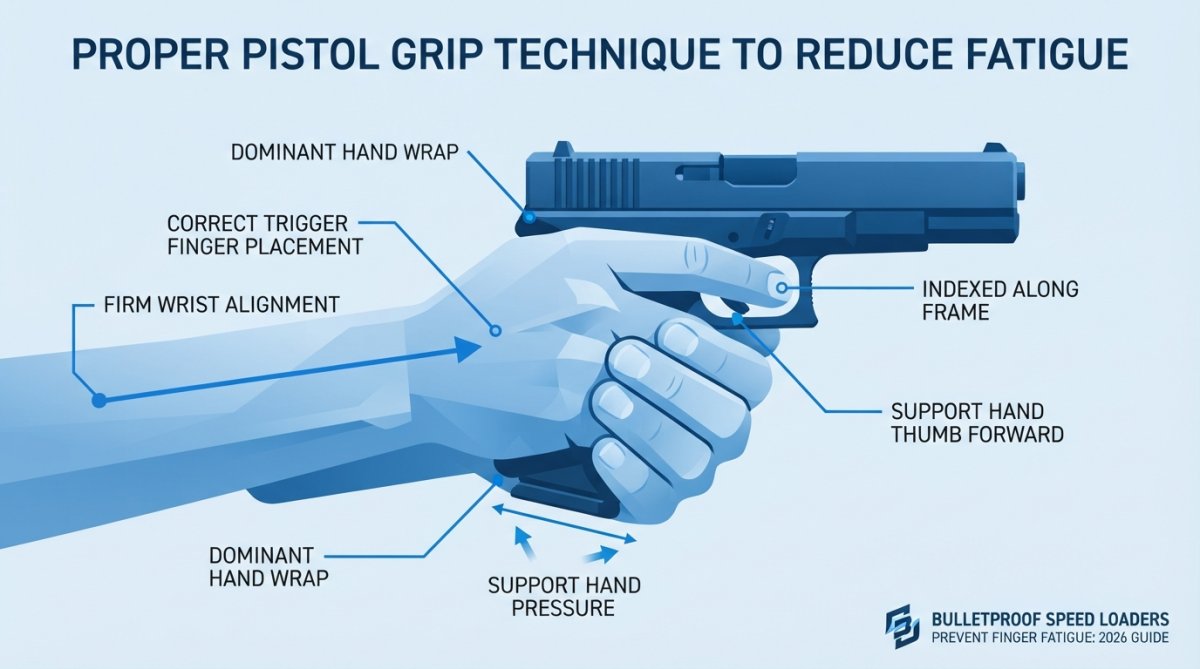
Trigger control is where fine motor skills matter most. A smooth, consistent trigger pull straight back, with no lateral pressure, prevents the trigger finger from fighting the grip.
Best Shooting Gloves for Recoil and Hand Protection
The best shooting gloves reduce shock transmitted to the palm and fingers on each shot, extend training time without fatigue, and protect against slide bite and hot brass.
What to look for in shooting gloves:
| Feature | Why It Matters | Best For |
|---|---|---|
| Padded palm | Absorbs recoil impulse | High-volume pistol training |
| Trigger finger cutout | Preserves tactile feedback | Precision shooting drills |
| Wrist support | Reduces strain on flexor tendons | Shooters with existing tendonitis |
| Breathable material | Prevents grip loss from sweat | Long range sessions |
| Low-profile fit | Doesn't interfere with mag changes | Competitive shooting |
The trigger finger cutout is non-negotiable for most pistol shooters. Gloves covering the trigger finger reduce tactile feedback and can increase grip pressure required for trigger control. For shooters dealing with hand tremors or recovering from muscle strain, a glove with wrist support provides additional stabilization without restricting range of motion.
Equipment Adjustments That Prevent Finger Fatigue at the Shooting Range
Technique matters more than equipment. But the right equipment adjustments can meaningfully reduce physical load on your hands, especially for high-volume shooters.
Trigger Pull Weight Modification
Trigger pull weight modification is one of the most direct ways to reduce trigger finger fatigue. A lighter trigger pull requires less force per actuation, which multiplies across hundreds of rounds into significant cumulative muscle load reduction. A qualified gunsmith can assess your specific firearm and recommend modifications that improve trigger control without compromising reliability or safety.
Ammunition Choice and Recoil Impulse
Ammunition grain weight directly affects recoil impulse. For high-volume training, lighter grain ammunition reduces the recoil impulse per shot, reducing shock load transmitted to hands and forearms across a full session. Running lighter ammunition for volume marksmanship training, then switching to your carry load for final confirmation drills, is a practical approach that reduces cumulative fatigue.
Speed Loaders: Protecting Your Thumb and Trigger Finger
A significant portion of range-day hand fatigue comes from reloading magazines by hand. Loading rounds into a magazine, especially high-capacity mags with stiff springs, creates repetitive stress on the thumb and trigger finger that compounds across a full session.
A quality speed loader eliminates this entirely. The Bulletproof EZ-MAG Pistol Speed Loader reduces the loading process to two steps, removing the thumb compression load that causes cumulative fatigue. For shooters running high-capacity magazines or .45 ACP with heavy springs, the Bulletproof COMBAT Model and TACTICAL Model are built specifically for that application. The DELTA Model, machined from solid 6061 aircraft aluminum, is the choice for law enforcement and competitive shooters who need a loader that holds up to daily high-volume use.

According to Occupational Safety and Health Administration's ergonomics guidelines on repetitive hand tasks, reducing the frequency and force of repetitive hand motions is the primary intervention for preventing cumulative trauma disorders. Removing manual magazine loading from your range routine does exactly that.
Intentional Rest Intervals and Smart Training Structure
Intentional breaks make you better, not slower. Muscle fatigue is not linear. The first signs, reduced grip strength, slight hand tremors, inconsistent trigger control, appear well before you feel pain.
Structured rest intervals prevent this. A practical framework for a range day session:
| Session Block | Duration | Rest Interval | Focus |
|---|---|---|---|
| Warm-up | 5 min | , | Stretching and dry fire |
| Block 1 | 50 rounds | 5 min | Fundamentals and trigger control |
| Block 2 | 50 rounds | 5 min | Speed drills and tactical reloads |
| Block 3 | 50 rounds | 10 min | Unconventional positions and movement |
| Block 4 | 50 rounds | , | Confirmation and cool-down |
During rest intervals, shake out your hands, stretch your forearm flexors, and consciously release grip tension. Five minutes of active recovery between blocks extends your effective training time and keeps fine motor skills sharp through the final drill.
Smart training structure also means tracking your volume. Keeping a simple log lets you identify the point at which accuracy degrades, your personal fatigue threshold. Train up to that threshold, not through it.
Finger fatigue at the shooting range is a solvable problem requiring a systematic approach: technique, conditioning, equipment, and recovery. The shooters who train consistently without injury are more systematic. If you're still loading magazines by hand at the end of a long session, that's the first thing to change. The Bulletproof Speed Loaders lineup, from the compact EZ-MAG to the competition-grade DELTA Model, removes the single biggest source of thumb and trigger finger fatigue from your range day routine. Add the warm-up protocols, grip strength work, and intentional rest intervals from this guide, and you'll shoot more rounds with better technique for longer.

Frequently Asked Questions
Why does my index finger hurt after shooting?
Repeated trigger pulls place concentrated stress on the flexor tendons and the first joint of your index finger. Over a single range session, hundreds of repetitions can cause localized muscle fatigue, inflammation, and soreness. If the pain persists beyond 48 hours or includes swelling, it may indicate the early stages of tendonitis or a repetitive stress injury. Rest, ice, and gentle stretching usually resolve mild cases, but chronic pain warrants a visit to a sports medicine or orthopedic specialist.
How do you build grip strength for pistol shooting?
Consistent off-range conditioning makes the biggest difference. Grip trainers, stress balls, and reverse wrist curls with light dumbbells all target the forearm muscles used in pistol marksmanship. Dead hangs from a pull-up bar build overall hand stabilization. Aim for three short sessions per week rather than one long session to avoid overuse injuries. Combine strength work with flexibility exercises, finger stretches and wrist rotations, so you build endurance without sacrificing the fine motor skills trigger control demands.
Are shooting gloves effective for preventing hand fatigue?
Yes, when chosen correctly. Shooting gloves cushion the palm and fingers against recoil impulse, reducing the cumulative shock that leads to muscle strain over a long range day. Thin, form-fitting tactical gloves preserve trigger feel and fine motor control better than thick work gloves. Look for models with reinforced palm padding and minimal bulk over the trigger finger. They also protect against slide bite and hot brass, making them a practical addition to any range bag beyond just fatigue prevention.
How can I stop my hands from shaking at the shooting range?
Hand tremors during shooting usually come from a combination of muscle fatigue, grip pressure that is too tight, and adrenaline. Tighten your support hand more than your dominant hand to share the load, and consciously relax your shoulders and jaw. Taking intentional breaks every 50 to 100 rounds lets your forearm muscles recover before fatigue sets in. Breathing control also helps: exhale slowly before breaking the shot. If tremors persist even when rested, physical conditioning off the range will address the underlying strength deficit.
This article was written using GrandRanker