 how-to
Reduce Finger Fatigue at the Range: 7 Proven Strategies
Table of Contents
- What Causes Finger Fatigue During Shooting
- Proper Shooting Grip Techniques to Minimize Hand Strain
- Hand Exercises for Shooters to Build Endurance
- Best Magazine Speed Loaders for Pistols to Reduce Manual Effort
- Ergonomic Setup and Equipment Adjustments
- Post-Range Recovery Protocols for Hand Fatigue
- Identifying Hand Fatigue vs. Injury Signals
- Conclusion
Last Updated: August 19, 2026
What Causes Finger Fatigue During Shooting
Finger fatigue stems from repetitive strain on muscles, tendons, and joints during sustained trigger control and grip pressure. When you fire repeatedly, your finger flexors work overtime pulling the trigger while your hand stabilizes the firearm against recoil. This combination creates cumulative muscle tension throughout a shooting session.
The problem intensifies because most shooters don't warm up their hands before range time. Cold muscles fatigue faster and recover slower. Additionally, improper grip pressure, squeezing too hard, accelerates exhaustion by forcing your forearm and hand muscles to work against unnecessary tension. Trigger control compounds the issue: a heavy or gritty trigger requires more finger strength to manipulate cleanly, increasing strain with each round.
Your fingers contain no major muscle groups; they're powered by forearm muscles connected via tendons. When those forearm muscles fatigue, your fingers lose precision and endurance. This is why finger fatigue often feels like it originates in your hand but actually stems from weakness or exhaustion in your forearm.
Proper Shooting Grip Techniques to Minimize Hand Strain
The way you grip your firearm directly determines how quickly your hands fatigue. A proper grip distributes pressure evenly across your hand and forearm rather than concentrating force in your fingers, reducing fatigue by engaging larger muscle groups that can sustain effort longer.
Grip Pressure and Trigger Control
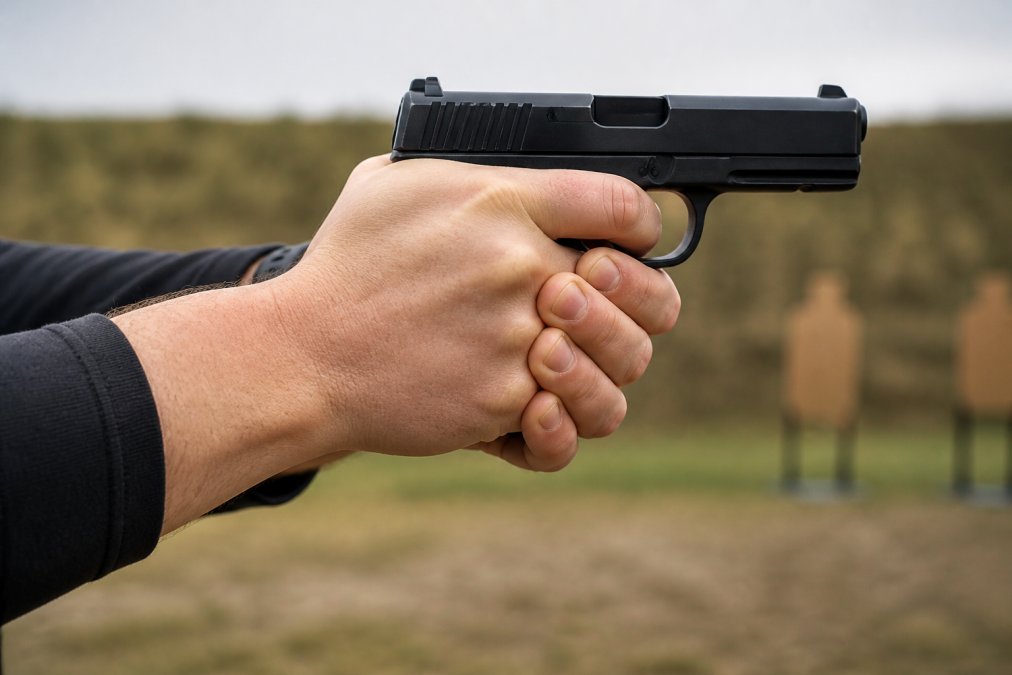
Your grip pressure should be firm but not white-knuckled. Excessive grip pressure actually increases hand tension and accelerates fatigue. A sustainable grip uses just enough pressure to maintain control during recoil, typically around 60-70% of your maximum grip strength.
The key is consistency. Your grip pressure should remain the same from the first shot to the last. Varying pressure forces your hand to constantly readjust, wasting energy and increasing finger fatigue. Focus on establishing a baseline pressure you can maintain for 50+ rounds without your hand shaking or losing position.
Trigger control directly affects grip fatigue. A smooth, straight-back trigger press requires less overall hand tension than a jerky or angular press. When your finger moves the trigger cleanly without disturbing your sight picture, your entire hand stays more relaxed. Practice dry fire to develop a consistent trigger press that doesn't cause your hand to tense up.
Hand Positioning for Reduced Tension
A high grip, where your hand sits as high as possible on the backstrap, reduces the mechanical leverage needed to manage recoil. This means your forearm muscles work less hard, and finger fatigue develops more slowly.
Position your trigger finger so the pad of your finger contacts the trigger, not the joint. Using the pad gives you better control and distributes pressure across a larger surface area rather than concentrating it on a single point. Your support hand placement matters equally: interlock your thumbs or position them safely to avoid recoil impact. A proper support hand grip shares the recoil load with your firing hand, preventing one hand from bearing all the burden.
Hand Exercises for Shooters to Build Endurance
Building finger endurance requires conditioning your forearm muscles, grip strength, and hand flexibility. Shooters who do targeted hand exercises report significantly less finger fatigue at the range, even during high-round-count sessions.
Grip Strength Training Exercises
Grip strength directly correlates with shooting endurance. Stronger hand muscles fatigue more slowly and recover faster between strings. Start with farmer's carries: hold dumbbells or kettlebells at your sides and walk for 30-60 seconds. This builds foundational grip strength without requiring specialized equipment.
Wrist curls with light weights target the forearm flexors that power trigger control. Use a weight you can handle for 15-20 reps without straining. Do three sets of 15 reps, three times per week, focusing on controlled movement rather than heavy weight.
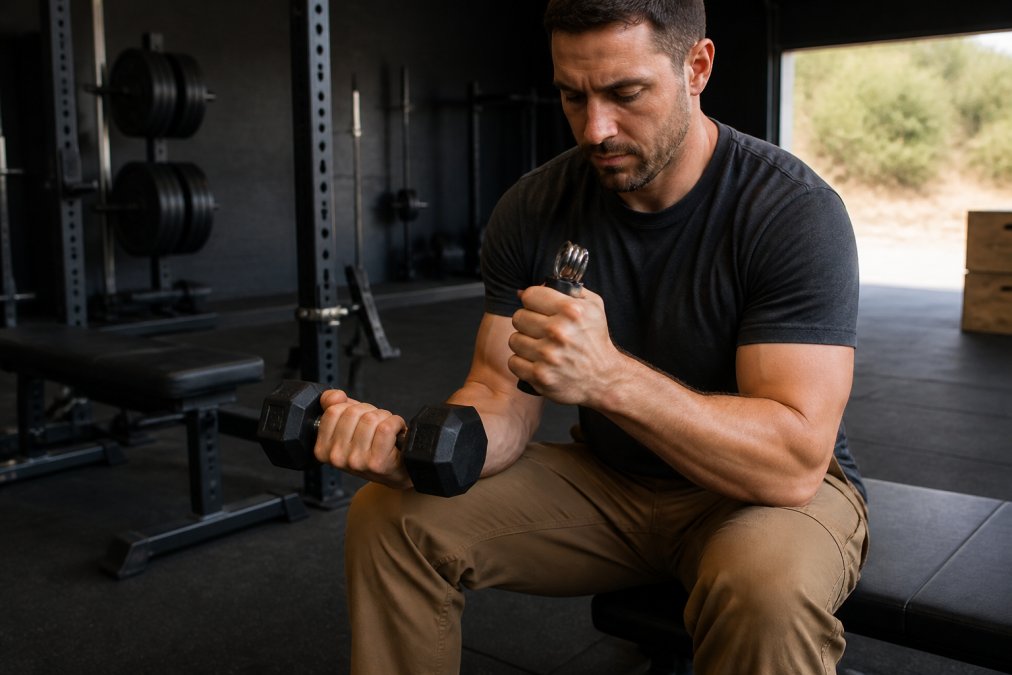
Grip trainers or hand squeezers offer portable conditioning. Use them for 10-15 minutes daily, focusing on consistent pressure rather than maximum squeeze. Dead hangs from a pull-up bar build grip endurance through isometric tension: hang for 20-30 seconds, rest 60 seconds, and repeat for 5 sets. This conditions your grip to sustain tension over time, which directly translates to reduced finger fatigue at the range.
Wrist and Forearm Strengthening Routines
Wrist curls and reverse wrist curls target the forearm muscles that control finger movement. Do wrist curls with a light dumbbell (5-10 pounds): curl your wrist up for 15 reps, rest, then curl downward for 15 reps. The reverse motion strengthens the extensors that stabilize your hand during recoil.
Radial and ulnar deviation exercises target the side-to-side wrist muscles. Hold a light dumbbell with your arm extended, then move your wrist side to side in a controlled motion. Pronation and supination exercises rotate your forearm to condition the muscles that control hand position.
The key to all forearm exercises is consistency and light weight. You're building muscular endurance, not maximum strength. Three 15-20 minute sessions per week is sufficient. Most shooters see noticeable improvements in finger endurance within 4-6 weeks of consistent training.
Best Magazine Speed Loaders for Pistols to Reduce Manual Effort
Magazine loading accounts for significant hand fatigue at the range. Manual loading exhausts your fingers quickly, especially during high-volume practice. A quality speed loader dramatically reduces this effort and keeps your hands fresher for actual shooting.

Why Speed Loaders Matter for Fatigue Prevention
Speed loaders compress multiple rounds simultaneously, distributing the loading force across a mechanical device rather than your fingers. This reduces the repetitive strain on your finger flexors and hand muscles. Instead of pressing 150 rounds manually with your thumb, you load 15 magazines using a device designed for efficiency.
The fatigue prevention benefit extends beyond the range. Manual loading causes finger soreness that can persist for days after a shooting session, affecting your grip strength during subsequent practice. A speed loader prevents this cumulative damage, allowing your hands to recover fully between sessions.
Choosing the Right Speed Loader for Your Needs
The best speed loader depends on your magazine type, hand size, and shooting volume. For 9mm shooters with standard-capacity magazines, the Bulletproof EZ-MAG Pistol Speed Loader offers straightforward operation at $34.95. The two-step loading process is intuitive and reduces hand strain per magazine loaded.
For competitive shooters or law enforcement conducting high-volume training, the Bulletproof Speed-Loader COMBAT Model at $69.95 handles sustained use without fatigue. Its durable polymer construction withstands hundreds of loading cycles, and the ergonomic design reduces hand strain compared to manual loading.

Shooters with small hands should test any loader before purchasing. The EZ-MAG accommodates various hand sizes due to its compact design. For maximum durability and performance, the Bulletproof Speed-Loader TACTICAL Model at $89.95 combines polymer construction with anodized aluminum components, making it ideal for frequent range time.

High-capacity magazine shooters or those using .45 ACP should consider the Bulletproof Speed-Loader DELTA Model at $179.95. Its solid 6160 aircraft aluminum construction provides the compression strength needed for difficult magazines.
Ergonomic Setup and Equipment Adjustments
Your range setup influences how quickly your hands fatigue. Poor ergonomics force your hand and arm muscles to work harder, accelerating finger fatigue. Simple adjustments to your shooting position and equipment can extend your endurance significantly.
Shooting bench height matters. Your elbows should rest at roughly 90 degrees when your hands are on the firearm. A bench that's too high forces your shoulders and forearms into an extended position, increasing muscle tension. Grip angle affects how much pressure your fingers must exert: firearms with steeper grip angles require less finger tension to manage recoil.
Hand position on the bench matters during rest periods. Support them on a rest or sandbag at a neutral angle rather than letting them dangle. Magazine pouch placement influences how much you move your hands: keep them close and at a comfortable height to minimize reach strain.
Post-Range Recovery Protocols for Hand Fatigue
What you do after shooting matters as much as what you do during shooting. Proper recovery protocols reduce soreness and prepare your hands for the next session.
Hand and Forearm Massage Techniques
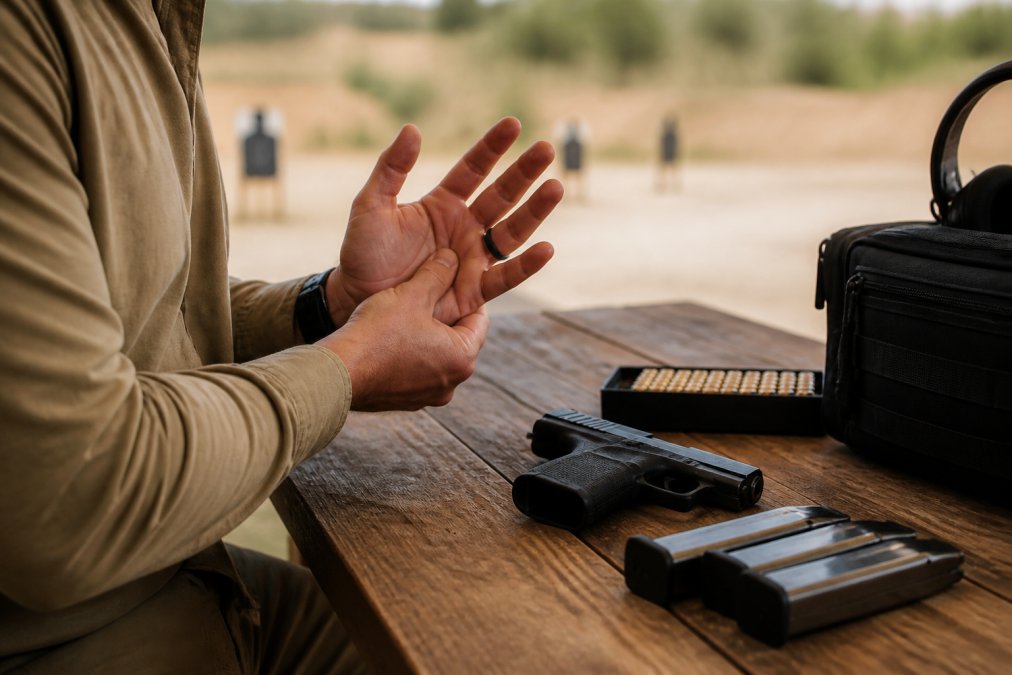
Self-massage accelerates recovery by increasing blood flow to fatigued muscles. Use your opposite thumb to apply firm, slow pressure along your forearm flexors, moving from your wrist toward your elbow in 2-3 inch strokes. Massage your hand itself by pressing your thumb into the palm and moving it in small circles, spending extra time on the webbing between your thumb and index finger.
Use a massage stick or foam roller on your forearm for deeper work. Roll from your wrist to your elbow, applying moderate pressure. Spend 2-3 minutes per forearm immediately after shooting while muscles are still warm. Heat enhances massage effectiveness: soak your hands in warm water for 5 minutes before massage.
Stretching Breaks and Flexibility Work
Stretching immediately after shooting maintains flexibility and prevents stiffness. Hold each stretch for 30 seconds without bouncing.
Wrist flexor stretch: extend your arm straight out, palm down, and gently press the back of your hand downward. Wrist extensor stretch: extend your arm with your palm facing up, and gently press the top of your hand downward. Finger flexor stretch: make a fist, then slowly straighten your fingers against resistance from your opposite hand.
Do these stretches twice daily on range days, once immediately after shooting and once before bed. This prevents the stiffness that develops overnight and improves your hand's readiness for the next session.
Identifying Hand Fatigue vs. Injury Signals
Not all hand discomfort is simple fatigue. Knowing the difference between normal muscle tiredness and potential injury prevents serious problems.
Hand fatigue feels like muscular tiredness: your grip weakens, your fingers feel heavy, and your hand loses precision. This is normal after high-round-count sessions and resolves within 24-48 hours with rest and stretching.
Tendonitis presents as sharp pain along the tendons, usually on the palm side of your forearm or along the back of your hand. The pain worsens with gripping and persists beyond a day or two. Trigger finger causes a specific tendon to catch or lock, with your finger feeling stuck in a bent position before suddenly straightening. Carpal tunnel symptoms include tingling or numbness in your thumb, index, and middle fingers, suggesting nerve compression.
If you experience sharp pain, swelling, numbness, or symptoms that persist beyond 48 hours, stop shooting and see a healthcare provider. Regular fatigue management prevents injury: shooters who warm up, use proper technique, do conditioning exercises, and take adequate breaks rarely develop tendonitis or carpal tunnel.
Reducing finger fatigue at the range requires a multi-faceted approach: proper grip technique, targeted conditioning exercises, efficient magazine loading, and smart recovery protocols. Start with technique, most shooters can reduce fatigue 30-40% just by improving their grip and trigger control. Add hand exercises to build endurance, use a quality speed loader to minimize manual loading strain, and finish with post-range recovery.
For shooters serious about high-volume training, BULLETPROOF SPEED LOADERS offers purpose-built solutions designed to reduce the fatigue factor that limits practice sessions. The Bulletproof EZ-MAG handles standard pistol magazines efficiently, while the TACTICAL and DELTA models provide the durability and compression strength for demanding training environments. Pair these with the conditioning and recovery strategies above, and you'll extend your effective range time while protecting your hands from overuse injuries.
Frequently Asked Questions
What causes finger fatigue during target practice?
Finger fatigue at the range stems from sustained grip pressure, repetitive trigger pulls, and the isometric muscle tension required to stabilize the firearm. Your forearm muscles and finger flexors work continuously during shooting sessions, especially during high-volume training days. Improper grip technique, excessive trigger finger tension, and inadequate hand conditioning accelerate fatigue. Speed loaders reduce fatigue by eliminating the manual effort required to load magazines by hand, which is a significant contributor to overall hand exhaustion.
How can I improve grip strength to prevent hand fatigue?
Build grip strength through targeted exercises: wrist curls with light weights (3 sets of 12-15 reps), squeeze training with a grip strengthener (3 sets daily), and forearm flexor stretches. Perform these exercises 3-4 times per week, allowing rest days between sessions. During range sessions, take 5-minute breaks every 30 minutes to stretch your hands and forearms. Proper hand positioning and trigger control also matter, avoid gripping too tightly, which accelerates muscle exhaustion. Consistent conditioning improves finger endurance over 4-6 weeks.
Are magazine speed loaders effective at reducing finger strain?
Yes. Manual magazine loading requires significant finger and hand effort, especially with high-capacity magazines or stiff springs. Speed loaders compress the springs mechanically, eliminating repetitive strain from pushing rounds into magazines by hand. The Bulletproof EZ-MAG Pistol Speed Loader ($34.95) reduces loading effort to just two steps, cutting hand fatigue substantially during high-volume training. For competitive shooters and law enforcement conducting frequent training, speed loaders are essential fatigue-prevention tools that also improve efficiency.
What are the best hand stretches for shooters after range sessions?
Perform these stretches immediately after shooting: Flex your wrist downward and hold 20 seconds per side; make a fist and spread your fingers wide, holding 15 seconds; gently pull each finger backward; and perform forearm pronation/supination (rotate your arm as if turning a doorknob). Hold each stretch for 20-30 seconds without bouncing. Combine stretching with hand and forearm massage using your thumb or a massage ball for 2-3 minutes. These post-range protocols accelerate recovery and reduce next-day stiffness.
This article was written using GrandRanker
Frequently Asked Questions
What causes finger fatigue during target practice?
Finger fatigue at the range stems from sustained grip pressure, repetitive trigger pulls, and the isometric muscle tension required to stabilize the firearm. Your forearm muscles and finger flexors work continuously during shooting sessions, especially during high-volume training days. Improper grip technique, excessive trigger finger tension, and inadequate hand conditioning accelerate fatigue. Speed loaders reduce fatigue by eliminating the manual effort required to load magazines by hand, which is a significant contributor to overall hand exhaustion.
How can I improve grip strength to prevent hand fatigue?
Build grip strength through targeted exercises: wrist curls with light weights (3 sets of 12-15 reps), squeeze training with a grip strengthener (3 sets daily), and forearm flexor stretches. Perform these exercises 3-4 times per week, allowing rest days between sessions. During range sessions, take 5-minute breaks every 30 minutes to stretch your hands and forearms. Proper hand positioning and trigger control also matter—avoid gripping too tightly, which accelerates muscle exhaustion. Consistent conditioning improves finger endurance over 4-6 weeks.
Are magazine speed loaders effective at reducing finger strain?
Yes. Manual magazine loading requires significant finger and hand effort, especially with high-capacity magazines or stiff springs. Speed loaders compress the springs mechanically, eliminating repetitive strain from pushing rounds into magazines by hand. The Bulletproof EZ-MAG Pistol Speed Loader ($34.95) reduces loading effort to just two steps, cutting hand fatigue substantially during high-volume training. For competitive shooters and law enforcement conducting frequent training, speed loaders are essential fatigue-prevention tools that also improve efficiency.
What are the best hand stretches for shooters after range sessions?
Perform these stretches immediately after shooting: Flex your wrist downward and hold 20 seconds per side; make a fist and spread your fingers wide, holding 15 seconds; gently pull each finger backward; and perform forearm pronation/supination (rotate your arm as if turning a doorknob). Hold each stretch for 20-30 seconds without bouncing. Combine stretching with hand and forearm massage using your thumb or a massage ball for 2-3 minutes. These post-range protocols accelerate recovery and reduce next-day stiffness.