 how-to
How to Choose a Magazine Speedloader: A Buyer's Guide
Last Updated: October 25, 2026
Quick Summary
To choose a magazine speedloader, match it to your exact magazine model, not just your caliber, by checking body width, feed lip shape, and cartridge length against the maker's fit list. Then pick the type that suits your routine: bench-supported for high volume, compact for carry, manual for simple use.
- Verify fit using the exact magazine part number, body width, feed lip profile, and cartridge overall length.
- Bench-supported loaders are fastest but stay home, while compact loaders travel but demand more technique.
- High-capacity double-stack magazines have stiffer springs, so buy a loader rated for double-stack magazines.
- If you load 10+ magazines per session, choose a bench-supported or heavy-duty loader.
- A polymer body with metal reinforcement at the lever and catch balances weight and strength.
Table of Contents
- Why a Magazine Speedloader Belongs in Your Range Bag
- Types of Magazine Loaders and How They Work
- Pistol Magazine Loader Compatibility: What Actually Fits
- Picking a 9mm Magazine Speedloader for Your Pistol
- Hand Strength, Grip, and Ergonomics: Who Each Loader Suits
- How to Use a Magazine Speedloader Correctly
- Durability, Portability, and What Separates the Best Magazine Loader
- Match Your Loader to Your Pistol and Range Routine
- Frequently Asked Questions
Why a Magazine Speedloader Belongs in Your Range Bag
A magazine speedloader compresses a pistol magazine's spring and guides cartridges into the feed lips, cutting thumb fatigue and loading time at the range.
Here's what most guides get wrong: they treat a speedloader as a luxury. It isn't. It's a tool that keeps your loading consistent, which matters more than raw speed.
If you load more than a couple of magazines per session, a loader earns its place. If you're ready to see what a dedicated pistol loader looks like, our Bulletproof Pistol Speed Loader is the place to start.

Types of Magazine Loaders and How They Work
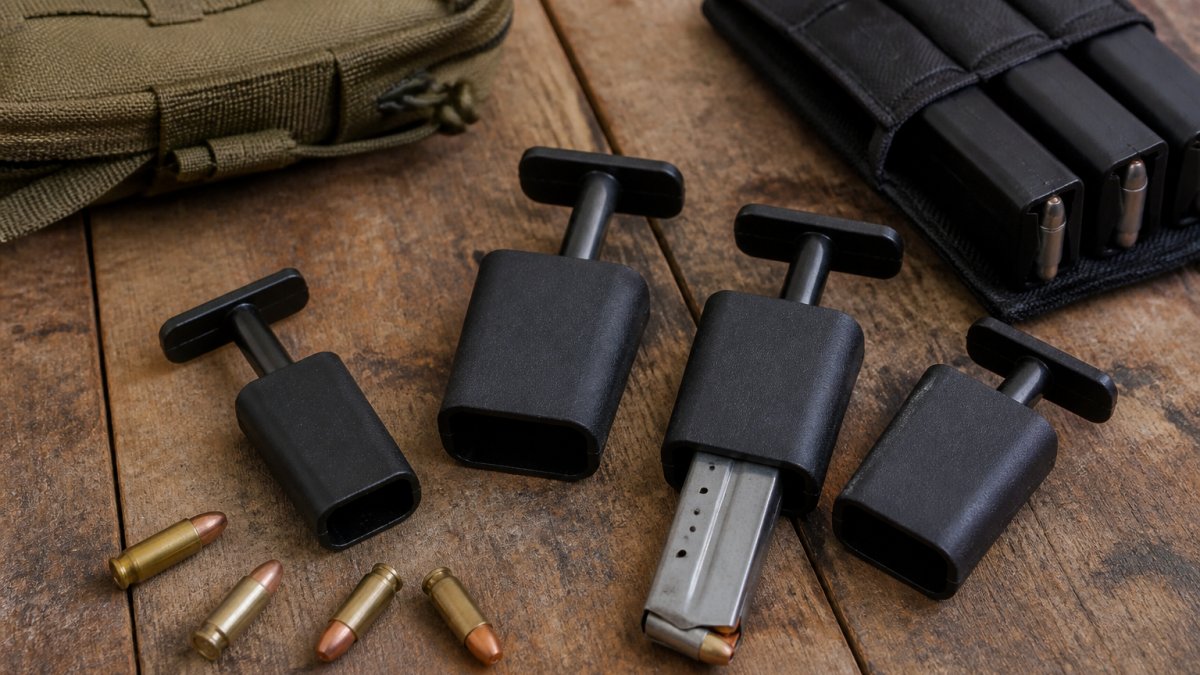
Magazine loaders fall into three families: manual hand loaders, bench-supported loaders, and compact designs you carry. Each pushes a round down and back against spring pressure so the next cartridge seats cleanly.
Manual, Bench-Supported, and Compact Designs
- Manual hand loaders: You hold the loader over the magazine and press each round in. Simple, light, and cheap.
- Bench-supported loaders: The loader rests on a flat surface, so the bench takes the force instead of your thumb. Best for high-volume sessions.
- Compact designs: Small enough for a range bag or pocket, built for carry and quick top-offs.
Bench-supported loaders are fastest but stay home. Compact loaders travel but demand more technique. Manual loaders split the difference. For a deeper look at how universal designs work, read our guide to the universal pistol speed loader.
The three loader families differ mainly in where the force goes and how they travel.
| Loader type | Best for | Key difference |
|---|---|---|
| Manual hand loaders | Simple, light, cheap use | You hold the loader and press each round in |
| Bench-supported loaders | High-volume sessions | Bench takes the force instead of your thumb |
| Compact designs | Carry and quick top-offs | Small enough for a range bag or pocket |
Pistol Magazine Loader Compatibility: What Actually Fits
Pistol magazine loader compatibility depends on three things: magazine body width, feed lip shape and angle, and cartridge overall length. A loader that fits a double-stack 9mm may not accept a single-stack .45 ACP magazine, and no universal loader handles every pistol ever made. Verify fit against your exact magazine model before you buy, not just your caliber.
How to Verify Fit Before You Buy
Use this four-step check to prevent most compatibility mistakes.
- Identify the exact magazine, not just the pistol. Write down the firearm model and the magazine part number if it is printed on the body. Magazine variants for the same pistol (flush-fit vs. extended, OEM vs. aftermarket) can have different body widths and feed lip geometry.
- Measure the magazine body width. Use calipers or a ruler at the widest point of the magazine body, just below the feed lips. Compare that number to the loader maker's stated opening width. A difference of a few thousandths of an inch matters on tight-fitting loaders.
- Check the feed lip profile. Single-feed and controlled-feed magazines present the round differently. Loaders that push against the follower plate need clearance for the feed lips; loaders that push the round down and back need the lips to be straight and undamaged.
- Confirm cartridge overall length. A loader set up for 9mm may not clear the longer .45 ACP or 10mm cartridge, even if the magazine body width is close.
Single-Stack vs. Double-Stack Magazines
Single-stack magazines are narrow, with rounds in one column. Double-stack magazines are wider, hold more rounds, and have stiffer springs. That extra spring pressure makes high-capacity double-stack mags the hardest to load by hand, so buy a loader rated for double-stack magazines.
Loaders designed around double-stack 9mm magazines often fit double-stack .40 S&W magazines of the same body width, but not single-stack .45 ACP or 10mm magazines. Do not assume a caliber match is a fit match.
Fit Notes by Popular Pistol Family
Use these notes as a starting point, then confirm against the maker's current fit list, since magazine generations change.
- Glock double-stack (17, 19, 22, 23, 26, 27, 34, 35, 45, 47): Widely supported by pistol loaders. Body width is consistent across these models, so a loader that fits one generally fits the others in the same caliber family.
- Sig P320 and P365: The P320 uses a wider double-stack body; the P365 uses a narrower micro-compact body. A loader that fits the P320 may be too loose on the P365, so check both separately.
- Springfield Hellcat and XD: The Hellcat is a micro-compact with a narrow body; the XD is a wider double-stack. Treat them as different fit categories.
If your pistol is not listed, measure the magazine body width and compare it to the loader's opening. When in doubt, contact the maker with your exact model and magazine part number.
Universal vs. Firearm-Specific Loaders
Universal loaders adjust to a range of magazine widths, convenient for shooters with several pistols, but a universal fit is a compromise fit: it may work well on the magazines it was designed around and less well on the edges of its range. Firearm-specific loaders fit one magazine family closely, which usually means smoother seating and less chance of scratching the magazine body, but they do not travel well across a mixed collection.
Picking a 9mm Magazine Speedloader for Your Pistol
The best 9mm magazine speedloader is one rated for your specific magazine, not just your caliber. A Glock 19 magazine and a single-stack 9mm magazine load very differently.
Start with the maker's fit list. Our EZ-MAG fits Glock 17, 18, 19, 22, 23, 24, 26, 27, 34, 35, 45, and 47 models in 9mm and .40 S&W, and works with most major brands including Sig P229, P320, and P365, Hellcat, Springfield XD, Ruger SR9, and Beretta 92. For Glock-specific guidance, see our roundup of the best speed loader for Glock 9mm magazines.
Hand Strength, Grip, and Ergonomics: Who Each Loader Suits
Ergonomics decide whether a loader helps or hurts. A good loader lets you push with your palm rather than your thumb and keeps your wrist neutral.
Shooters with limited hand strength, arthritis, or small hands benefit most from a loader with a wide, textured push surface and light spring resistance. Our guide on choosing a speed loader for arthritic hands walks through the fit factors that matter.
Bulletproof Speed-Loader Tier-1 Model →
A common mistake is buying the smallest loader available and then fighting it. Compact doesn't mean comfortable. Try the grip before you commit.
How to Use a Magazine Speedloader Correctly
Using a magazine speedloader correctly takes two steps: seat the magazine in the loader, then feed and push each round until it clicks into place. The technique is the same across most designs.
- Check the magazine. Confirm it's unloaded, clean, and the feed lips aren't bent.
- Seat the magazine. Slide it into the loader until it locks against the retention point.
- Feed a round. Drop a cartridge onto the follower plate, bullet facing the correct direction.
- Push down and back. Press the round past the feed lips until it seats. Repeat.
- Remove and check. Pull the magazine out and tap it against your palm to settle the rounds.
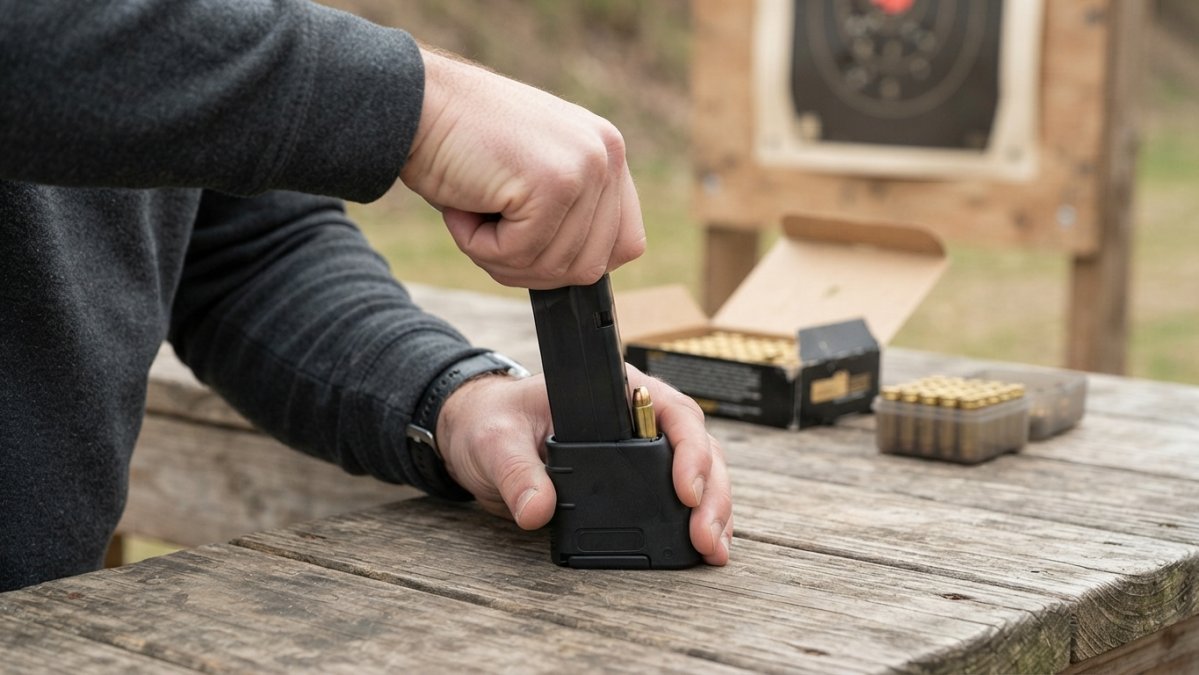
Watch out: forcing a round that won't seat usually means the magazine is misaligned in the loader or the round is backward. For the mistakes that damage feed lips, read our piece on common mistakes when loading handgun magazines.
Durability, Portability, and What Separates the Best Magazine Loader
The best magazine loader balances three things: construction that survives repeated use, a size that fits your range bag, and a design that won't scratch your magazines. Most buyers focus on the first and ignore the other two.
Construction Materials and Where Wear Happens
Polymer bodies resist heat and scratches and keep weight down. Aluminum parts add strength where the load concentrates. The parts that wear are predictable:
- The push mechanism or lever. This is where force is applied on every round. Polymer levers can flex under stiff double-stack spring pressure; aluminum levers resist flex but add weight and cost.
- The retention point or catch. This holds the magazine in place. A worn catch lets the magazine shift mid-load, which is a common cause of misaligned rounds and scratched magazine bodies.
- The feed lip contact area. Any surface that touches the feed lips should be smooth and free of burrs. Rough contact points are the usual cause of scratched magazines.
A practical pattern is a polymer body with metal reinforcement at the lever and catch. That combination keeps weight down while putting strength where the load concentrates.
Portability: What to Measure Before You Buy
A loader that lives in your safe does nothing for you. Before you buy, check three numbers:
- Weight. A heavy loader stays home. Compare the listed weight to a loaded magazine you already carry.
- Footprint. Measure the loader against the side pocket of your range bag. A loader that only fits in the main compartment is less likely to travel.
- Setup time. A bench-supported loader that needs assembly or clamping takes longer to deploy. A compact loader should seat on the magazine in one motion.
Care, Maintenance, and Troubleshooting
A loader is a simple tool, but it needs occasional attention. Most loading problems trace back to one of four causes:
- Sticking or hard seating. Clean the push mechanism and the retention point. Debris and accumulated case lube cause most sticking. A dry cloth and a light application of the maker's recommended lubricant, if any, usually resolves it.
- Poor fit. If the magazine shifts in the loader, the retention point may be worn or the magazine may be outside the loader's stated range. Stop and verify fit rather than forcing it.
- Damaged feed lips. Bent or burred feed lips cause rounds to seat crookedly. Inspect feed lips before each session and retire damaged magazines from loader use.
Store the loader clean and dry, and keep it out of direct sun if it has polymer parts. For the mistakes that damage feed lips, read our piece on common mistakes when loading handgun magazines.
Warranty and Support
Durability comes down to the push mechanism and the retention point. Ask what the maker does if a part fails, and read the warranty terms before you buy: a stated remedy (repair, replace, or refund), a stated term, and a support channel you can reach.
Our COMBAT and TACTICAL models are built from durable polymer for everyday range use, and the TACTICAL adds an anodized aluminum lever, mag release button, and catch for extra strength.
Match Your Loader to Your Pistol and Range Routine
Match the loader to how you actually shoot. A high-volume competitor needs a bench-supported or heavy-duty loader. A concealed carry holder needs something compact that fits a range bag. A casual shooter can start with a simple manual loader.
Use this framework to decide:
- If you load 10+ magazines per session: choose a bench-supported or heavy-duty loader.
- If you carry daily: choose a compact loader that fits your bag.
- If you have limited hand strength: choose a loader with a wide push surface and light resistance.
Our COMBAT and TACTICAL models are built from durable polymer for everyday range use, and the TACTICAL adds an anodized aluminum lever, mag release button, and catch for extra strength.
Frequently Asked Questions
Are magazine speedloaders worth it?
For anyone who shoots regularly, a magazine speedloader saves thumb pressure and range time. One product guide claims Maglula loaders load magazines three times faster than manual methods, though that figure comes from the guide's own claim rather than an independent benchmark. The practical case is simpler: loading double-stack magazines by hand gets painful after a few boxes, and a loader removes that friction. Some shooters still hand-load on purpose to slow their ammunition use, so a loader is a tool, not a requirement.
How do I know if a speedloader fits my magazine?
Check the loader's stated model list against your pistol and magazine design before buying. The Bulletproof Pistol Speed Loader, for example, lists Glock 17, 18, 19, 22, 23, 24, 26, 27, 34, 35, 45 and 47, plus Sig P229, P320 and P365, Hellcat, Springfield XD, Ruger SR9, Beretta 92 and CZ P10, and notes it does not work well with most Canik or H&K models. If a loader's listing does not name your firearm, assume it will not fit.
Is there a universal magazine loader?
Some loaders are marketed as universal, but fit still varies by magazine width, feed lip shape and spring tension. A loader that accepts a wide range of double-stack 9mm magazines may still struggle with a high-capacity .45 ACP magazine whose spring is harder to compress. Treat universal as a starting point, not a guarantee, and confirm your specific magazine appears in the compatibility list. Model-specific loaders trade flexibility for a more consistent fit.
How do you use a magazine speedloader safely?
Keep the firearm unloaded and pointed in a safe direction, and load magazines away from the pistol. Seat the magazine into the loader, feed rounds nose-first and push each one down until it locks. Check that rounds sit evenly against the feed lips before inserting the magazine. Keep your thumb clear of the follower path, and stop if a round seats at an angle rather than forcing it. Inspect the feed lips periodically, since repeated loading with a poor-fitting tool can bend them.
Loading magazines by hand works until it doesn't, and the day your thumbs give out mid-session is the day a loader pays for itself. At BULLETPROOF SPEED LOADERS, we build combat-ready loaders with durable construction and a lifetime repair, replace, or refund warranty, backed by US-based support. Get started with BULLETPROOF SPEED LOADERS and spend your range time shooting, not loading.