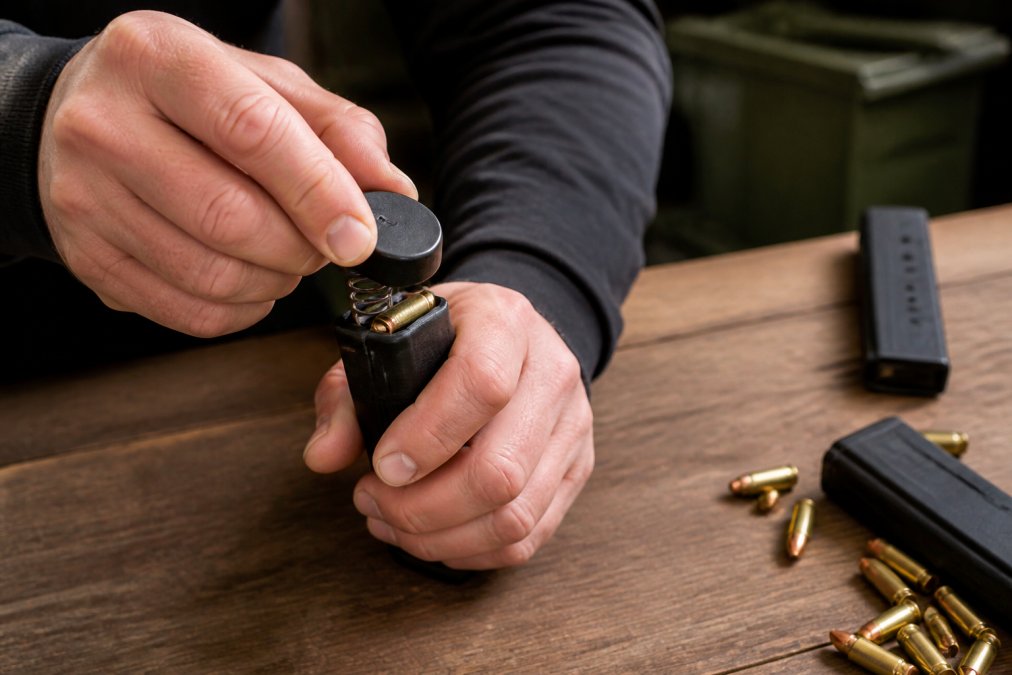
 how-to
Speed Loader for Stiff Magazine Springs: A How-To Guide
Table of Contents
- Why Magazine Springs Get Stiff and Why It Matters
- How to Break in Stiff Magazine Springs Properly
- Speed Loader for Stiff Magazine Springs: Types and Mechanics
- Best Magazine Speed Loader Options for Your Needs
- Addressing Thumb Pain From Loading Magazines
- Step-by-Step Technique for Loading with a Speed Loader
- Maintenance and Durability: Keeping Your Speed Loader Ready
- Frequently Asked Questions
Last Updated: August 7, 2026
Why Magazine Springs Get Stiff and Why It Matters
Stiff magazine springs are a reality for any serious shooter. New magazines come tight from the factory, and over time, springs can become stiffer due to manufacturing tolerances and material composition. When a magazine spring resists compression, loading becomes a battle of grip strength and endurance. Your thumb takes the punishment, range sessions get cut short, and competitive performance suffers.
At BULLETPROOF SPEED LOADERS, we've worked with shooters who abandoned their magazines because loading them hurt. The problem wasn't the magazines, it was the method. The right speed loader for stiff magazine springs transforms a painful chore into a smooth, repeatable action that takes seconds instead of minutes.

How to Break in Stiff Magazine Springs Properly
Breaking in stiff magazine springs properly accelerates the natural softening process and prevents premature fatigue. Start with dry-fire practice at home. Load and unload your magazine repeatedly without ammunition, performing 50-100 cycles per session three to four times per week. This conditions the spring material without overstressing it.
Next, use live fire with full loads. Load your magazine completely and shoot it down, then reload and repeat. The spring experiences real compression under the weight of actual cartridges plus the mechanical stress of chambering rounds. Most shooters see noticeable improvement after 200-300 rounds through a single magazine.
For high-capacity magazines, rotate between multiple magazines during range sessions. This distributes the break-in load across several springs rather than overworking one.
Avoid forcing a stiff magazine. Aggressive manual compression can damage the feed lips or cause the follower to bind.
Speed Loader for Stiff Magazine Springs: Types and Mechanics
A speed loader for stiff magazine springs provides mechanical advantage where your thumb alone cannot deliver sufficient force efficiently. Two primary designs dominate the market: collar-style loaders and lever-based loaders.
Collar-Style Loaders
Collar-style loaders work by sliding over the magazine and using a rotating collar to compress the spring stack. You insert the magazine, place rounds into the top opening, and rotate the collar downward. The mechanical advantage comes from the rotational motion distributed across the collar's circumference, reducing peak force at any one point. This design excels with single-stack magazines and is typically compact and lightweight, ideal for range bags.
The trade-off is speed. Rotating the collar takes slightly longer than a lever-based approach and requires a specific technique to avoid misalignment.
Lever-Based Loaders
Lever-based loaders use a hinged or sliding lever mechanism to compress the magazine spring directly. You insert the magazine, place rounds in the loading chamber, and pull or push the lever. This design shines with double-stack magazines and high-capacity designs where spring tension is intense. Competitive shooters favor lever designs because they enable faster tactical reloads.
The downside is ergonomics for certain hand conditions. A lever requires sustained grip pressure, which can aggravate thumb pain in shooters with small hands or previous hand injuries.
Best Magazine Speed Loader Options for Your Needs
The Bulletproof EZ-MAG Pistol Speed Loader stands as the top choice for most shooters dealing with stiff magazine springs. At $34.95, it combines affordability with proven reliability. The polymer construction keeps weight minimal, and the compact footprint fits any range bag. For recreational shooters and those new to speed loaders, this is where to start.
For shooters who demand more durability and faster reload cycles, the Bulletproof COMBAT Model ($69.95) upgrades to reinforced polymer with enhanced spring compression mechanics. Law enforcement and security professionals running high-volume training appreciate the durability investment.

The Bulletproof TACTICAL Model ($89.95) introduces anodized aluminum components and lever design, delivering the speed of a lever loader with precision engineering. If you shoot competitively or run frequent tactical training, the TACTICAL model's faster reload cycles justify the premium.
For operators who accept no compromise, the Bulletproof DELTA Model ($179.95) is machined from solid 6160 aircraft aluminum with a jet-black polymer lever. This is the speed loader for professional environments where equipment failure isn't an option.
| Model | Price | Best For | Magazine Compatibility |
|---|---|---|---|
| EZ-MAG Pistol | $34.95 | Beginners, recreational shooters | Single/double stack |
| COMBAT Model | $69.95 | Training, law enforcement | Single/double stack |
| TACTICAL Model | $89.95 | Competitive shooters | Single/double stack |
| DELTA Model | $179.95 | Professional operators | Single/double stack |
Each loader handles the mechanical challenge of spring tension differently, but all share the core advantage: they replace thumb fatigue with mechanical efficiency.
Addressing Thumb Pain From Loading Magazines
Thumb pain from loading magazines stems from repetitive compression against spring tension, compounded by magazine geometry that forces your thumb into an awkward angle. This pain isn't weakness, it's a mechanical problem. Some shooters experience thumb pain after loading just 50 rounds, while others can load 200 before discomfort sets in.
A speed loader eliminates this pain entirely by transferring compression force from your thumb to the loader's mechanical system. Instead of your hand fighting the spring, the loader compresses it. Your role becomes guiding rounds into the magazine, a task requiring minimal force.
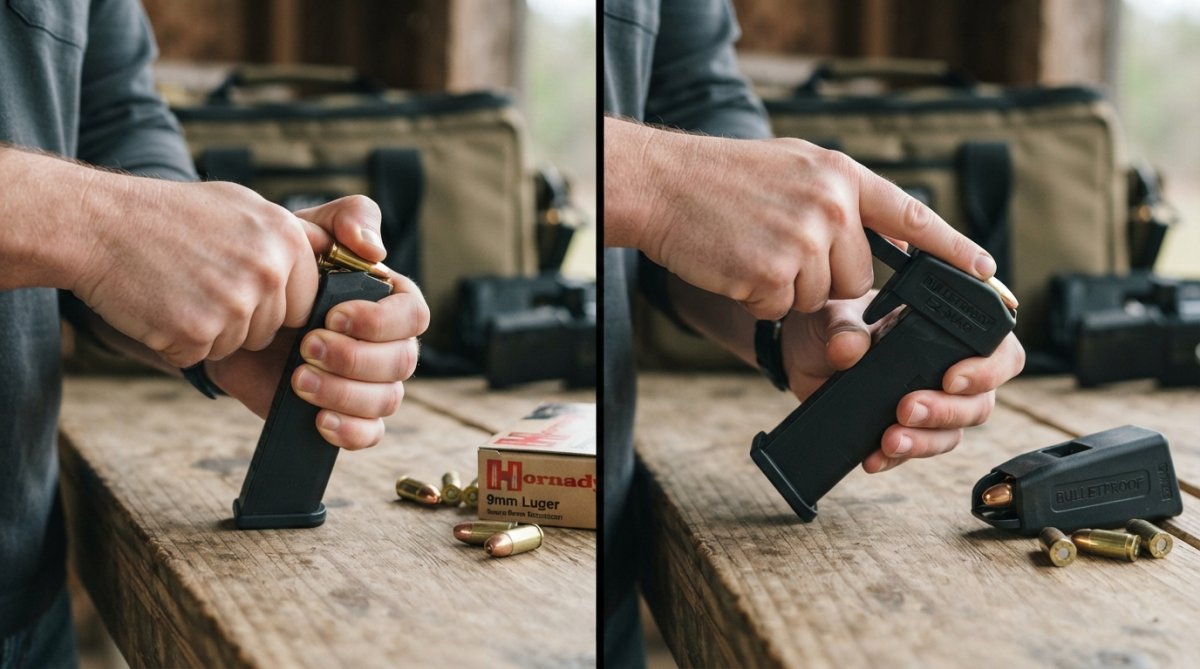
For shooters with small hands, the ergonomic benefit is even more pronounced. A smaller hand has less mechanical advantage when compressing springs manually. A speed loader levels the playing field by providing the same compression force regardless of hand size.
Step-by-Step Technique for Loading with a Speed Loader
Loading with a speed loader requires a specific technique to maximize speed and reliability. Let the loader compress the spring while you guide the rounds.
Step 1: Prepare Your Workspace Arrange your ammunition, magazine, and loader on a stable surface. Organize so you can access rounds without fumbling.
Step 2: Insert the Magazine Place the magazine into the loader according to its design. For collar-style loaders, slide the magazine straight up into the collar until it seats fully. For lever loaders, insert the magazine into the loading chamber and ensure it's seated flush.
Step 3: Load Your First Round Place a single round into the loader's top opening. The round should sit naturally in the loader's geometry without forcing.
Step 4: Activate the Compression Mechanism For a collar loader, rotate the collar downward in a smooth, controlled motion. For a lever loader, apply steady pressure to compress the spring. Controlled pressure is key, aggressive force doesn't load faster and risks damaging feed lips.
Step 5: Load Subsequent Rounds Once the spring is compressed, place each additional round into the loading chamber. The loader's geometry feeds each round into the magazine automatically.
Step 6: Release and Remove Release the compression mechanism and remove the loaded magazine. Verify that all rounds are seated properly.
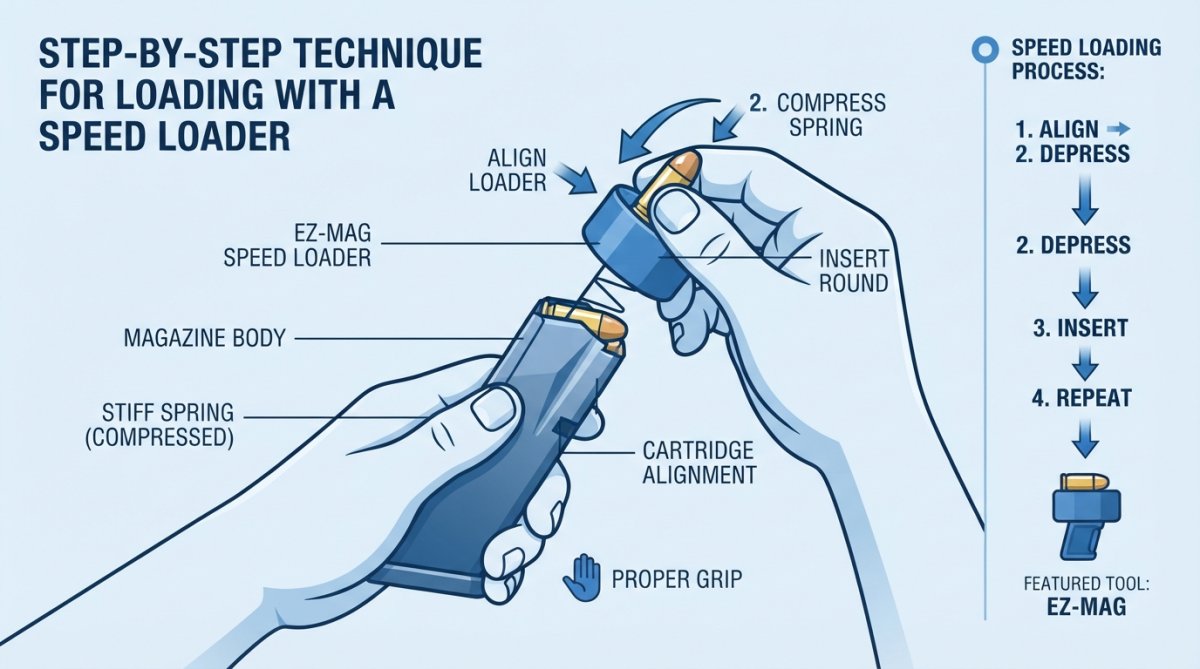
The entire process takes 20-30 seconds per magazine once you develop muscle memory. Compare that to 60-90 seconds of manual loading, and the efficiency gain becomes obvious. More importantly, your thumb stays fresh, allowing you to load more magazines during a range session without fatigue.
Common mistakes include forcing the magazine into the loader, using excessive compression force, and trying to load too quickly before the spring is properly compressed.
Maintenance and Durability: Keeping Your Speed Loader Ready
A speed loader is a simple mechanical device, but like any tool, it requires basic maintenance to function reliably for years. Clean your loader after every range session by wiping the exterior with a dry cloth to remove powder residue and debris. Use a soft brush or compressed air to clear the internal loading chamber. Polymer loaders can be rinsed with warm water and dried thoroughly.
Inspect the compression mechanism for cracks or wear. For collar loaders, check that the collar rotates smoothly. For lever loaders, verify that the lever moves freely and returns to its original position without sticking. Check the loading chamber for burrs or sharp edges that could damage feed lips on your magazines.
For aluminum components like those on the TACTICAL and DELTA models, avoid storing the loader in humid environments. Keep your loader in a dry range bag or storage case.
The durability difference between polymer-only designs and aluminum-reinforced models becomes apparent over 1,000+ loading cycles. A Bulletproof DELTA Model will function identically after five years of heavy use. A budget polymer loader may develop cracks or compression inconsistencies after two years of competitive use.

Replace your loader if the compression mechanism becomes unreliable, the loading chamber develops burrs, or any structural component cracks.
Stiff magazine springs don't have to define your shooting experience. The right speed loader transforms loading from a painful, time-consuming chore into a smooth, efficient process that keeps you fresh through entire range sessions. Whether you're a recreational shooter managing thumb fatigue, a competitive shooter optimizing reload speed, or a professional who demands equipment that never fails, Bulletproof Speed Loaders offers precision-engineered solutions designed for the specific challenge of stiff springs.
Start with the Bulletproof EZ-MAG Pistol Speed Loader if you're new to loaders or shooting 9mm with limited hand size. Progress to the COMBAT or TACTICAL models as your volume increases and your needs demand faster reload cycles. For professionals and serious competitors, the DELTA Model delivers the durability and mechanical certainty that justifies the investment.
Add Bulletproof Speed Loaders and experience the difference that mechanical advantage brings to your shooting. Your thumb will thank you.
Frequently Asked Questions
Why are my magazine springs so stiff?
New magazine springs are engineered with high spring tension to maintain consistent feed lips geometry and cartridge alignment throughout the magazine's service life. Stiff springs prevent follower tilt and ensure reliable chambering. Over time and with use, springs gradually relax, but quality magazines maintain tension for thousands of rounds. Polymer-frame firearms and high-capacity double-stack magazines often have stiffer springs due to the weight and compression required for reliable feeding.
How do you break in a new stiff magazine spring?
Load and unload the magazine 20-30 times by hand or with a speed loader over 2-3 range sessions. This gradual compression cycles the spring material and reduces initial stiffness without damaging feed lips. Avoid forcing the magazine into the firearm repeatedly, as this can bend the feed lips. A speed loader like the Bulletproof EZ-MAG ($34.95) makes break-in easier by distributing compression force evenly across the follower, preventing thumb fatigue during the process.
Do speed loaders damage magazine springs or feed lips?
Quality speed loaders with proper mechanical advantage and polymer followers are designed to compress springs safely without stripping feed lips. Cheap universal loaders with poor tolerances or metal followers can damage feed lips if they don't align correctly with the magazine geometry. The Bulletproof TACTICAL Model ($89.95) uses anodized aluminum components with precision engineering to ensure even compression and protect feed lips from damage during high-volume loading sessions.
Will a universal speed loader work with my .45 ACP high-capacity magazines?
Universal speed loaders vary in compression capability. Single-stack .45 ACP magazines typically have lighter spring tension than 9mm double-stack magazines, so most universal loaders handle them easily. However, high-capacity double-stack .45 magazines have significantly stiffer springs and require a loader with strong mechanical advantage. The Bulletproof DELTA Model ($179.95), made from solid aircraft aluminum, provides maximum compression force for demanding calibers and magazine types without risk of spring or feed lip damage.
This article was written using GrandRanker