 how-to
How to Store Your Concealed Carry Firearm Safely at Home
Table of Contents
- Why Safe Storage Matters for Concealed Carry Owners
- Choosing the Best Biometric Gun Safes for Home Defense
- Storing Loaded vs Unloaded Firearms: What You Need to Know
- Firearm Storage Laws by State: What You Must Follow
- Layered Security Strategies for Your Home
- Preventing Unauthorized Access: Child Safety and Theft Deterrence
- Accessibility vs. Security: Finding the Right Balance
- Frequently Asked Questions
Last Updated: September 20, 2026
Why Safe Storage Matters for Concealed Carry Owners
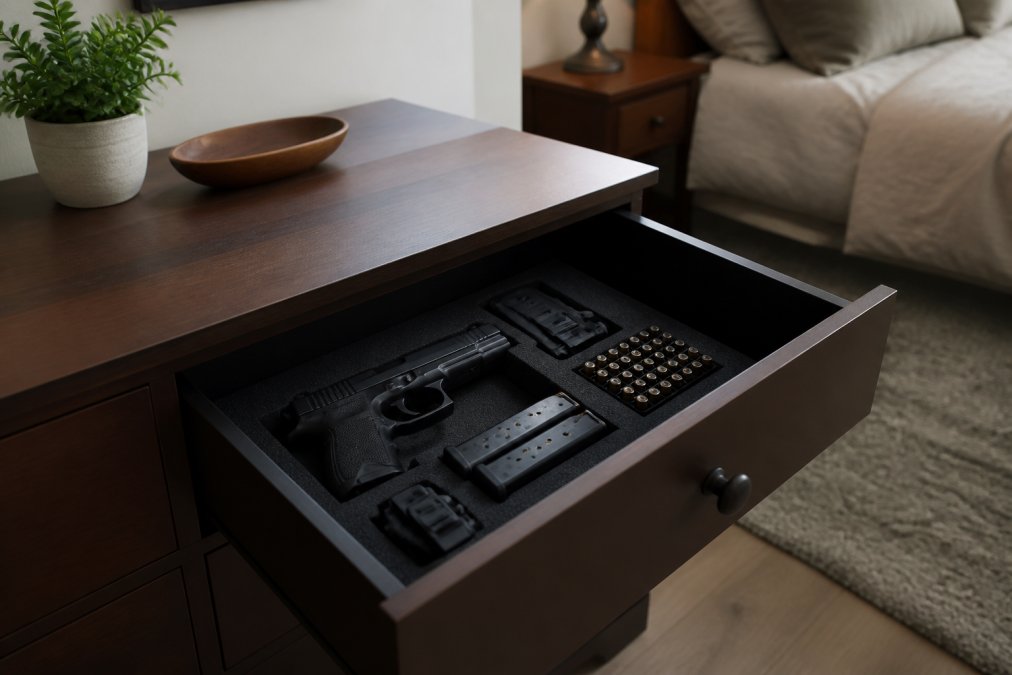
Knowing how to store your concealed carry firearm safely at home is the practice of keeping a defensive handgun secured against unauthorized access while still being reachable when you need it. For daily carriers, that balance is the whole game, and it is where most advice falls short.
Both choices create real risk. A firearm that is not secured can be taken by a child, a guest, or a burglar.
The Real Cost of Unsecured Firearms
An unsecured handgun is the single most common link in household firearm accidents and thefts. Many law enforcement agencies report that a large share of stolen guns come from vehicles and nightstands rather than from locked safes.
- A locked container that only you can open
- A firearm that is either unloaded or stored in a holster with the trigger covered
- Ammunition stored in a separate locked location when practical
- A habit of returning the gun to storage every single time
Choosing the Best Biometric Gun Safes for Home Defense
The best biometric gun safes for home defense open in under two seconds, run on a reliable power source, and mount to something solid. Speed matters because a safe you avoid using is a safe that fails you.
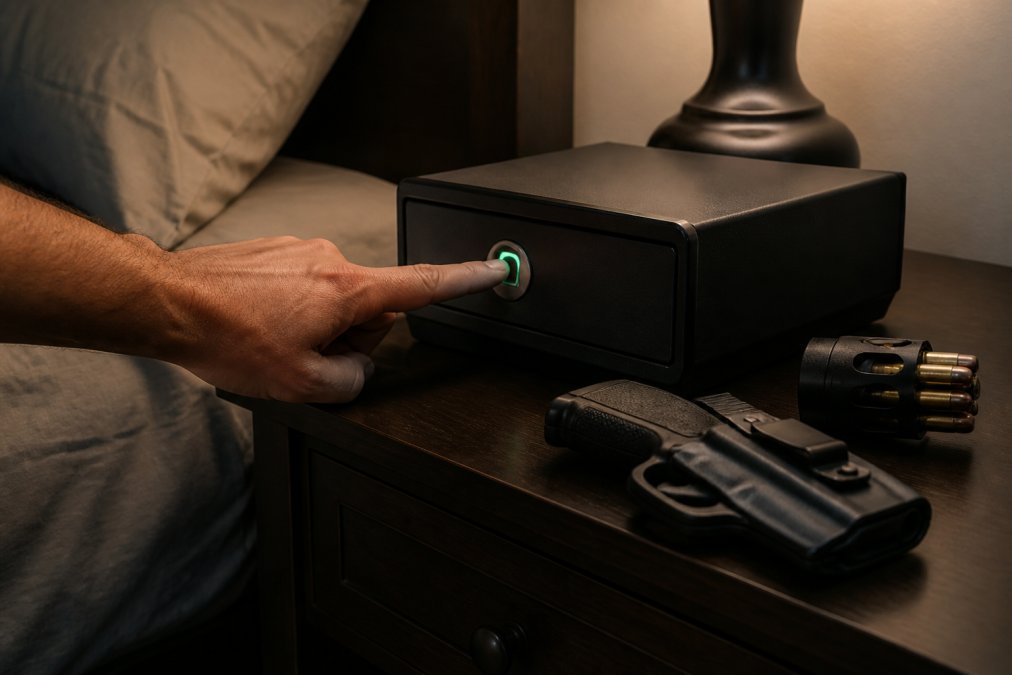
When you shop, check these specs:
- Steel construction with a gauge thick enough to resist prying
- Anchor points so the safe can be bolted down
- Mechanical override in case the battery dies
- Tamper-resistant latch and hinge design
- A security rating from a recognized testing standard
Biometric vs. Mechanical Locks: Which Is Right for You?
Biometric locks win on speed. Mechanical locks win on reliability. A combination or key lock never runs out of battery and never fails to read a fingerprint.
Battery Life and Maintenance for Electronic Safes
Electronic safes need routine care. A common mistake is installing the safe and never thinking about it again until it beeps.
- Replace batteries on a set schedule, not when they die
- Test the fingerprint reader monthly
- Keep the override key somewhere secure but reachable
- Wipe the sensor clean; oils and dust reduce reads
Storing Loaded vs Unloaded Firearms: What You Need to Know
Storing loaded vs unloaded firearms is a personal decision shaped by your household, your training, and your state law. There is no single right answer, but there is a wrong one: leaving a loaded gun where anyone can reach it.
Here is how most experienced carriers think about it:
| Storage Approach | Speed to Access | Risk Level | Best For |
|---|---|---|---|
| Loaded in quick-access safe | Fastest | Low if secured | Homes with no small children |
| Loaded, chamber empty | Fast | Low | Carriers who train to rack |
| Unloaded, ammo separate | Slowest | Lowest | Homes with children or visitors |
Firearm Storage Laws by State: What You Must Follow
-
18 U.S.C. § 922(g) prohibits possession by certain categories of people, including anyone convicted of a felony and anyone subject to a qualifying domestic violence protective order. If a prohibited person can access your firearm, the exposure is not just a storage violation.
-
18 U.S.C. § 922(q) is the federal Gun-Free School Zones Act. It generally bars possession of a firearm in a school zone, with limited exceptions, and it is a reminder that storage and transport rules do not stop at your front door.
-
18 U.S.C. § 924 supplies the penalties that attach to the offenses above, which is why federal prosecutors treat access by prohibited persons as a serious matter.
-
The Protection of Lawful Commerce in Arms Act (PLCAA) shields manufacturers and sellers from most civil liability for a third party's criminal misuse of a lawfully sold firearm, but it does not shield an owner who stores negligently.
-
Locked-storage-or-locking-device states. Some states require that a firearm be stored in a locked container or secured with a locking device when it is not in your immediate control, or when a minor or prohibited person could gain access. The trigger is usually access, not ownership.
-
Minor-access statutes. Many states impose criminal liability when a minor gains access to a negligently stored firearm, sometimes with an exception if the minor's access was unlawful. The age threshold and the exceptions differ by state.
-
Strict-storage jurisdictions. A smaller group of states goes further, requiring locked storage in the home in defined circumstances and, in some cases, imposing liability when a firearm is stolen from an unsecured location and later used in a crime.
-
Preemption and local ordinances. Many states preempt local firearm regulation, but not all do. In non-preemption states, a city or county ordinance can add a storage requirement your state statute does not.
How to check your own jurisdiction in about ten minutes:
- Search your state legislature's official site for the statute covering firearm storage, often titled something like "secure storage of firearms" or "firearm access by minors."
- Read the definitions section first. The words "minor," "locked container," and "immediate control" carry the weight.
- Check your state attorney general's published guidance, which frequently summarizes the statute in plain language.
- Check your county and city code for a local storage provision, especially if your state does not preempt local firearm law.
- Note the effective date of the current version. A statute amended last year may read differently than the summary you find first.
State legislature and attorney general firearm storage guidance
Layered Security Strategies for Your Home
Layered security means no single point of failure protects your firearm. If one layer fails, another still stands between your gun and an unauthorized person.
Build your layers like this:
- Secure the firearm in a locked safe or lockbox.
- Anchor the container to a wall, floor, or heavy furniture.
- Store ammunition separately in its own locked location.
- Control access with keys, codes, or biometrics only you hold.
- Add home security like cameras or alarms for theft deterrence.
Concealment vs. Security: Why You Need Both
Concealment hides the safe; security protects it. A safe bolted inside a closet, behind a door, or in an interior room is harder to find and harder to remove.
Preventing Unauthorized Access: Child Safety and Theft Deterrence
Preventing unauthorized access starts with knowing who is in your home. Children, guests, roommates, and contractors all pass through, and any of them could find an unsecured gun.
Practical steps that work:
- Teach children that firearms are off-limits and never a toy
- Keep every safe locked, even when the gun is out for cleaning
- Never leave a firearm unattended during cleaning or dry practice
- Re-key or reset codes when a roommate moves out
- Store spare keys and override keys away from the safe
Accessibility vs. Security: Finding the Right Balance
Accessibility and security pull against each other, and the right balance depends on your home and your training. The goal is a setup you will actually use every day, not a perfect one you abandon after a week.
Ask yourself three questions:
- Can I open this in the dark, under stress, in under three seconds?
- Can a child or visitor open it?
- Will I still use it on a tired Tuesday night?
Frequently Asked Questions
Where is the safest place to store your firearm at home?
The safest place is a locked gun safe or lockbox that is bolted down or secured to a solid surface. Ideally, place it in a low-traffic area like a bedroom closet or a designated interior room. Avoid hiding it in obvious spots like a nightstand drawer or under a mattress, as these are easy targets for theft or unauthorized access. A bolted-down safe with a biometric lock gives you quick access for home defense while keeping the firearm secure from children and intruders.
Should I store my concealed carry firearm loaded or unloaded?
For home defense, storing your firearm loaded in a quick-access safe is a common and legal choice. It allows you to retrieve it rapidly if needed. However, if you have children or visitors, an unloaded firearm with ammunition stored separately adds an extra layer of safety. The key is to follow your state's storage laws and ensure that any loaded firearm is always under your control or locked away. Many concealed carry holders keep a loaded magazine in the safe but not in the gun itself.
What are the legal requirements for firearm storage in the home?
Storage laws vary significantly by state. Some states, like California and Massachusetts, require firearms to be stored in a locked container or with a trigger lock when not in use. Others have no specific storage mandate but hold owners liable if a minor accesses the firearm. Check your state's statutes or consult a local attorney to ensure compliance. Regardless of the law, using a gun safe, cable lock, or lockbox is a responsible practice that reduces risk and liability.
How can I keep my firearm accessible for home defense while keeping it secure?
A biometric gun safe offers the best balance of speed and security. It opens in under a second with your fingerprint, yet keeps the firearm locked away from unauthorized users. Mount the safe near your bed, bolted to a stud or floor. Practice accessing it in the dark to build muscle memory. For added security, use a layered approach: a locked safe, a home security system, and a firearm that is loaded but with no round in the chamber if you prefer. Always follow safe handling rules.