 how-to
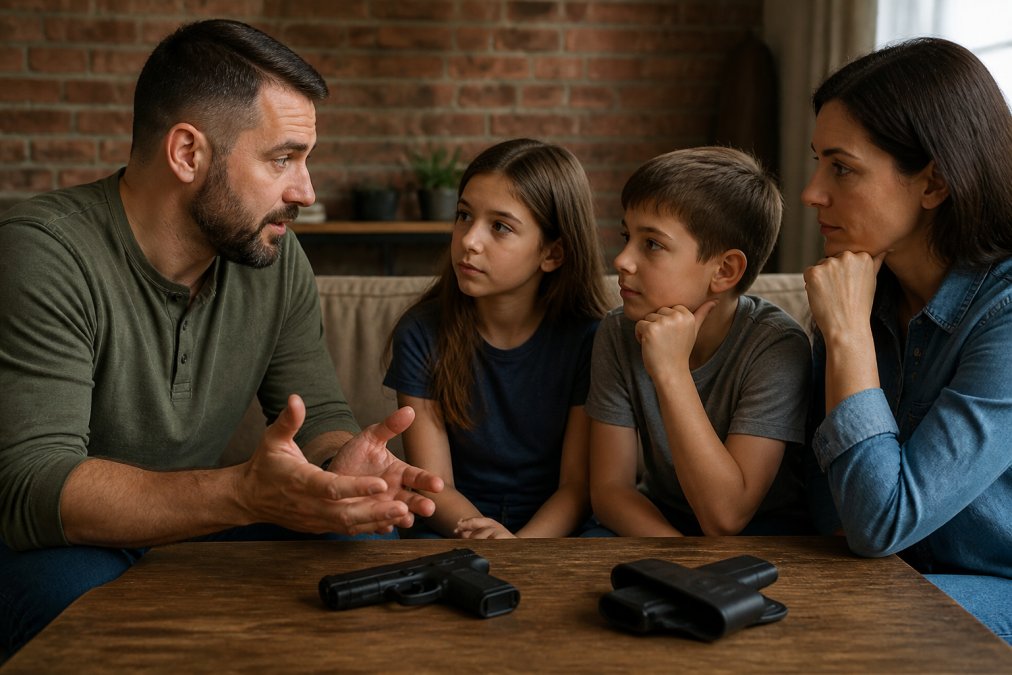
How to Talk to Family About Concealed Carry Safety
Table of Contents
- Why These Conversations Matter More Than Ever
- Gun Safety Conversation Scripts That Actually Work
- Best Practices for Safe Firearm Storage at Home
- Firearm Safety Rules for the Home Every Family Should Know
- Teaching Children What to Do If They Find a Firearm
- Managing Anti-Gun Family Dynamics Without Conflict
- Legal and Liability Considerations for Concealed Carry Safety
- Practical Gear That Supports Safe Carry
- Frequently Asked Questions
Last Updated: September 17, 2026
Why These Conversations Matter More Than Ever
Concealed carry safety starts at the dinner table.

A firearm in the home is only as safe as the people who know about it. Family members who do not know you carry cannot help keep it secure or teach your kids what to do.
Gun Safety Conversation Scripts That Actually Work
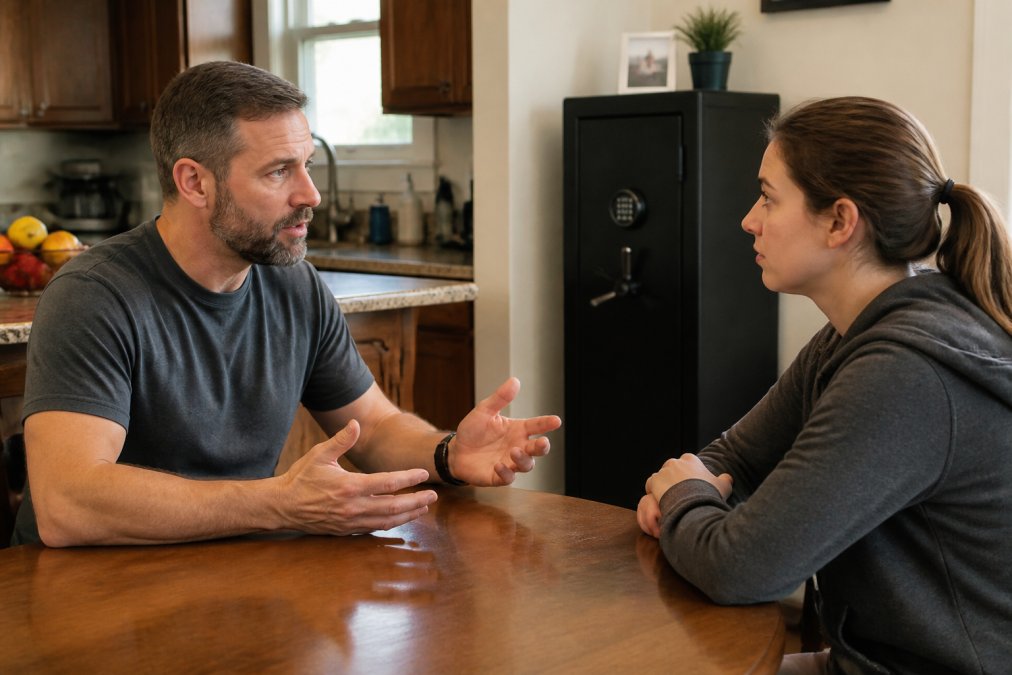
Here is the framework we recommend:
- Start with why you care. "I want our home to be safe, and I want you to know what I do."
- Name the choice. "I carry a firearm for personal protection. I want to be honest about that."
- Invite questions. "What worries you about that?"
- Agree on rules. "Here is how I store it and where it stays."
Opening Lines for Different Family Members
Different people need different openers: a spouse wants partnership, a teenager honesty, a parent reassurance.
- Spouse: "I want us to be a team on home safety. Can we talk about how I carry?"
- Teen: "You are old enough to know the truth about the firearm in this house."
- Parent or in-law: "I know we see this differently. I still want you to feel safe here."
De-Escalation Phrases When Tensions Rise
When fights happen, drop the facts and name the feeling.
- "I hear that this scares you."
- "I am not asking you to agree. I am asking you to understand."
- "Let's pause and come back to this tomorrow."
Best Practices for Safe Firearm Storage at Home
Secure storage is the most important part of concealed carry safety at home. A locked firearm cannot be used by a child, a guest, or a thief.
Core storage rules:
- Keep every firearm unloaded when not in use.
- Lock it with a gun safe, cable lock, or trigger lock.
- Store ammunition in a separate locked spot.
- Keep the safe key or code private.
Storage Options That Fit Different Households
| Household Type | Best Storage Option | Why It Fits |
|---|---|---|
| Home with young kids | Full gun safe, ammo locked apart | Blocks all access |
| Apartment, tight space | Small quick-access safe | Compact, still secure |
| Home with teens | Safe plus a safety talk | Locks plus education |
| Solo carrier | Trigger lock or cable lock | Fast, low cost |
The NSSF guidance on responsible firearm ownership stresses matching your storage to your household. A safe that fits one home may not fit another.
Firearm Safety Rules for the Home Every Family Should Know
Firearm safety rules for the home are simple, and every family member should be able to say them out loud. Teach these four first.
- Treat every firearm as if it is loaded.
- Never point a firearm at anything you do not want to destroy.
- Keep your finger off the trigger until you are ready to shoot.
- Know your target and what is behind it.
Teaching Children What to Do If They Find a Firearm
Teach children one short script: stop, do not touch, leave the area, and tell an adult. Practice until they can say it without thinking.
- Stop. Freeze the moment they see a firearm.
- Do not touch. Hands off, always.
- Leave the area. Walk away right away.
- Tell an adult. Find a parent, teacher, or trusted grown-up.
Managing Anti-Gun Family Dynamics Without Conflict
Some family members will never support concealed carry. That is their right. Your job is not to change their mind but to keep the peace and keep your home safe.
The Three-Tier Response Framework
Sort the objection before you answer it. Anti-gun family members fall into three tiers, each needing a different response.
-
"I hear you. Here's exactly how it's stored, and here's what I've trained on. Ask me anything."
-
"You don't have to like it. I just want you to know the facts so you're not guessing."
-
"I'm not going to change your mind on policy, and you're not going to change mine. Can we agree the kids' safety matters more than winning this?"
-
"I'm happy to talk about my storage and my training. I'm not going to debate the Second Amendment at Thanksgiving."
-
"I respect your choice not to carry. I need you to respect mine. That's the deal for being in my home."
-
"If you can't do that, we can meet somewhere else. I'd rather see you than win this."
Boundary Scripts for Common Flashpoints
These are the situations that actually blow up. Have the line ready before you need it.
- "Don't bring that into my house.", "Understood. I'll leave it locked in the car safe or at home. I'd ask the same respect when you're at mine."
- "I don't want my kids around it.", "Fair. It stays locked, unloaded, and out of reach the entire visit. I'll show you the safe if that helps."
- "You're paranoid.", "Maybe. I'd rather be prepared and wrong than unprepared once."
- "What are you so afraid of?", "Nothing specific. I just decided a long time ago that I'd rather have the option than not."
- "If you loved us you wouldn't carry.", "I carry because I love you. That's the whole reason."
The Rules That Keep the Peace
- Lead with shared values. Family safety, not politics. Everyone in the room agrees kids should be safe.
- Skip the debate. You will not win a policy argument at a dinner table, and you do not need to.
- Share facts about your setup, not your opinions. Storage, training, and rules are concrete. Politics is not.
- State the boundary once, then stop. Repeating it turns a boundary into a fight.
- Give them an exit. "We can agree to disagree" is not weakness. It is how you keep the relationship.
- Never argue in front of kids. Take it to another room or another day.
When to Stop Trying
Some family members will not come around, and that is allowed. You do not need their approval to carry, you need their awareness so they do not accidentally create a risk, like leaving a door unlocked or letting kids into a room they should not enter.
Legal and Liability Considerations for Concealed Carry Safety
Concealed carry safety includes knowing the law. Rules vary by state and change often, and you are responsible for knowing what applies where you live and travel. But the part most guides skip matters most to your family: what happens legally if a firearm you own is used by someone else.
The Liability Question Your Family Will Ask
When you tell a spouse or parent you carry, the unspoken question is often, "What happens to us if something goes wrong?" Here is the framework.
- Criminal liability. If a firearm you own is used in a crime, investigators will look at how it was stored and who had access. Secure storage is your first line of defense.
- Civil liability. Even without criminal charges, you can be sued if a firearm you own injures someone. Negligent storage is the theory plaintiffs use most often.
- Household access. If a family member is legally prohibited from possessing firearms, a felony conviction, certain domestic-violence restraining orders, some mental-health adjudications, allowing them access can expose you to federal and state charges. Federal law under 18 U.S.C. § 922(g) lists the categories of prohibited persons.
The Federal Backstop: 18 U.S.C. § 922(d) and § 922(g)
Two federal provisions matter here.
- § 922(d) makes it unlawful to sell or otherwise transfer a firearm to a person you know or have reasonable cause to believe is prohibited.
- § 922(g) lists who is prohibited: felons, fugitives, unlawful users of controlled substances, persons adjudicated mentally defective or committed to a mental institution, persons subject to certain protective orders, persons convicted of misdemeanor crimes of domestic violence, and others.
"Transfer" is broader than a sale: letting a prohibited family member access a firearm you own can be treated as a transfer in some jurisdictions. That is why your storage rules are not negotiable.
State Storage Laws You Should Check
There is no single federal safe-storage statute, and state differences matter.
- Some states impose criminal liability when a minor gains access to a negligently stored firearm. These are often called "child access prevention" (CAP) laws.
- Some states require locked storage whenever a prohibited person resides in the home.
- Some states require reporting a lost or stolen firearm within a set number of hours.
- Some states require a locking device to be sold with every handgun.
The Four Legal Points to Cover in the Family Talk
When you sit down with your family, say these four things out loud so no one is guessing.
- Where you can legally carry, and where you cannot. Schools, federal buildings, courthouses, and post offices are common off-limits locations. State rules differ on bars, churches, and private property with posted signs.
- Your duty to inform. Some states require you to tell an officer you are carrying during a traffic stop. Others do not. Know which applies where you are.
- Storage rules if a child or prohibited person lives with you. This is the one that creates the most legal exposure and the one families most often ignore.
- Your liability if an unsecured firearm is used in a crime or injury. Explain it plainly. It is the reason the safe stays locked.
Reciprocity and Travel
If you travel across state lines with a firearm, your permit may or may not be recognized. Reciprocity is state-by-state and changes with legislation and court decisions. Before any trip, check the destination state's own website, not a third-party map, for rules on recognition, magazine capacity, and vehicle transport.
What to Put in Writing
A short written household firearm policy removes ambiguity and shows you took the duty seriously.
- Who may access the safe, and who may not.
- Where the firearm is stored and where ammunition is stored.
- What a child should do if they find a firearm.
- Who to call in an emergency.
- The date the policy was reviewed and by whom.
Practical Gear That Supports Safe Carry
Safe carry habits pair well with the right gear. A speed loader keeps range time smooth and magazines loaded without finger fatigue, which matters when you train often.

Frequently Asked Questions
What should you teach your family about firearm safety?
Teach the four universal rules: treat every gun as loaded, never point it at anything you don't intend to shoot, keep your finger off the trigger until ready, and know your target and what's behind it. For concealed carry safety, add that the firearm stays holstered and secured unless there is a genuine threat. Practice these rules together and revisit them regularly so they become habit.
How do you explain the importance of safe firearm storage to family members?
Frame it around protecting everyone, not restricting access. Explain that secure storage with a gun safe, trigger lock, or locked case keeps guns out of the wrong hands, especially children and visitors. Mention that most unauthorized access happens with unsecured firearms. Offer to demonstrate your storage setup and walk through your safety protocols so family members see you take responsibility seriously.
Should you disclose your concealed carry status to extended family?
Disclosure is a personal decision with legal and relational angles. In some states, you have no duty to inform family, but if they live with you or visit often, they should know a firearm is in the home for safety reasons. Use a non-judgmental approach: share that you carry for personal protection, explain your safety habits, and answer questions calmly. If someone is strongly anti-gun, focus on secure storage and boundary setting rather than debating rights.
What role does gear like speed loaders play in overall firearm safety?
Speed loaders reduce the time and hand strain of loading magazines, which helps you stay focused and avoid rushed, unsafe handling at the range or during practice. A tool like the Bulletproof EZ-MAG Pistol Speed Loader ($34.95) lets you load rounds with two simple steps, so you spend less time fumbling and more time reinforcing safe habits. Reliable gear supports consistent, controlled training, which is a core part of concealed carry safety.