 how-to
Choosing the Right Magazine Pouch for 1911
Table of Contents
- Understanding 1911 Magazine Pouch Basics
- Single 1911 Magazine Pouch vs. Dual Configurations
- Double Magazine Pouch for 1911: Side-by-Side vs. Stacked
- 1911 Magazine Pouch Retention: Snap, Flap, and Open-Top
- 1911 Mag Pouch Recommendations by Carry Method
- Material, Durability, and Maintenance
- Step-by-Step Fit and Compatibility Check
- Common Mistakes to Avoid
- Frequently Asked Questions
Last Updated: October 14, 2026
Understanding 1911 Magazine Pouch Basics
Choosing the right magazine pouch for your 1911 pistol starts with your firearm's dimensions.
The standard single-stack 1911 magazine measures approximately 4.25 inches and holds seven to eight rounds; double-stack variants run wider and taller.
Belt compatibility matters equally. Pouches attach via belt loops, paddle attachments, or MOLLE webbing, and one designed for a 1.5-inch belt won't secure on a 1.75-inch tactical belt, causing shifting, printing, and retention failures.
Magazine dimensions and fit requirements
Your 1911 magazine's exact measurements are non-negotiable.
Capacity affects how the magazine sits: seven-round magazines compress differently than eight or nine-round variants. Too loose and the magazine rattles; too tight and reload speed suffers.
Test fit before purchasing whenever possible. Insert your magazine and draw it one-handed; it should slide out with consistent resistance, neither falling freely nor requiring excessive force.
Carry position and belt compatibility
Where you carry your spare affects your loadout. Hip carry near your primary holster offers quick reload access; appendix carry conceals but can print; rear carry sits away from your strong hand but offers a lower profile.
Belt width determines attachment security. Standard duty belts run 1.5 to 1.75 inches; tactical belts often exceed 2 inches.
Measure your actual carry belt before selecting a pouch, checking width and material thickness, since leather and nylon behave differently under load. Your belt must support the added weight without sagging or rotating.
Single 1911 Magazine Pouch vs. Dual Configurations
A single magazine pouch carries one spare. For recreational shooting, one reload gets you through most range sessions; for concealed carry, it maintains a lower profile and reduces printing.
Dual configurations carry two magazines. Competitive shooters and professionals favor them because two spares eliminate the need to reload twice during extended engagements or stages.
The trade-off is weight and concealment.
When single-mag pouches make sense
Single pouches excel for everyday carry and recreational shooting.
Range sessions work well with a single pouch if you reload from a bag or table between strings, since access speed matters less than simplicity.
Budget-conscious shooters often start with a single pouch, investing in quality without overcommitting. Once you determine your preferred carry position and retention style, upgrading to dual capacity is straightforward.
Advantages of carrying two magazines
Two magazines enable faster reloads during matches or high-round-count training days.
Law enforcement and security professionals benefit from dual capacity during extended operations, where a single reload might not suffice. Two spares provide a meaningful buffer without a full ammunition pouch.
Redundancy is another advantage: if one magazine develops a feeding issue, you have an immediate alternative without interrupting your training or duty cycle.
Double Magazine Pouch for 1911: Side-by-Side vs. Stacked
A double magazine pouch for 1911 carries two magazines in one carrier. The arrangement, side-by-side or stacked, affects access speed, concealment profile, and draw consistency.
Side-by-side magazine arrangement
Side-by-side pouches position magazines horizontally, spreading weight across your waistband and reducing pressure concentration. Access is intuitive: reach, grab, reload.
The downside is horizontal width. A side-by-side double pouch creates a wider footprint than a single pouch, printing visibly under concealment garments and adding noticeable bulk during extended wear.
Stacked magazine arrangement
Stacked pouches position one magazine above the other vertically, minimizing horizontal width for concealed carry. The vertical profile hides more easily under fitted clothing and prints less.
Access requires more deliberate hand placement, reaching higher or lower depending on which magazine you grab first. Once trained, access speed matches side-by-side arrangements through muscle memory.
Stacked pouches concentrate weight in a smaller footprint, creating pressure points during extended wear, especially with a low-riding belt or tight clothing.
1911 Magazine Pouch Retention: Snap, Flap, and Open-Top
Retention systems secure your magazine inside the pouch during movement, preventing loss during tactical transitions or intense activity. Three primary systems dominate the market: snap closures, flap designs, and open-top configurations.
Snap and flap retention systems
Snap closures secure the magazine with mechanical fasteners. One snap at the top prevents the magazine from sliding out during movement.
Snaps and flaps provide maximum security. Your magazine stays in place during running, diving, or aggressive movement. This security comes at a cost: draw speed.
Flap designs offer a middle ground. They secure the magazine without requiring active release. A properly fitted flap creates friction that prevents loss while allowing a confident draw.
Open-top design for speed
Open-top pouches rely on friction and fit alone to retain the magazine. No snaps, no flaps, just a precisely dimensioned pouch that grips your magazine securely.
Open-top works only if the pouch fit is exact. Too loose, and the magazine falls out. Too tight, and drawing becomes difficult. This arrangement demands precision manufacturing and careful fit verification before purchase.
Open-top excels in competitive environments where draw speed is measured in fractions of seconds.
Testing retention and draw access
Before committing to a pouch, test retention under realistic conditions. Insert your magazine and perform basic movements: bending, twisting, walking, running if space permits.
Test draw speed with your eyes closed. Muscle memory and tactile feedback should guide your hand to the magazine.
Wet your hands and test again. Moisture changes grip dynamics. A pouch that functions perfectly with dry hands might fail when you're sweating or have been exposed to rain.
1911 Mag Pouch Recommendations by Carry Method
Your carry method determines which pouch styles function best. Outside-the-waistband, inside-the-waistband, and belt-mounted approaches each have distinct advantages and limitations.
Outside-the-waistband (OWB) carry
OWB pouches mount on the exterior of your belt, visible when your cover garment rides up or when you bend. This visibility is acceptable in open-carry states or duty environments.
OWB pouches typically use belt loops or paddle attachments. Belt loops thread through your belt, creating a permanent connection.
OWB carry suits range shooting and competitive environments. The visible pouch doesn't conflict with concealment objectives, and the mounting position offers ergonomic access from most body positions.
Inside-the-waistband (IWB) options
IWB pouches tuck inside your waistband, hidden by your cover garment. This concealment is essential for daily carry in public environments.
IWB pouches use specialized belt clips or loops that secure to your belt from inside your waistband. The magazine sits between your body and your clothing.
IWB works best for single-magazine carry. Dual IWB configurations create significant bulk and discomfort.
Belt-mounted and paddle-style attachment
Paddle attachments hook over your belt without threading through it. This design allows rapid removal, unclip the paddle and the pouch separates from your belt.
Belt-loop attachments thread through your belt, creating a permanent connection. Belt loops suit duty carry and competitive shooting where stability matters more than quick removal.
Paddle styles work best on belts with consistent width and material. Leather belts can stretch, causing the paddle to shift. Tactical nylon belts provide stable mounting surfaces.
Material, Durability, and Maintenance
Your pouch material affects durability, comfort, concealment, and maintenance requirements. Nylon, leather, and polymer each offer distinct advantages for different use cases.
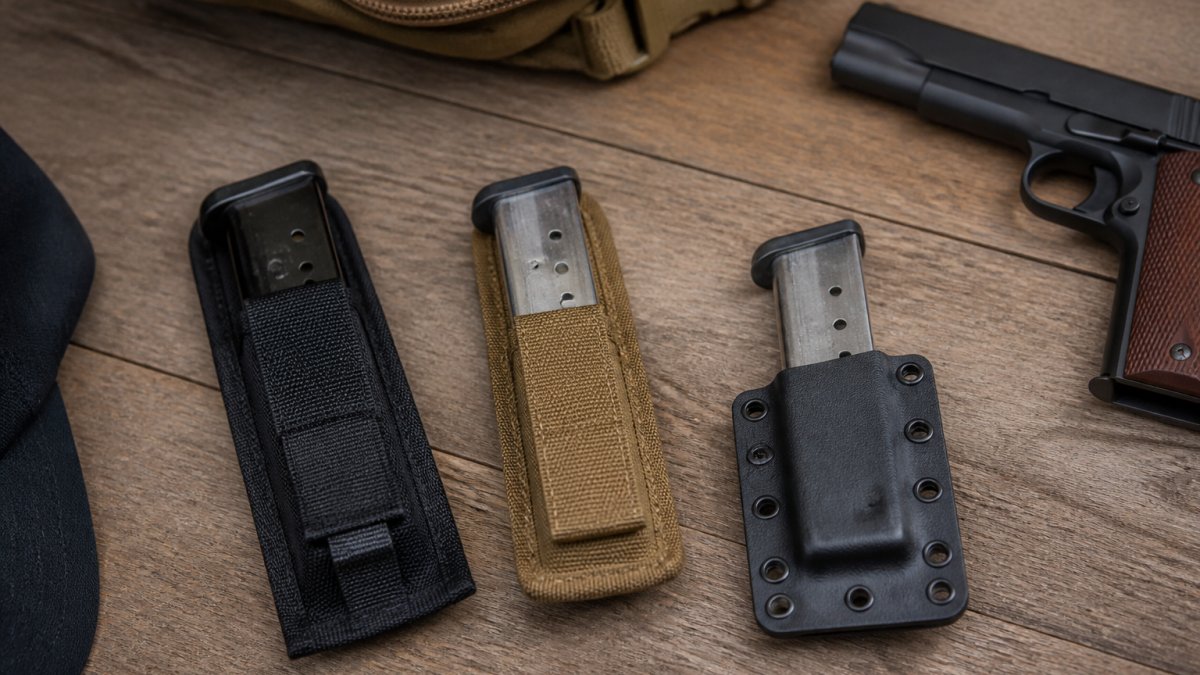
Nylon, leather, and polymer comparison
Nylon pouches are lightweight, affordable, and fast-drying. They resist moisture and don't require conditioning. Nylon is ideal for range use and training where durability matters more than aesthetics.
Leather pouches offer classic durability and a professional appearance suitable for duty or concealed carry. Leather ages gracefully and develops character with use.
Polymer pouches combine nylon's lightweight properties with enhanced rigidity. They maintain their shape better than soft nylon and resist deformation under load.
Magazine protection and long-term wear
Your spare magazine deserves protection from the elements and physical damage. Pouches with rigid sides protect against impacts and crushing forces.
Over time, magazine feed lips can wear or become damaged if the pouch allows excessive movement. A well-fitting pouch with appropriate retention prevents this wear.
Maintenance extends pouch lifespan. Nylon pouches require occasional washing with mild soap and water. Leather needs periodic conditioning to prevent cracking.
Step-by-Step Fit and Compatibility Check
Before purchasing a magazine pouch for 1911, verify that it will function reliably with your specific setup. This systematic check prevents costly mistakes and ensures your spare magazine remains accessible when needed.
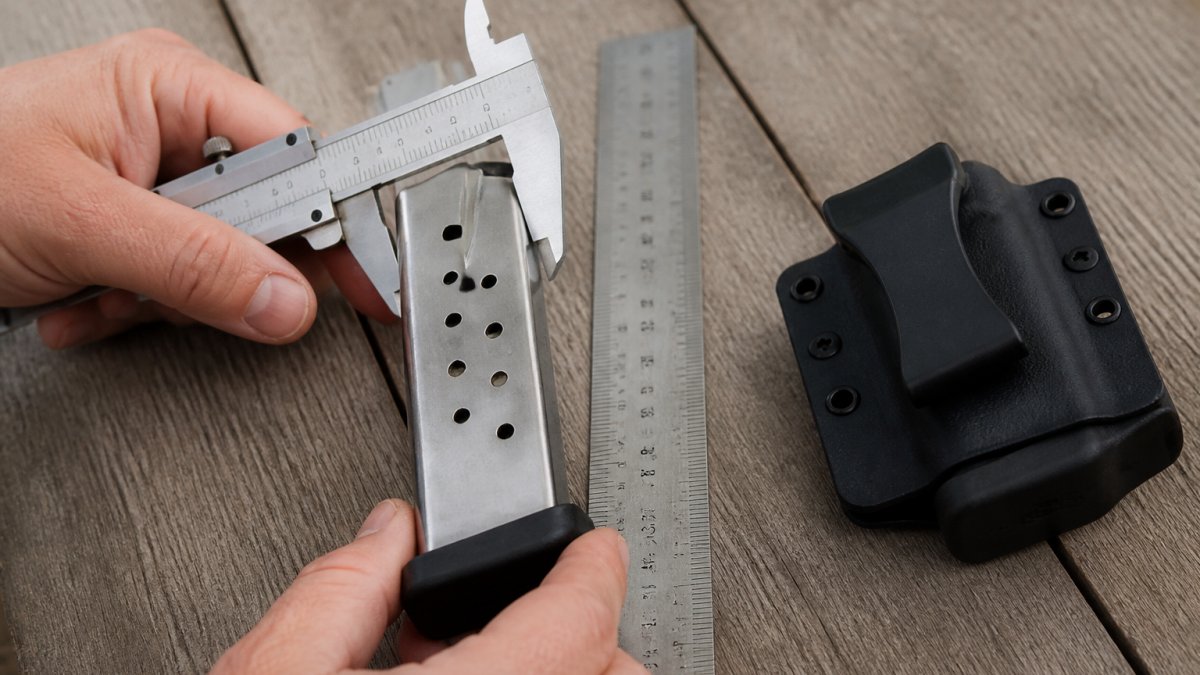
Verifying magazine dimensions
Measure your 1911 magazine from the base plate to the top of the feed lips. Record the length in inches.
Compare these measurements to the pouch specifications. Manufacturers should provide internal dimensions or compatibility lists. If specifications aren't available, contact the manufacturer directly.
If you own multiple magazines with slight dimensional variations, test fit each one. Manufacturing tolerances can cause one magazine to fit perfectly while another sits loose or tight.
Testing belt width and attachment security
Measure your carry belt width at the buckle and at points where you'll mount the pouch. Most belts taper slightly or vary in thickness.
Install the pouch on your belt using the manufacturer's recommended method. Ensure all attachment points are secure and the pouch doesn't rotate or shift when you tug on it firmly.
Walk around and perform basic movements, bending, twisting, reaching. The pouch should stay in place without rotating toward your back or front.
Checking concealment and comfort
Wear the pouch at your intended carry position for at least 30 minutes. Note any pressure points, rubbing, or discomfort.
Check for printing by looking in a mirror from multiple angles. Have someone else observe your profile from a distance.
Test draw speed and access consistency. Practice reaching for the magazine with your eyes closed. Your hand should find the magazine reliably without searching or adjusting your grip.
Common Mistakes to Avoid
Assuming all 1911 magazines are interchangeable is mistake number one. Single-stack and double-stack designs vary significantly.
Prioritizing aesthetics over function ranks high on the mistake list.
Ignoring belt compatibility creates ongoing frustration. A pouch sized for a 1.5-inch belt will shift on a 2-inch tactical belt.
Choosing retention systems based on speed alone without considering your use case is another common error.
Failing to test draw access and comfort during the evaluation phase leads to buyer's remorse.
Selecting the right magazine pouch for 1911 requires understanding your magazine dimensions, carry method, and intended use. At BULLETPROOF SPEED LOADERS, we recognize that your spare magazine is critical to your readiness, whether you're training at the range, competing in matches, or carrying concealed.
Frequently Asked Questions
How do I choose a magazine pouch for a 1911?
Start by measuring your 1911 magazines and comparing them to the pouch's interior dimensions. Verify belt width compatibility with your carry belt. Decide between single and double-mag configurations based on your use case: recreational shooting, concealed carry, or competitive matches. Test retention by holding the pouch upside down and shaking gently, magazines should stay secure without excessive force needed to draw. Finally, try the pouch on your belt and check for printing or discomfort before committing.
Should I choose an inside-the-waistband or outside-the-waistband 1911 magazine pouch?
OWB pouches offer faster access and easier draw, making them ideal for range use and competitive shooting. They sit outside your waistband, so they print more noticeably. IWB pouches sit inside your pants, providing better concealment for everyday carry but slightly slower access. Concealed carry permit holders typically prefer IWB for daily wear, while shooters at the range benefit from OWB speed. Your choice depends on your primary use case and concealment needs.
Is a single or double magazine pouch better for a 1911?
Single-mag pouches are lighter, more concealable, and sufficient for most concealed carry situations where you carry a backup magazine. Double-mag pouches give you a spare reload at the range or in duty situations, reducing time spent managing ammunition. Competitive shooters often prefer double pouches for faster stage transitions. Recreational shooters may choose single for simplicity. Your decision should match your shooting frequency, carry environment, and reload speed priorities.
How tight should a 1911 magazine pouch hold the magazine?
The pouch should hold your magazine firmly enough that it doesn't fall out during normal movement or when the pouch is inverted, but not so tight that you need excessive force to draw it. Test by holding the pouch upside down and shaking gently, the magazine should stay in place. When drawing, you should feel controlled resistance, not a struggle. Tension depends on your retention system: snap and flap closures provide additional security, while open-top designs rely on body friction alone.