 how-to
How to Use a Speed Loader with Extended Magazine Baseplates
Last Updated: November 3, 2026
Quick Summary
Speed loader compatibility with extended magazine baseplates depends on baseplate clearance, not just the magazine model name. Measure your magazine's overall length, widest floorplate dimension, hardware height and body width, then match the loader type to your baseplate. Test-fit an empty magazine before loading live rounds.
- Measure overall length, widest floorplate, hardware height and body width with calipers before shopping.
- Body-gripping loaders tolerate extended baseplates better than floor-indexed loaders.
- Universal loaders can fit less consistently with extensions, so test them before relying on them.
- Run the lever through a full stroke with an empty magazine to check for rocking or binding.
- Stop loading if the magazine stops short or the lever resists, and inspect feed lips for bends.
Table of Contents
- Why Extended Baseplates Affect Speed Loader Fit
- Checking Speed Loader Compatibility Before You Buy
- Universal Pistol Magazine Speed Loader vs. Model-Specific Designs
- Step-by-Step Aftermarket Magazine Baseplate Installation Check
- Troubleshooting Feed Lip Stress and Loader Binding
- Choosing the Right Bulletproof Loader for Your Extended Magazines
- Frequently Asked Questions
Why Extended Baseplates Affect Speed Loader Fit
Extended magazine baseplates can make a speed loader that works fine on a standard magazine stop seating correctly. The problem is almost always physical: the loader was designed around a specific magazine length and footprint, and an aftermarket baseplate changes that footprint. Understanding where the fit breaks down is the first step to avoiding a loader that binds, slips or damages your magazine.
Speed loader compatibility depends on three things: the magazine body, the baseplate, and the loader's internal geometry. Most loaders are built for standard-length magazines, so an extension can prevent the magazine from fully entering the loader or change where the spring pressure lands.
How the Loader Seats on the Magazine Body
A speed loader grips the magazine body and uses a lever or plunger to compress the magazine spring while rounds are fed in. For that to work, the loader must sit squarely and stay centered. A loader that seats on the magazine body with a clean, even fit stays stable during loading. A loader that rocks or sits high will shift under pressure.
Check how far the magazine slides into the loader before you start loading. The magazine should seat fully without forcing it. If you have to push hard or the magazine stops short, the baseplate is likely contacting the loader before the magazine reaches its intended position.
Where Baseplate Clearance Causes Interference
Clearance problems usually show up at the bottom of the loader, where the baseplate meets the loader's base. Extended baseplates add length and sometimes a wider edge. Both can rub against the loader body, lift the magazine off its seat, or prevent the lever from completing its travel.
Watch for these warning signs during a test fit:
- The magazine stops before it is fully seated in the loader
- The loader wobbles or tilts when pressure is applied
- The lever or plunger does not complete its full stroke
- Scratches or scuffs appear on the baseplate or magazine body
If you see any of these, stop loading. Forcing a loader onto a baseplate it does not fit can crack the baseplate, bend the loader or strip the feed lips.
Checking Speed Loader Compatibility Before You Buy
Manufacturer compatibility lists are a starting point, not an answer. They typically name the magazine model, for example, a double-stack 9mm pistol magazine, without accounting for the aftermarket baseplate you have installed. Because the baseplate is the variable that breaks fit, you have to check compatibility at the baseplate level, not the magazine level.
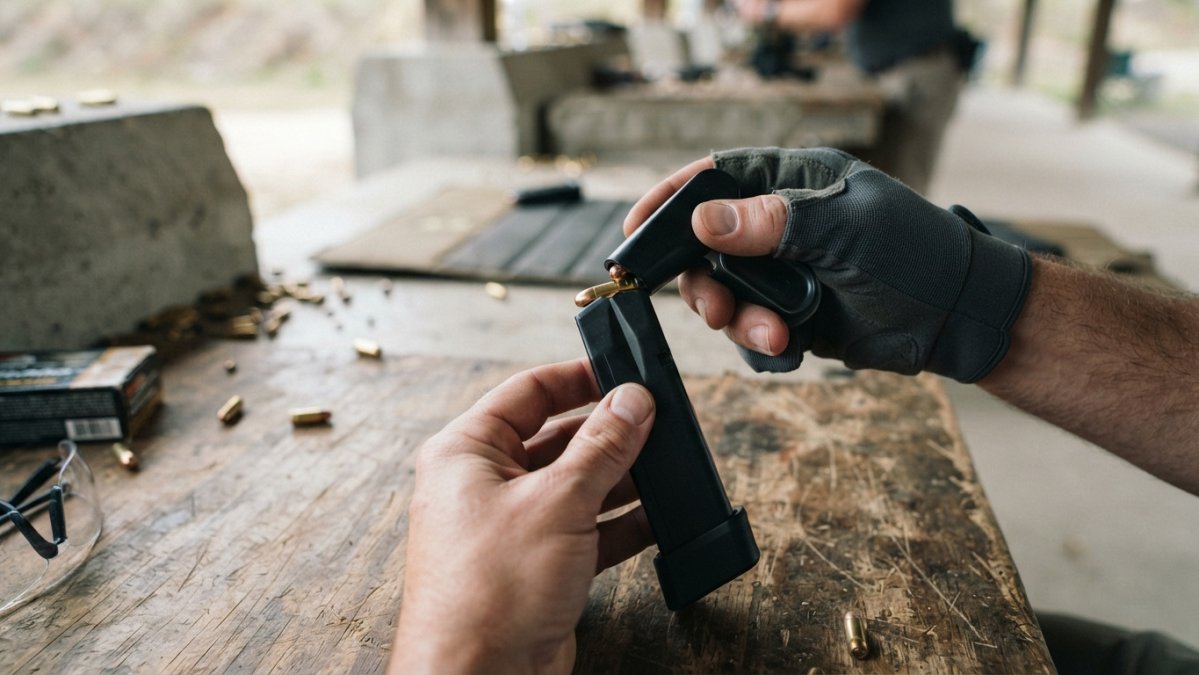
Build a Fit Profile for Your Magazine
Before you shop, record four measurements with calipers:
- Overall length from the top of the feed lips to the bottom of the installed baseplate.
- Widest floorplate dimension, measured across the extension or funnel at its widest point.
- Hardware height, meaning how far any screw head, pin, or locking plate sits below the floorplate.
- Body width at the magazine tube, which tells you whether the loader's body channel is sized correctly.
Write these down. Every loader you consider should be checked against all four, not just the magazine model name.
Match the Loader Type to the Baseplate Type
Loader designs differ in where they index on the magazine, and that determines which baseplates they tolerate:
- Floor-indexed loaders (the magazine bottoms out inside the loader) are the most sensitive to extension length and hardware protrusion. They work best with flush or low-profile extensions and struggle with tall competition funnels.
- Body-gripping loaders (the loader clamps the magazine tube above the baseplate) are more tolerant of extension length because the baseplate never reaches the loader floor. They are the better choice for +5 and +6 extensions and for funneled baseplates.
- Universal loaders usually rely on adjustable or spring-loaded jaws. They can work with a wide range of baseplates, but the fit is looser, so test with an empty magazine before trusting them with a full high-capacity stack.
Test Fit Without Spending Money
If you can, bring an empty magazine with the extension installed to the counter and ask to test-fit the display loader. Seat the magazine, run the lever through a full stroke with no rounds, and check for rocking. Most retailers will allow this with an empty magazine. If you are buying online, look for customer reports that name your specific baseplate brand and extension size, a review that says "works with a +5 extension on this magazine" is worth more than a compatibility chart that lists only the magazine model.
When Modification Is Reasonable, and When It Is Not
Some plastic loaders can be trimmed to clear a wider baseplate, but the margin is narrow. Material removed from the loader's floor or side walls reduces the structure that keeps the magazine square under spring pressure. A safe modification removes only the material that is actually contacting the baseplate, leaves the seating shoulder intact, and is followed by an empty-magazine cycle test before any live rounds are loaded. If the interference is at the lever or plunger linkage, do not modify, change loaders instead. Trimming structural linkage parts is how loaders crack and how magazines get dropped mid-load.
Watch out: a loader modified for one baseplate may no longer fit factory magazines squarely, so keep a dedicated modified loader rather than treating it as a universal tool.
Note that the BULLETPROOF SPEED LOADERS team reviews fit questions for each magazine style we carry. If you are unsure whether a loader will work with your extension, check the product listing or contact support before you order.
Firearm magazine maintenance and reliability overview
Universal Pistol Magazine Speed Loader vs. Model-Specific Designs
A universal pistol magazine speed loader is designed to fit a range of magazine styles. A model-specific loader is built for one magazine type or caliber. Each has a place, and the right choice depends on what you shoot.
Bulletproof Speed-Loader COMBAT Model →
Universal loaders work well when you use several magazine types and want one tool. Model-specific loaders usually offer a tighter fit, which matters when you use extended baseplates or high-capacity magazines.
| Option | Best For | Main Trade-Off |
|---|---|---|
| Universal loader | Shooters with mixed magazine types | Fit can vary with extensions |
| Model-specific loader | One magazine type or caliber | Works with fewer magazines |
Test fit before relying on a universal loader for high-capacity or extended magazines.
Step-by-Step Aftermarket Magazine Baseplate Installation Check
If you have just installed an aftermarket baseplate, run this check before loading live rounds into your magazine. Our guide on when to upgrade to aftermarket magazine base plates explains when an upgrade makes sense.
- Remove the magazine and inspect the baseplate for loose screws or misalignment.
- Insert the empty magazine into the speed loader without any rounds.
- Confirm the magazine seats fully and stays centered.
- Run the lever through its full stroke slowly and watch for rubbing.
- Repeat the test with the loader at a slight angle to check for side play.
- Load one round and confirm it feeds cleanly.
Once you pass these steps, load the full magazine in short batches. Check the loader and baseplate after each batch for scuffs or loosening.
Guidance on aftermarket accessory installation and fit
Troubleshooting Feed Lip Stress and Loader Binding
Feed lip stress and loader binding are the two most common problems shooters report with extended magazines. Both usually come from the loader pressing the magazine out of alignment.
Feed lip stress shows up as bent or spread lips that cause feeding failures. Binding shows up as a lever that will not move smoothly or a loader that jams partway through a stroke.
To reduce both problems:
- Stop loading if the lever stops or the magazine resists
- Check that the baseplate is fully seated and not cocked
- Make sure the loader is sitting straight on the magazine body
- Inspect the feed lips for bends after each loading session
- Replace or adjust the loader if binding continues with a properly installed baseplate
For deeper troubleshooting on loading issues, see our guide to troubleshooting pistol magazine loading issues.
Choosing the Right Bulletproof Loader for Your Extended Magazines
For most extended-magazine setups, we recommend starting with a model built for a tighter, more controlled fit. The Bulletproof Speed-Loader COMBAT Model is a durable polymer loader designed for everyday range trips and harsher conditions. It is priced at $69.95 and suits shooters who want a compact, simple-to-carry option.

If you want an alternative with more durability features, the Bulletproof Speed-Loader TACTICAL Model at $89.95 adds an anodized aluminum lever, mag release button and catch to the same polymer build.

If you use several magazine types, the Bulletproof Pistol Speed Loader at $34.95 offers a lower-cost universal option. Test its fit with your extended baseplates before relying on it for high-capacity magazines, since universal designs can fit less consistently than model-specific ones.

Whichever loader you choose, run the installation check above before loading a full magazine.
Frequently Asked Questions
Do universal speed loaders work with extended magazine baseplates?
Some do, but fit varies. Universal loaders are designed around standard magazine geometry, so an extended baseplate can prevent the magazine from seating fully or leave the loader unable to compress the spring. Before relying on one, test it with your exact magazine and baseplate combination. If the loader will not seat fully or binds during the first compression stroke, it is not compatible, even if it fits a standard magazine of the same caliber.
Why does my speed loader not fit my extended magazine?
Extended baseplates add length below the magazine body, which changes where the loader's jaws or base engage. The loader may hit the baseplate before it reaches full travel, or the magazine may not sit square in the loader. Check whether the loader's stop or bottom lip contacts the extension. Model-specific loaders built for your magazine's length usually resolve this, while universal designs may not.
Can I use a Bulletproof speed loader with +2 or +5 baseplates?
Compatibility depends on the specific loader and the baseplate's added length. The Bulletproof Pistol Speed Loader lists compatibility with Glock 17, 18, 19, 22, 23, 24, 26, 27, 34, 35, 45 and 47, but its listing does not specify fit with extended baseplates. Measure your magazine with the baseplate installed and confirm fit with the loader before loading a full magazine. Contact customer support with your magazine make, model and baseplate details for a direct answer.
Does using an extended baseplate affect how fast I can load?
An extended baseplate does not change the loading process itself, but a poor fit does. When the loader seats correctly, loading speed depends on the stroke and your grip. When the fit is off, you lose time realigning the magazine and risk stressing the feed lips. A loader that seats cleanly on your extended magazine will keep the speed advantage it gives standard magazines.
Find the right loader for your setup in the Bulletproof Speed Loaders collection, and pick the model that fits your magazines and shooting style.