 how-to
Magazine Speed Loader Issues: 7 Quick Fixes
Last Updated: October 23, 2026
Quick Summary
Magazine speed loader issues typically stem from three causes: compatibility mismatches between loader and magazine, physical obstructions like debris or worn components, and incorrect loading technique. Identify which problem you're facing by checking compatibility first, inspecting for debris and damage second, and practicing correct technique third.
- A loader designed for Glock 17 won't work the same way on a Sig P320, even though both are 9mm.
- Most stuck-loader problems disappear after cleaning debris and powder residue from inside the magazine.
- Weak magazine springs develop after 10,000+ rounds or from age and storage in a compressed state.
- The biggest loading mistake is tilting the loader; keep it straight and apply steady downward pressure.
- Replace your magazine if feed lips are bent, the spring won't compress, or rounds fall out during normal handling.
Table of Contents
- How to Diagnose Magazine Speed Loader Issues
- Magazine Speed Loader Not Working: Check Compatibility First
- Speed Loader Stuck on Magazine: Causes and Solutions
- Glock Magazine Hard to Load: Feed Lips and Spring Tension
- How to Use a Pistol Speed Loader Correctly
- Preventing Rounds from Pushing Back Into the Loader
- When to Replace Your Speed Loader or Magazine
- Frequently Asked Questions
How to Diagnose Magazine Speed Loader Issues
Magazine speed loader problems fall into three categories: compatibility mismatches, physical obstructions, or worn components. Identify which one you're facing before troubleshooting the wrong issue.
Ask three questions: Does the loader fit your magazine? Can you see or feel debris inside? Does the magazine spring still push back with normal force? The answers narrow down the problem fast.
Symptom-Based Diagnostic Flowchart
Use this sequence to pinpoint what's wrong:
- Does the loader slide onto the magazine? If no, skip to the compatibility section. If yes, continue.
- Can you push rounds in smoothly? If no, check for debris or feed lip damage. If yes, continue.
- Do rounds push back out when you release pressure? If yes, the magazine spring is weak. If no, your loader works fine.
- Does the loader feel stuck or hard to remove? If yes, misalignment or swelling is the issue. If no, you're good.
Magazine Speed Loader Not Working: Check Compatibility First
Before assuming your loader is broken, confirm it fits your magazine. You can find a compatible speed loader that works with your specific magazine model.

Magazine dimensions vary across brands and calibers. A loader designed for a Glock 17 won't work the same way on a Sig P320, even though both are 9mm.
Check your magazine's markings first, most manufacturers stamp caliber and model number on the spine or base.
If compatibility checks out, move on to physical inspection.
Speed Loader Stuck on Magazine: Causes and Solutions
A stuck loader means you can't remove it cleanly, and forcing it risks damaging the magazine.
Misalignment and Seating Problems
Misalignment happens when the loader isn't centered on the magazine as you push down. Even slight off-center pressure can bind the mechanism. The loader's walls catch the magazine body instead of sliding smoothly.
Check your grip: apply downward pressure straight along the loader's centerline. Place the loader on the magazine, then push down with your palm flat and fingers relaxed, no twisting, no side pressure.
If the loader still sticks after correcting your technique, the magazine itself may be warped from heat, age, or rough handling. A warped body won't accept a loader smoothly, and you'll feel binding at a specific point as you push. How to Fix a Jammed Magazine Speedloader covers removal techniques when you're truly stuck.
Debris and Obstruction Removal
Dirt, dust, and powder residue accumulate inside magazines, and even small particles create friction that makes loaders stick.
Open the magazine and inspect the interior. Look for:
- Powder residue or dirt along the walls
- Debris near the feed lips or follower
- Discoloration suggesting moisture or corrosion
Wipe the interior with a dry cloth; a small brush handles stubborn debris.
Once clean, test the loader again. Most stuck-loader problems disappear after a good cleaning. Magazine Loader Maintenance and Cleaning Tips walks through the full process if you need detailed guidance.
Glock Magazine Hard to Load: Feed Lips and Spring Tension
Glock magazines are reliable but demanding: feed lips wear faster than other components, and the spring can lose tension over thousands of rounds. Before inspecting either, make the magazine safe and separate it from the firearm.
Safe Inspection and Unloading First
Never troubleshoot a magazine while it is in the firearm or while live rounds are present. Follow this sequence every time:
- Make the firearm safe. Remove the magazine, lock the slide or bolt to the rear, and visually and physically confirm the chamber is empty. Keep the muzzle pointed in a safe direction.
- Unload the magazine completely. Push each round forward and out of the feed lips with your thumb, working from the top round down. Do not strike the magazine against your hand or a bench to shake rounds loose, that bends feed lips.
- Separate the magazine from the loader. If the loader is stuck, remove it before inspecting the magazine so you can see the feed lips and follower clearly.
- Count and account for every round. A round left in the magazine or on the bench is the most common cause of a later "mystery jam."
For range or training use, a dedicated unloading tray keeps rounds contained and makes the count easy to verify.
Inspecting Feed Lips for Damage
Feed lips are the two metal protrusions at the magazine opening that guide rounds into the chamber and hold them during loading. Bent or damaged feed lips create massive loading resistance.
Look straight down into the opening. The feed lips should be parallel and symmetrical. If one is bent inward or the pair is uneven, bent lips pinch rounds as they enter, making the loader feel like it's fighting the magazine.
Check for these signs:
- One feed lip sitting lower than the other
- Visible dents or bending on either lip
- Lips that angle inward instead of staying straight
Bent feed lips can sometimes be carefully straightened with a plastic mallet and wooden block, but it's risky. If the damage is severe, replacement is safer. Signs Your Pistol Speedloader Needs Replacement explains when a magazine has reached the end of its life.
Testing Magazine Spring Tension
A weak spring can't push rounds up with enough force, so the loader compresses it but the rounds won't move upward into the mechanism.
Test spring tension by hand: remove all rounds, push the follower down with your thumb, and let go.
Compare the feel to a new magazine if you have one, the difference is obvious. Weak springs develop after 10,000+ rounds or from age and storage in a compressed state.
Repair or Replace?
Use this threshold before you spend time on a fix:
Bulletproof Speed-Loader COMBAT Model →
- Clean and retest if the only symptom is grit or sluggish follower movement.
- Replace the spring if the follower returns slowly but the body and feed lips are sound. Replacement spring kits are inexpensive and restore most magazines.
- Replace the magazine if feed lips are cracked, the body is swollen, or the follower is cracked or missing.
A magazine that fails any of the replace-level checks is a liability at the range and worse in a defensive situation. When in doubt, retire it.
How to Use a Pistol Speed Loader Correctly
Using a speed loader correctly prevents most problems. Bad technique creates the same symptoms as broken equipment.
Step-by-Step Loading Technique
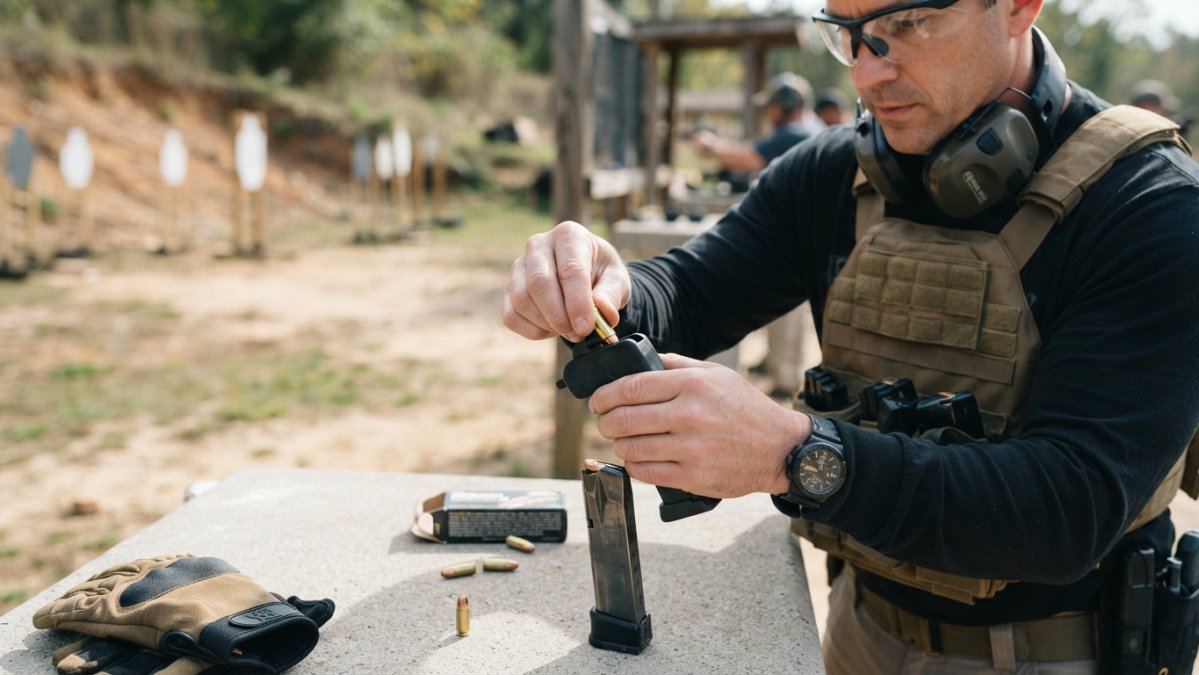
Follow this process every time:
- Insert the magazine into the loader. Slide it straight in until it seats fully. You should feel a slight click or resistance as the loader grips the magazine.
- Hold the loader level. Keep it horizontal or at a slight downward angle. Don't tilt or twist.
- Feed rounds into the top opening. Drop or push rounds in one at a time. The loader's mechanism guides them down.
- Push down gently. Apply steady downward pressure. Don't force it. The rounds should move into the magazine smoothly.
- Release and remove. Once full, release pressure and slide the loader off. The magazine should stay full.
Speed comes with practice, not from forcing the process.
Common Loading Mistakes to Avoid
The biggest mistake is tilting the loader. Any side-to-side movement or angle creates friction, so keep it straight.
Another common error is overloading. If rounds resist going in near the end, stop, the magazine is full.
Rushing also causes problems: dropping rounds carelessly or slamming the loader down creates jams.
Common Mistakes When Loading Handgun Magazines details these errors and how to avoid them.
Preventing Rounds from Pushing Back Into the Loader
Rounds pushing back out means the magazine spring is too weak or the loader isn't seating the magazine fully. But the loader itself is often overlooked: worn parts, a dirty mechanism, and a magazine that no longer matches the loader's tolerances all cause the same symptom.
Confirm Seating and Spring Tension
First, confirm the magazine is seated all the way in the loader, push it in until you feel resistance.
Second, check spring tension as described earlier; weak springs can't hold rounds in place and the magazine needs replacement.
Third, don't overload. Load until rounds begin resisting, then stop, forcing more creates backpressure that pushes rounds back out when you release.
Loader-Specific Wear and Cleaning
Most guides blame the magazine, but the loader's moving parts wear too, and that wear shows up first as rounds backing out.
Inspect these loader components:
- Feed ramp or guide track, Look for burrs, gouges, or polymer shavings. A rough track drags on the case and lets rounds slip backward.
- Retaining clip or catch, If it no longer snaps over the magazine base, the magazine shifts during loading and rounds back out.
- Push rod, lever, or plunger, Check for bending, mushrooming, or a worn tip that no longer contacts the case head squarely.
Clean the loader on the same schedule you clean magazines. Wipe the track and contact surfaces with a dry cloth, brush out grit, and avoid liquid lubricants that attract dust. A dry-film or silicone cloth is enough for metal-on-metal contact points; excess oil is a debris magnet.
Prevention Checklist
Run through this before each loading session:
- Magazine seats fully in the loader with a firm click or stop
- Loader track and contact points are clean and dry
- Magazine spring returns the follower briskly
Magazine Loader Maintenance and Cleaning Tips includes prevention strategies that keep your loader and magazine working together smoothly.
When to Replace Your Speed Loader or Magazine
Speed loaders and magazines wear out. Knowing when to replace them saves frustration and keeps you reliable.
Replace your speed loader when:
- The mechanism feels loose or rattles
- Rounds jam consistently despite correct technique
- The lever or catch breaks or cracks
The Bulletproof Speed Loader COMBAT Model and TACTICAL Model are built for heavy use and years of range time.
Replace your magazine when:
- Feed lips are bent or cracked
- The spring won't compress or return
- The follower is cracked or missing
Old magazines are a liability. They fail when you need them most.
Magazine speed loader issues usually come down to three things: compatibility, wear, and technique. Check compatibility first. Inspect for debris and damage second. Practice correct loading technique third.
When your loader or magazine is truly worn out, replacement is the answer.
Know when your loader or magazine has reached the end of its life.
| Component | Replace When | Reason |
|---|---|---|
| Speed Loader | Mechanism feels loose or rattles | Internal parts are worn |
| Speed Loader | Rounds jam consistently despite correct technique | Mechanism no longer functions reliably |
| Speed Loader | Lever or catch breaks or cracks | Structural failure prevents operation |
| Speed Loader | No longer grips magazine securely | Cannot seat magazine properly |
| Magazine | Feed lips are bent or cracked | Rounds cannot load or feed correctly |
| Magazine | Spring won't compress or return | Cannot hold or advance rounds |
| Magazine | Follower is cracked or missing | Rounds will not stay in magazine |
| Magazine | Rounds fall out during normal handling | Magazine is unsafe for use |
Frequently Asked Questions
Why won't my magazine speed loader work with my Glock magazines?
Magazine speed loader compatibility depends on magazine dimensions, feed lip design, and spring tension. Your loader may not fit if your magazines have non-standard dimensions, bent feed lips, or excessive spring compression. Check that your magazine model matches your loader's compatibility list. The Bulletproof Pistol Speed Loader works with Glock 17, 18, 19, 22, 23, 24, 26, 27, 34, 35, 45, and 47 models. It also fits magazines of most major brands, including Sig P229, P320, P365, Hellcat, Springfield XD, Ruger SR9, P85, P89, P95, CZ P10, 8000, Beretta 92, 99, AXP, PX4, and many single stack mags. (Note: DOES NOT work well with most Canik or H&K).
How do I tell if my loading problem is caused by the magazine or the speed loader?
Test with a different magazine. If the loader works smoothly with another magazine, the problem is magazine-related (bent feed lips, weak spring, or obstruction). If the loader fails with multiple magazines, the loader itself may be damaged or misaligned. Inspect both for visible damage, debris, or bent components. A functioning loader should seat flush and push rounds without resistance.
Can I use the same speed loader for different calibers and magazine types?
No. Magazine dimensions vary significantly between calibers and firearm models. A loader designed for 9mm Glock magazines will not work reliably with .45 ACP, .40 S&W, or AR-15 magazines because the magazine width, height, and feed lip geometry differ. Using an incompatible loader risks damaging feed lips or jamming rounds. Choose a loader matched to your specific magazine type and caliber.
What's the difference between a basic speed loader and a premium model like the Bulletproof TIER-1?
Premium models like the Bulletproof TIER-1 ($199.95) use aircraft-grade aluminum and precision machining for durability under heavy use, while basic models like the Bulletproof COMBAT ($69.95) use durable polymer. Premium loaders resist wear better over thousands of rounds, maintain alignment longer, and perform reliably in harsh conditions. For casual range use, a basic loader works fine; for law enforcement or competitive shooting with heavy round counts, premium construction justifies the investment.